

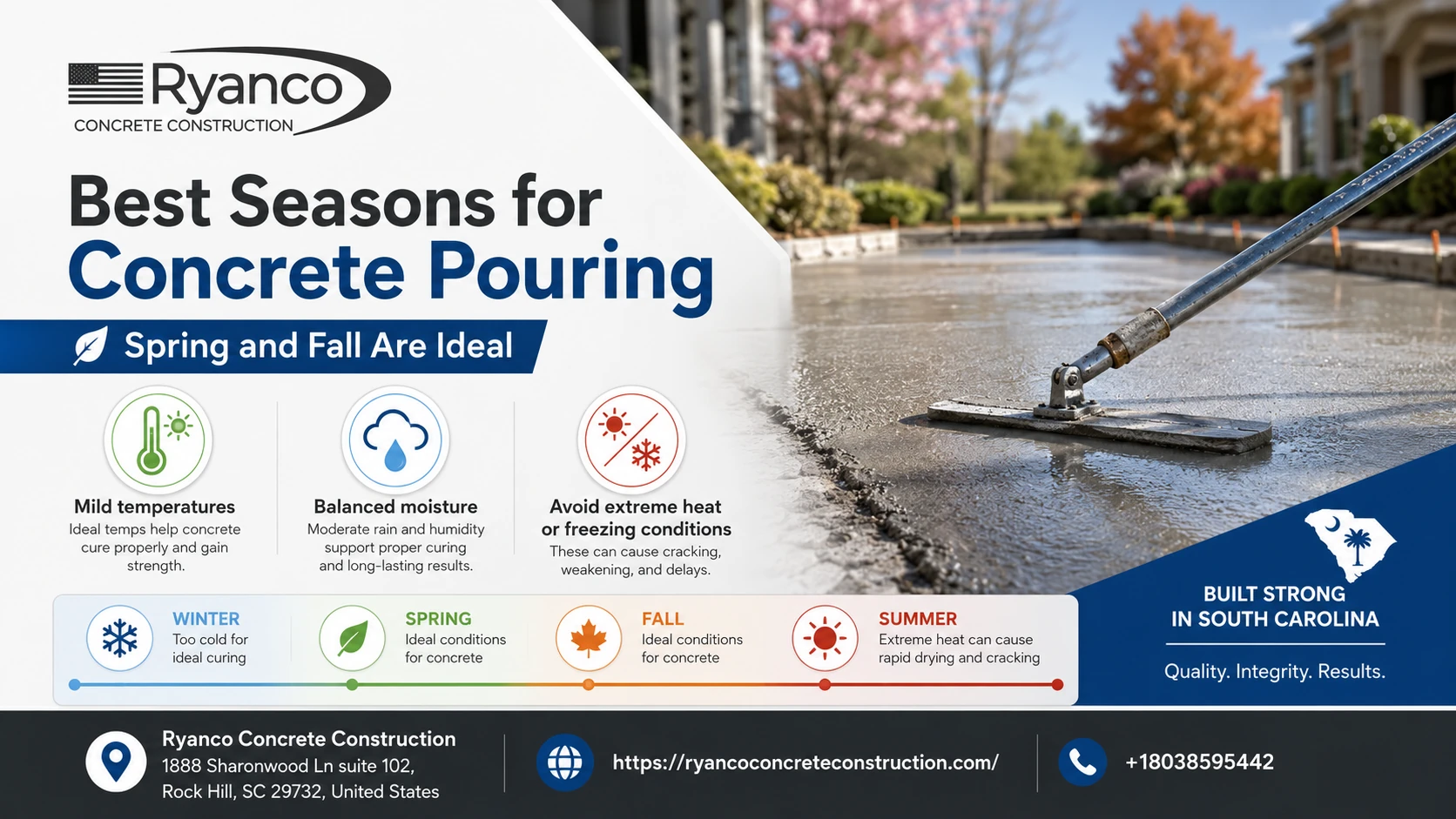
The best time of year to pour concrete in South Carolina is generally when temperatures are moderate and the weather is relatively predictable. Spring and fall can often provide favorable conditions because they may avoid some of the most intense summer heat and the coldest winter temperatures.
That does not mean concrete can only be poured during those seasons. Residential projects can often be completed during summer, winter, and other periods when weather conditions are evaluated carefully and the concrete contractor uses appropriate placement, scheduling, and curing practices.
For homeowners, the better question is often not “What month should I pour concrete?” but “What conditions are expected when my project is scheduled?” Temperature, rainfall, site moisture, direct sunlight, project size, and the curing period all matter.
What Is the Best Time of Year to Pour Concrete in South Carolina?
Spring and fall are often convenient seasons for concrete projects in South Carolina because moderate temperatures can make concrete placement and curing easier to manage.
Still, there is no single month that is automatically best statewide.
South Carolina has meaningful regional differences in climate, and weather can change substantially from one week to the next. Rainfall also occurs throughout the year rather than being limited to one clearly defined wet season.
That means a mild day in July may sometimes be more workable than an unusually hot day in May, just as a dry winter week may be preferable to a rainy spring period.
For residential flatwork such as driveways, patios, sidewalks, walkways, and slabs, contractors generally consider both the seasonal pattern and the immediate forecast before choosing a pour date.
Why Does Weather Matter When Pouring Concrete?
Concrete does not simply need good weather at the moment it is placed.
Conditions during the hours and days afterward also influence how it cures and develops strength.
Temperature can affect how quickly the concrete sets and how rapidly moisture leaves the surface. Direct sunlight and wind can also influence surface drying, while cold conditions can slow strength development.
Rain introduces another set of concerns. A project site may need to be delayed if the ground is saturated, drainage is poor, or heavy rain is expected during placement and finishing.
This is why contractors usually evaluate several conditions together rather than looking at temperature alone.
They may consider:
- Air temperature
- Surface and ground conditions
- Direct sun exposure
- Humidity
- Wind
- Recent rainfall
- Forecast rainfall
- Project size
- Site drainage
- Access to the work area
- Required finishing
- Expected weather during early curing
The goal is to give the concrete suitable conditions for placement, finishing, and curing.
Is Spring a Good Time to Pour Concrete in South Carolina?
Spring can be a favorable time for many South Carolina concrete projects.
Temperatures are often more moderate than they are during peak summer, which can make placement and curing more manageable. Homeowners may also find spring appealing for projects they want completed before heavy summer use of patios, driveways, or outdoor spaces.
The challenge is changing weather.
Spring conditions can shift quickly, and rain may affect both the scheduled pour and the condition of the project site. South Carolina receives precipitation throughout the year, and individual spring storms can produce significant rainfall in some areas.
For that reason, contractors typically watch the forecast rather than assuming that a spring date will automatically provide ideal conditions.
A dry, moderate stretch of spring weather can be excellent for concrete work. A week of storms and saturated ground may require rescheduling.
Can You Pour Concrete During the Summer?
Yes. Concrete can be poured during South Carolina summers.
The main challenge is that hot weather can affect how quickly concrete begins setting and how quickly moisture is lost from the surface.
Direct sunlight can make the concrete and surrounding surfaces even warmer. This can reduce the amount of working time available during placement and finishing and may create additional curing challenges if conditions are not managed appropriately.
Humidity also matters, but high humidity does not eliminate concerns related to heat and surface conditions.
Experienced concrete professionals may plan hot-weather projects around the expected conditions. Depending on the project, this can involve adjusting scheduling, coordinating delivery carefully, and planning appropriate curing methods.
For homeowners, summer is not necessarily a season to avoid. It is simply a season when the day’s specific temperature, sunlight, and weather forecast deserve additional attention.
Is Fall a Good Season for Concrete Projects?
Fall is another season that can provide favorable conditions for concrete work in South Carolina.
As summer heat begins to ease, more moderate daytime temperatures can make outdoor construction conditions easier to manage.
Fall can be especially appealing for projects such as:
- Driveways
- Patios
- Walkways
- Sidewalks
- Concrete pads
- Other residential flatwork
Still, homeowners should avoid choosing a date based solely on the word “fall.”
Early fall may still bring hot conditions, while later fall can include much cooler weather. Tropical systems can also affect South Carolina during portions of late summer and early fall.
The actual forecast and site conditions should guide the decision.
Can Concrete Be Poured During the Winter?
Concrete work does not automatically stop when winter arrives.
South Carolina winters are generally milder than those in many northern states, although freezing conditions can still occur and must be taken seriously.
Cold weather slows the rate at which concrete develops strength. If temperatures fall low enough, additional precautions may be necessary to protect fresh concrete.
This makes winter scheduling more dependent on the short-term forecast.
A mild, dry winter period may provide workable conditions for a residential project. A stretch of very cold nights or freezing weather may require the project to be postponed or planned differently.
Rock Hill, for example, experiences average winter temperatures substantially lower than its summer temperatures, and freezing nights are possible.
Homeowners should therefore rely on a contractor’s assessment of the expected conditions rather than assuming winter automatically makes a project impossible.
How Do Temperature and Humidity Affect Concrete Curing?
Concrete gains strength through a chemical process involving cement and water.
That process continues after the concrete has been placed and finished, which means the curing environment matters.
Hot weather
Higher temperatures can accelerate setting.
When combined with direct sunlight, wind, or other drying conditions, this can cause the surface to lose moisture quickly and reduce the time available for proper finishing.
Hot weather does not necessarily mean the project should be canceled, but it can require more careful planning.
Cold weather
Cold temperatures slow strength development.
If temperatures approach freezing, fresh concrete may require additional protection because freezing can interfere with early curing.
Humidity
Humidity influences how quickly moisture evaporates from the concrete surface.
Higher humidity can slow evaporation, while dry air can encourage faster moisture loss. Humidity is therefore one part of the overall conditions a contractor considers along with temperature, wind, and sunlight.
The important point for homeowners is that concrete needs suitable conditions after the truck leaves.
Good curing conditions help the material develop the strength and durability expected from the finished surface.
How Does Rain Affect a Concrete Pour?
Rain can affect both the concrete itself and the project site.
Contractors pay attention to whether rain is expected during placement and finishing because heavy rainfall can interfere with fresh concrete.
The ground conditions before the pour also matter.
If the project area is saturated, muddy, poorly drained, or holding standing water, additional preparation or a delay may be necessary before concrete is placed.
Rain can also create logistical issues. Equipment access, excavation, grading, base preparation, and finishing may become more difficult when the site is wet.
This does not mean any chance of rain requires cancellation.
Forecast intensity, timing, project size, site drainage, and how prepared the site is all influence the decision. Contractors typically evaluate the specific forecast rather than making scheduling decisions based solely on a percentage shown in a weather app.
What Weather Conditions Are Best for Pouring Concrete?
In general, favorable concrete weather combines moderate temperatures with relatively stable conditions.
A workable forecast often includes:
- Moderate rather than extreme temperatures
- Little or no heavy rainfall expected during the work
- A site that is not saturated
- Manageable wind conditions
- Enough time for placement and finishing before major weather changes
- Suitable conditions during the early curing period
The exact acceptable range depends on the project and the methods being used.
That is why there is a difference between ideal conditions and workable conditions.
Ideal weather can make the project easier to schedule and manage. Workable weather may still allow a successful pour when the contractor plans appropriately for heat, cold, moisture, or other seasonal factors.
How to Plan a Concrete Project Around South Carolina Weather
Homeowners can make scheduling easier by thinking beyond a single target date.
Start by discussing the size and scope of the project with the contractor. A small walkway and a large driveway do not have the same placement, access, finishing, or scheduling requirements.
Site conditions matter as well.
Drainage, grading, soil conditions, demolition, access for equipment, and base preparation may all affect how quickly the site becomes ready for concrete.
It is also helpful to keep some flexibility in the schedule. A contractor may recommend shifting a pour because of an unexpected storm, extreme heat, saturated ground, or a cold-weather event.
That does not necessarily mean the project is experiencing a problem. Weather-related adjustments are often part of responsible concrete scheduling.
If you’re planning a driveway, patio, walkway, slab, or similar project, our Concrete Flatwork Page provides more information about common residential flatwork applications.
For a broader overview of available concrete work, you can also visit our Concrete Services Page.
What Rock Hill Homeowners Should Know Before Scheduling Concrete Work
Rock Hill homeowners experience a wide range of weather conditions throughout the year.
Climate normals for the Rock Hill/York County area show average summer highs around the upper 80s to about 90°F, while winter conditions are much cooler and can include freezing nights. Rainfall occurs throughout the year rather than disappearing during one particular season.
That makes flexibility valuable when scheduling exterior concrete work.
A spring or fall project may benefit from moderate temperatures, but thunderstorms or wet site conditions can still affect the schedule. Summer projects may require additional consideration for heat and sun exposure, while winter projects may depend more heavily on overnight temperatures.
Local drainage and site conditions can matter just as much as the season.
A backyard patio with limited equipment access, for example, may require different planning from an open driveway. Similarly, a site that stays wet after rain may need more preparation time before concrete can be placed.
FAQs
Can concrete be poured in South Carolina during the summer?
Yes. Concrete projects can often be completed during summer, but high temperatures, direct sunlight, and other hot-weather conditions may affect placement and curing. Contractors generally plan the work around the expected weather rather than automatically avoiding the season.
Can concrete be poured during winter?
Yes, depending on the conditions. Cold temperatures slow concrete strength development, and freezing weather requires additional consideration, so contractors typically review both daytime and overnight forecasts before scheduling winter work.
What happens if it rains after concrete is poured?
The effect depends on when the rain occurs, how heavy it is, and the stage of the concrete. Heavy rain during placement or finishing can create problems, which is why contractors monitor forecasts closely and may reschedule when significant rain is expected.
Does temperature affect how concrete cures?
Yes. Hot conditions can accelerate setting and increase moisture loss, while cold conditions can slow strength development. Concrete contractors account for these conditions when planning placement and curing.
How long should I wait before using new concrete?
The appropriate waiting period depends on the type of concrete surface, expected loads, mix, weather, and project conditions. Follow the contractor’s instructions before walking, parking vehicles, placing heavy objects, or otherwise loading newly placed concrete.
Should I postpone my concrete project if the weather looks bad?
Possibly. Heavy rain, saturated ground, extreme temperatures, or other unfavorable conditions may justify adjusting the schedule. Your contractor can evaluate the forecast, project site, and expected curing conditions to determine whether postponement makes sense.
Choose the Right Conditions, Not Just the Right Season
The best time to pour concrete in South Carolina is not determined by one month on the calendar. Spring and fall often provide favorable moderate conditions, but successful projects can also be completed during summer and winter when the weather, site, and curing requirements are planned appropriately.
At RyanCo Concrete Construction, we evaluate the project itself along with site conditions and the expected weather before scheduling concrete work. That helps homeowners make practical decisions without unnecessarily delaying a driveway, patio, walkway, slab, or other flatwork project simply because it falls outside a supposedly “perfect” season.
If you’re planning concrete work in Rock Hill or the surrounding area, consider discussing your project and timing with our team so we can help determine a practical window based on the site and current conditions.
