
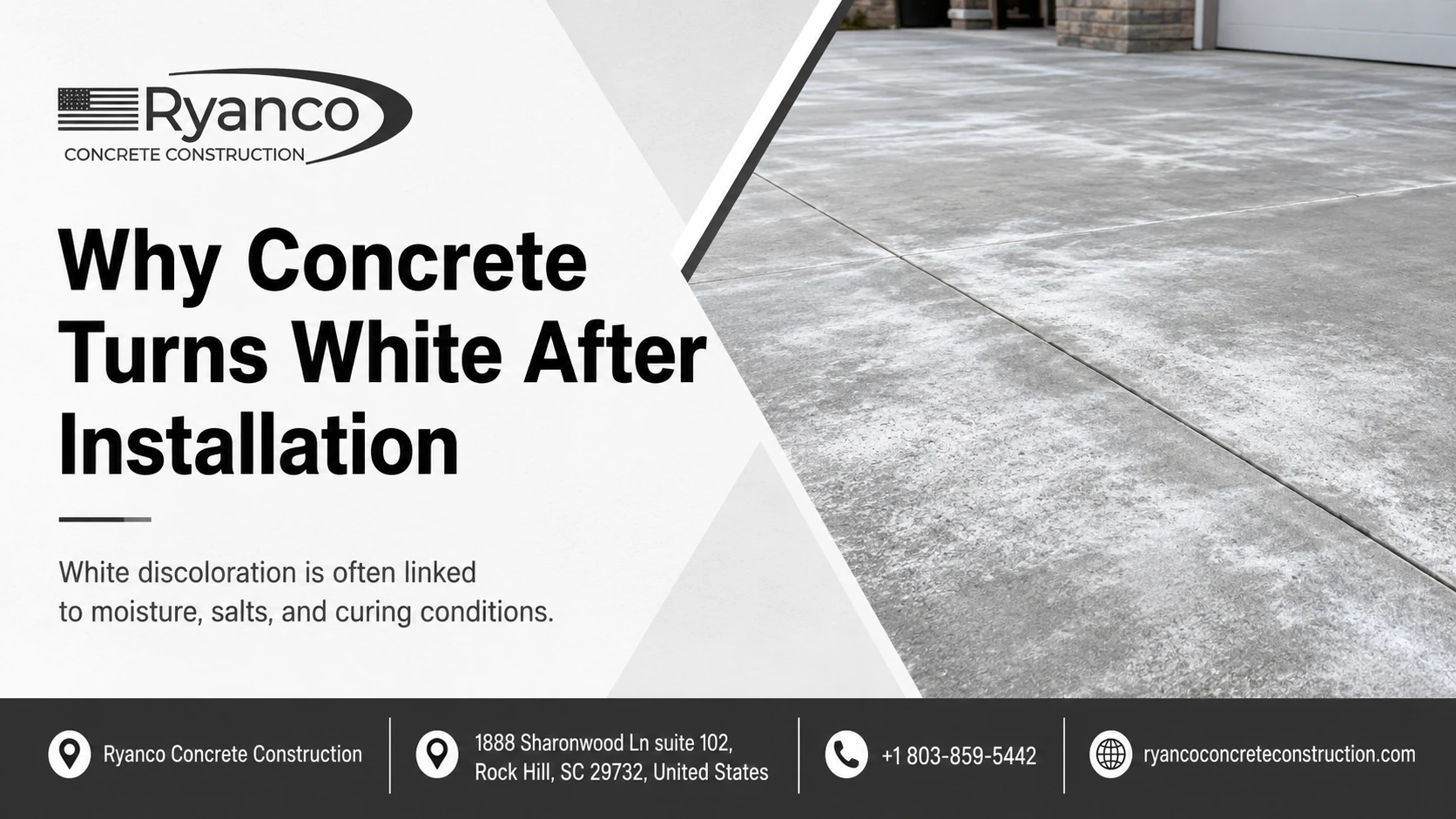
A white, chalky, cloudy, or powdery appearance on concrete can be concerning, especially when the slab is new. Homeowners may notice white spots on a driveway, a hazy film across a patio, or powdery deposits along a walkway and assume something has gone wrong with the concrete.
In many cases, the cause is efflorescence, a common surface condition related to moisture and naturally occurring soluble salts. However, not every white concrete surface is caused by efflorescence. Curing conditions, finishing, surface residue, and even moisture trapped beneath certain sealers can create a similar appearance.
Understanding the difference can help you decide whether the issue is mainly cosmetic or whether the concrete should be evaluated more closely.
Why Does Concrete Turn White After Installation?
Concrete can turn white after installation for several reasons, but moisture is often an important part of the process.
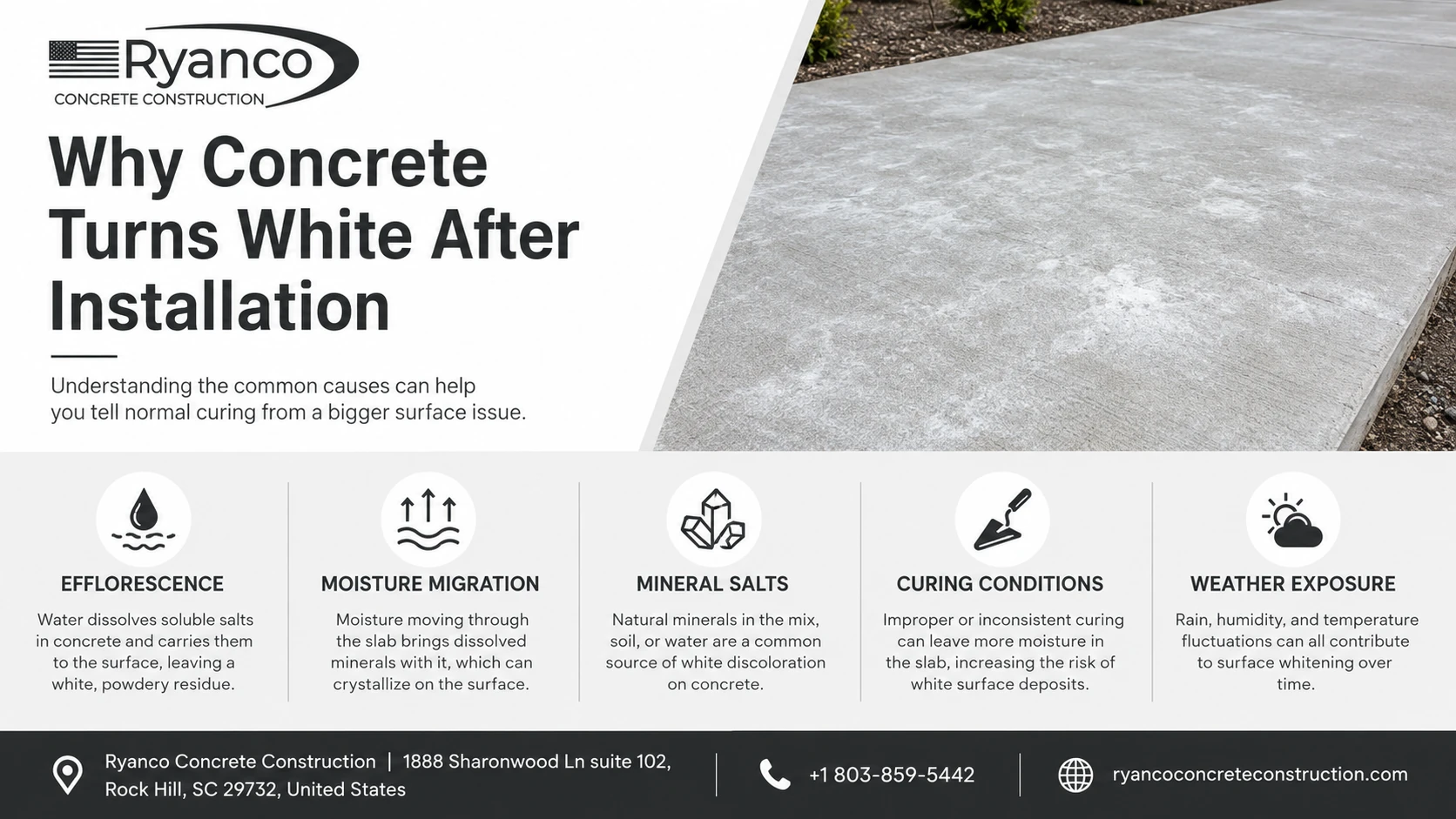
As moisture moves through concrete, it can carry dissolved minerals toward the surface. Once the water evaporates, those minerals may remain behind as a white or light-colored deposit. This is known as efflorescence.
Other possible causes of a white or cloudy appearance include:
- Curing-related color variations
- Surface residue
- Improper or uneven finishing
- Moisture beneath a coating or sealer
- Sealer applied under unsuitable conditions
- Differences in how the concrete dried
Because several surface conditions can look similar, identifying the cause is important before deciding how the discoloration should be handled.
What Is Efflorescence on Concrete?
Efflorescence is a mineral deposit that forms when moisture moves through concrete and carries soluble salts toward the surface.
When that moisture reaches the surface and evaporates, the salts remain behind. These deposits often appear white, pale gray, powdery, or crystalline.
Efflorescence can show up on many residential concrete surfaces, including:
- Driveways
- Patios
- Sidewalks
- Walkways
- Porches
- Steps
- Other exterior slabs
The amount and appearance of efflorescence can vary depending on the concrete, surrounding materials, and moisture conditions.
What Causes Efflorescence to Form?
Efflorescence generally requires three things: moisture, soluble salts, and a path for the moisture to move through the concrete.
Moisture Movement
Water can enter or move through concrete from several directions. Rain, irrigation, groundwater, drainage problems, or moisture beneath a slab may all contribute.
Soluble Salts
Concrete and surrounding masonry materials can contain naturally occurring soluble minerals. Water can dissolve some of these compounds as it moves through the material.
Evaporation at the Surface
As the moisture reaches the exposed surface and evaporates, the minerals are left behind. Over time, those deposits can become visible as white residue.
Site drainage and ongoing exposure to moisture can also influence how frequently efflorescence develops.
Is White Concrete a Sign of Damage?
Not necessarily.
Typical efflorescence is often more of an appearance concern than a sign that the concrete is failing. The white residue itself does not automatically mean the slab is structurally damaged.
However, recurring discoloration can sometimes indicate that moisture is continuing to move through the concrete.
That distinction matters.
If the white deposits keep returning, it may be worth determining where the moisture is coming from rather than repeatedly addressing only the visible residue.
White discoloration should also be evaluated more carefully if it appears alongside cracking, scaling, surface deterioration, or another noticeable change in the concrete.
How Can You Tell Efflorescence From Other Concrete Discoloration?
Efflorescence often looks powdery or chalky and may sit directly on the surface. In some cases, loose deposits can be brushed or wiped away, although they may later return if moisture continues moving through the slab.
Other types of white discoloration may look different.
Curing or Finishing Variations
New concrete can develop uneven coloring as it cures and dries. Differences in moisture, finishing, or surface preparation can sometimes create light or cloudy areas.
Proper surface preparation and finishing can influence how newly placed concrete looks and performs. Homeowners planning new flatwork can learn more through the [Concrete Finishing] page.
Cloudiness Under a Sealer
A whitish or milky appearance beneath a sealer is not always efflorescence.
Moisture can sometimes become trapped beneath certain coatings or sealers, or a sealer may develop a cloudy appearance when it is applied under unsuitable conditions.
Because these issues may look similar from the surface, a professional evaluation can help identify what is actually causing the discoloration.
Can White Deposits Be Removed From Concrete?
In many cases, superficial efflorescence can be reduced or removed, but the correct approach depends on what is causing the white appearance.
Loose mineral deposits may respond to relatively simple cleaning, while discoloration caused by a coating, sealer, finishing issue, or another surface condition may require a different approach.
The key is to identify the problem first.
Homeowners should avoid jumping directly to aggressive chemical treatments or harsh cleaning methods. Using the wrong product or technique can change the concrete surface or create additional discoloration.
Can Efflorescence Come Back After Cleaning?
Yes.
Removing the visible white deposits does not necessarily eliminate the condition that caused them.
If moisture continues traveling through the concrete and carrying dissolved salts toward the surface, efflorescence may return after cleaning.
This is why recurring efflorescence should be viewed as both a surface issue and a moisture-management question.
Cleaning addresses what you can see. Long-term improvement may also require considering drainage, water exposure, or other sources of moisture around the slab.
How Can White Discoloration Be Prevented?
There is no single method that prevents every form of concrete discoloration, but proper installation and moisture management can reduce the likelihood of certain surface issues.
Important considerations include:
- Proper site drainage
- Appropriate concrete installation practices
- Careful moisture management
- Suitable curing conditions
- Proper finishing
- Appropriate surface preparation
- Protection after the concrete has adequately cured
Each of these factors can influence how concrete dries, performs, and looks over time.
The details of finishing and installation should be addressed as part of the overall concrete project rather than treated as an afterthought.
Can Concrete Sealing Help Prevent Efflorescence?
An appropriate concrete sealer may help reduce the amount of moisture entering the surface, which can be useful as part of a broader protection strategy.
However, sealing is not a universal solution for every efflorescence problem.
If significant moisture is already moving through the slab from below or from another source, applying a sealer without understanding those conditions may not solve the problem.
The type of sealer and the condition of the concrete also matter.
In some cases, moisture trapped beneath certain sealers can create a cloudy, milky, or whitish appearance that may be mistaken for efflorescence.
For homeowners considering long-term surface protection, the [Concrete Sealing] page provides more information about sealing options and how they can fit into an overall concrete maintenance plan.
When Should You Have White or Discolored Concrete Professionally Evaluated?
Some mild discoloration may be temporary or primarily cosmetic, while other conditions deserve a closer look.
Consider professional evaluation when:
- White deposits repeatedly return after cleaning
- The discoloration covers a large area
- The concrete is also cracking, scaling, or deteriorating
- The white appearance seems to be beneath a sealer or coating
- The concrete recently received a surface treatment
- You cannot confidently identify the discoloration as efflorescence
- Moisture appears to be entering the slab repeatedly
A professional assessment can help distinguish surface deposits from coating problems, finishing issues, or conditions involving ongoing moisture.
What Fort Mill Homeowners Should Know About Concrete Discoloration
For homeowners in Fort Mill, the most useful starting point is to look at how water moves around the property.
A driveway, patio, walkway, or porch may experience different levels of water exposure depending on grading, drainage, nearby landscaping, roof runoff, irrigation, and how the slab was installed.
If white deposits keep returning, consider whether moisture regularly reaches or moves beneath the concrete.
It is also worth looking at the timing of the discoloration. Did it appear soon after installation? Did it develop after sealing? Does it become more noticeable after wet weather?
Those details can help narrow down the cause without assuming that every white patch is the same problem.
Homeowners planning additional concrete work in the area can also review the [Fort Mill] location page for information about available concrete services.
FAQs
Does efflorescence damage concrete?
Efflorescence itself is usually a surface deposit rather than direct structural damage. However, recurring deposits may indicate ongoing moisture movement, which can be worth investigating.
Does efflorescence go away on its own?
Some light efflorescence may become less noticeable over time, particularly as moisture conditions change. Persistent or recurring deposits may require cleaning and a closer look at the moisture source.
Why does new concrete develop white spots?
New concrete can develop white spots because of efflorescence, curing conditions, moisture movement, finishing variations, or surface residue. The appearance alone may not be enough to identify the exact cause.
Can efflorescence return after cleaning?
Yes. If moisture continues carrying dissolved salts toward the concrete surface, the white deposits can return even after they have been cleaned away.
Does concrete sealer stop efflorescence?
A suitable sealer may help reduce some moisture penetration, but it does not solve every efflorescence problem. Existing moisture conditions should be understood before choosing or applying a sealer.
Why can sealed concrete turn white?
Some sealers can develop a cloudy or milky appearance when moisture becomes trapped beneath the coating or when application conditions are not suitable. This can resemble efflorescence even though the cause is different.
Clear Up Concrete Discoloration With RyanCo Concrete Construction
White concrete does not automatically mean your driveway, patio, walkway, or other slab is failing. In many cases, the issue may be related to efflorescence or another surface condition that can be evaluated and addressed appropriately.
If the discoloration continues to return, appears beneath a sealer, or is accompanied by other surface changes, RyanCo Concrete Construction can help you better understand what may be happening.
Our team can evaluate the condition of the concrete and discuss practical next steps for protecting its appearance and long-term performance.
