
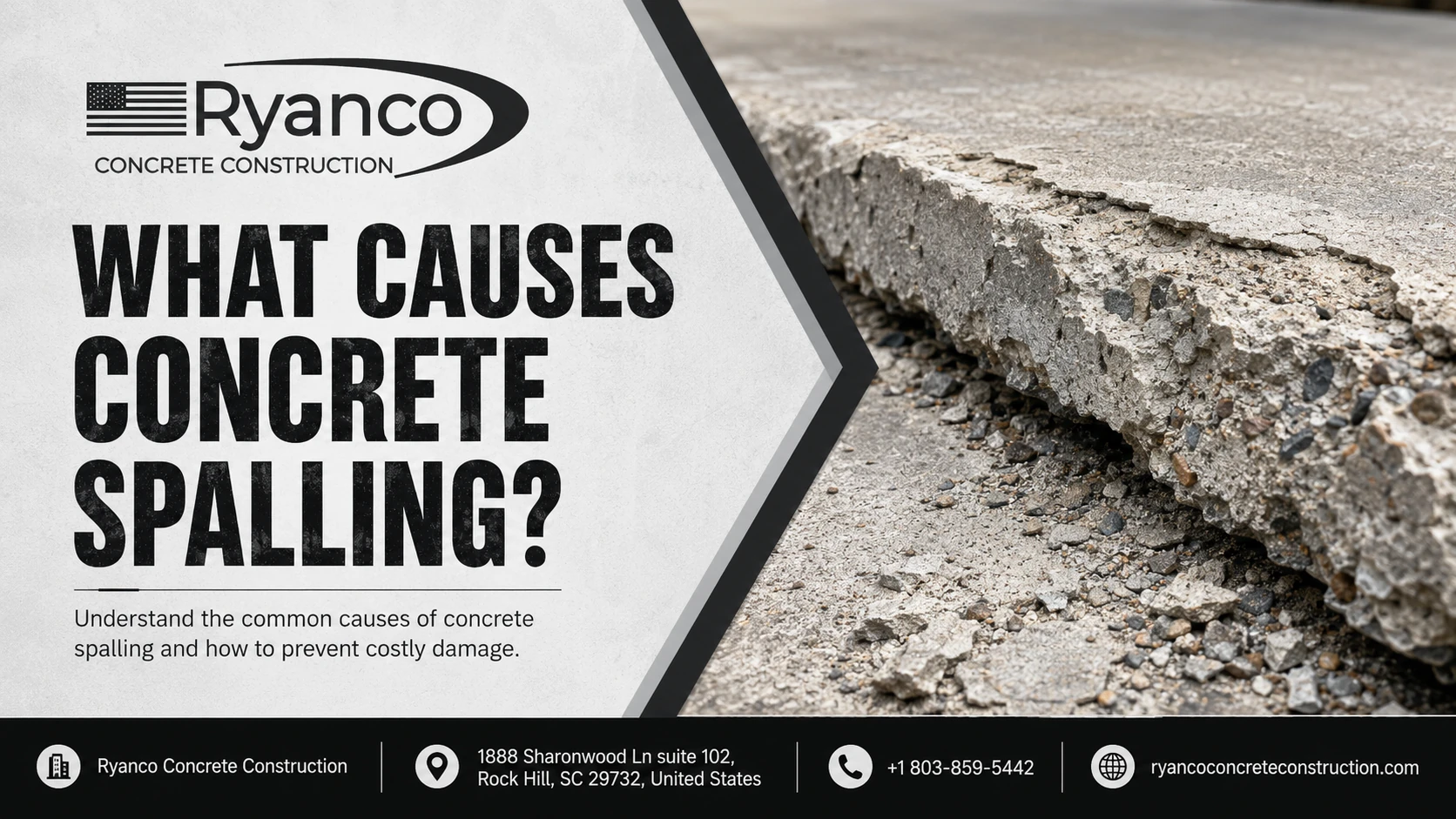
Concrete is built to handle years of weather and everyday use, but its surface can sometimes begin to flake, chip, pit, or break away. This type of deterioration is commonly described as concrete spalling.
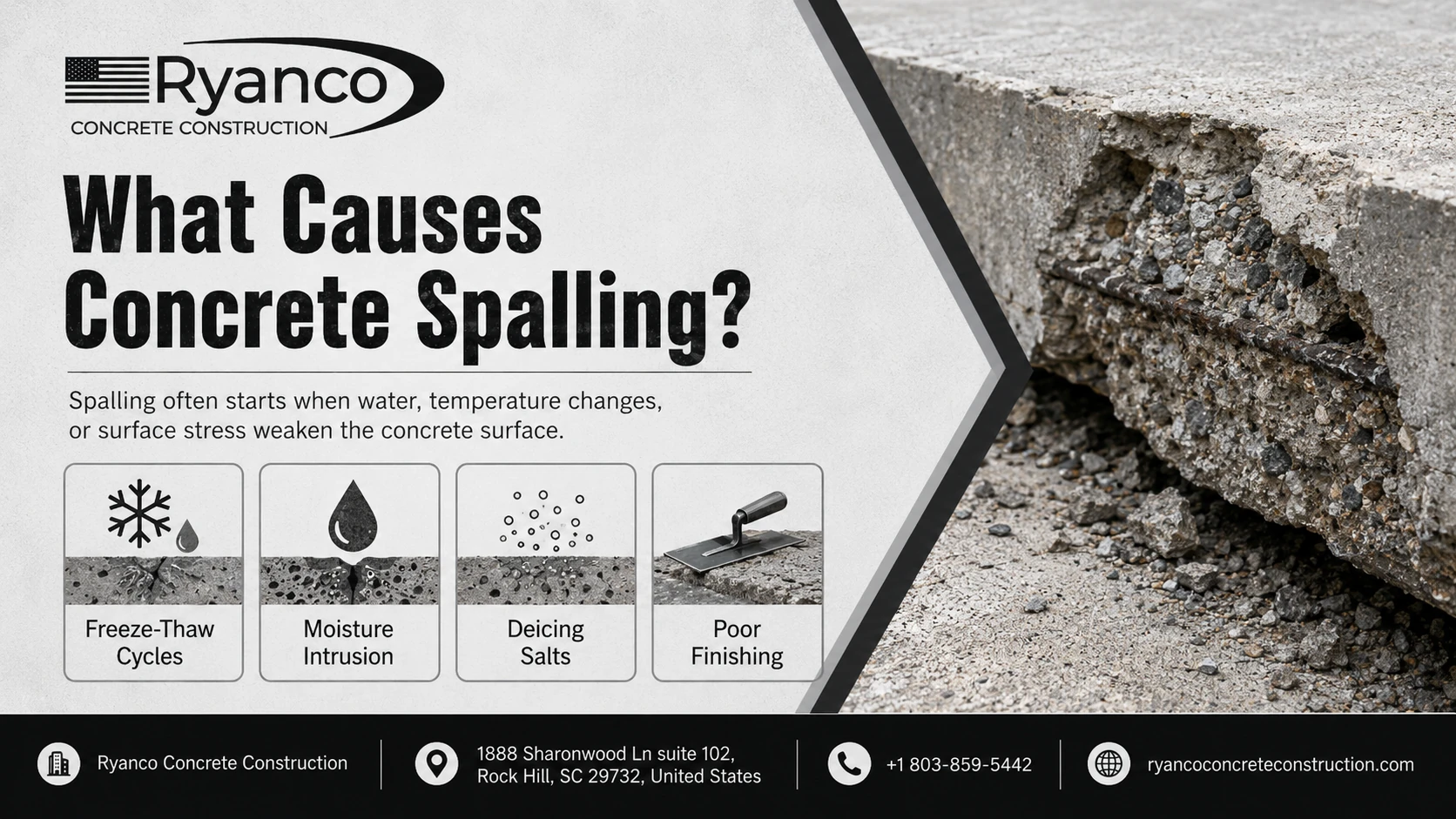
If you are trying to understand what causes concrete spalling, there is not always one explanation. Moisture exposure, freezing and thawing, deicing chemicals, corrosion of embedded reinforcement, surface weakness, and installation or curing problems can all contribute depending on the concrete and its environment. The American Concrete Institute identifies reinforcement corrosion, freeze-thaw deterioration, and chemical attack among common causes of spalling in horizontal concrete surfaces.
Spalling is different from an ordinary crack. A crack creates a separation through or across the concrete, while spalling involves portions of the surface or concrete cover actually breaking, flaking, or separating.
Small areas may sometimes be repairable. Widespread deterioration, exposed reinforcement, recurring surface failure, or damage that continues getting deeper deserves a closer professional evaluation.
What Is Concrete Spalling?
Concrete spalling occurs when part of the concrete surface separates and breaks away from the material underneath.
It can appear as a shallow patch of flaking on a driveway or develop into deeper areas where chunks of concrete detach and expose coarse aggregate or reinforcing steel.
Homeowners may describe the surface as:
- Flaking or peeling
- Chipped
- Pitted
- Crumbling
- Rough or uneven
- Missing its top layer
- Exposing aggregate underneath
Spalling can affect driveways, patios, sidewalks, steps, garage slabs, walls, and other concrete surfaces.
It is also helpful to distinguish spalling from scaling. The terms are sometimes used interchangeably in everyday conversations, but scaling generally refers to shallow deterioration or flaking of the surface mortar. Spalling can describe deeper localized breakouts as well, including deterioration associated with reinforcement corrosion.
Ordinary cracking is different again. Concrete can have a crack without losing material from the surface, although cracking can sometimes allow moisture into the slab and contribute to later deterioration.
What Causes Concrete Spalling?
Several conditions can contribute to spalling, and more than one may affect the same slab.
Moisture and freeze-thaw exposure
Concrete contains small pores that can absorb or transport moisture. When sufficiently saturated concrete experiences freezing temperatures, water within the pore system can freeze and create internal pressure.
Repeated freezing and thawing can gradually damage vulnerable concrete. ACI notes that entrained air is used in concrete exposed to freeze-thaw conditions because the small air spaces provide room for pressure associated with freezing water.
Not every wet slab will spall, and not every spalling problem is related to freezing. Concrete quality, drainage, saturation, air entrainment, surface condition, and exposure all matter.
Deicing chemicals
Certain deicing chemicals can make concrete surface deterioration worse, particularly when combined with moisture and freezing conditions.
ACI identifies saturated concrete, freeze-thaw action, and some chloride-based deicing products as contributors to deterioration at concrete pavement joints.
For homeowners, the practical takeaway is that repeatedly applying aggressive deicing chemicals to vulnerable concrete can create additional stress on the surface.
Corrosion of reinforcing steel
Reinforced concrete may contain steel bars or other reinforcement.
If moisture and chlorides reach embedded steel, corrosion can develop. Corrosion products occupy more space than the original steel and can create pressure against the surrounding concrete. Eventually, cracking, delamination, and pieces of concrete breaking away may occur.
ACI’s repair guidance specifically identifies corrosion of embedded reinforcement as a cause of delamination and spalling.
This type of damage requires more attention than simply covering the missing concrete because the underlying corrosion may also need to be addressed.
Improper finishing
Surface problems can sometimes begin when concrete is being placed and finished.
For example, finishing concrete while excessive bleed water remains at the surface can contribute to a weaker surface layer. Excessive or improper finishing practices can also contribute to surface deterioration.
ACI research has documented relationships between finishing problems and concrete scaling, abrasion, or delamination.
The damage may not become obvious immediately. Weather and regular use can gradually expose weaknesses in the surface.
Inadequate curing
New concrete needs suitable curing conditions to develop its intended properties.
Poor curing can leave the near-surface concrete more vulnerable to wear and environmental exposure. Curing conditions, mixture characteristics, placement, and finishing all affect how well a surface performs over time.
Impact and heavy wear
Physical damage can also cause localized spalling.
Repeated vehicle traffic, dropped equipment, hard impacts, or heavy loads may break already weakened concrete. Corners, edges, steps, and joints can be particularly susceptible because they have less surrounding concrete supporting them.
In these cases, the surface damage may involve both environmental deterioration and mechanical wear.
What Are the Signs of Spalling Concrete?
Spalling is often easier to recognize as it becomes more advanced.
Early deterioration may start with relatively small pits, shallow flakes, or rough patches. Over time, larger sections can separate.
Watch for concrete that develops obvious flaking, small pieces breaking loose, shallow depressions, exposed coarse aggregate, crumbling edges, or deeper cavities.
You may also notice cracks around the perimeter of a damaged patch. On reinforced concrete, rust staining or visible reinforcing steel deserves additional attention because it can indicate that deterioration extends below the surface.
One important clue is continued change. A small cosmetic surface variation that stays the same for years is different from an area that becomes larger, deeper, or increasingly loose over several months.
If you can remove pieces of material easily or the deteriorated area continues spreading, professional evaluation becomes more worthwhile.
Does Concrete Spalling Get Worse Over Time?
It can.
Once part of the surface breaks away, the newly exposed concrete may become more vulnerable to water, contaminants, abrasion, and additional weather exposure.
The outcome depends on what caused the original problem.
For example, patching over deterioration caused by active reinforcement corrosion without addressing the steel may allow the underlying process to continue. Similarly, repairing surface damage without correcting persistent drainage or moisture problems can leave the slab exposed to the same conditions that contributed to deterioration initially.
Spalling does not always progress at the same rate. A small localized defect may remain relatively stable, while another area can deteriorate much more quickly.
That is why the cause matters as much as the size of the visible damaged area.
How Is Spalling Concrete Repaired?
The appropriate repair depends on the depth, extent, and underlying cause of the deterioration.
The first step is determining whether the damage is primarily superficial or whether it involves deeper concrete, reinforcement, settlement, or another structural concern.
For repairable areas, professionals may remove loose and unsound material until stable concrete is reached. The surface then needs appropriate preparation so the repair material can bond properly.
If reinforcing steel is exposed or corroded, simply filling the surface cavity may not be enough. The reinforcement and surrounding deterioration may need to be addressed as part of the repair.
Possible approaches can include localized patching, resurfacing, or partial replacement depending on the condition of the slab. When deterioration is widespread or the underlying concrete is no longer sound enough to support a durable repair, replacement may make more sense.
ACI’s guidance for horizontal spall repair emphasizes evaluating the deterioration first and developing the repair plan around the actual cause and extent of the problem.
RyanCo’s concrete repair service similarly covers chipped, spalled, worn, and deteriorating surfaces as well as resurfacing when appropriate.
Can Concrete Sealing Help Prevent Spalling?
Sealing may help protect suitable, sound concrete, particularly by reducing the amount of water and contaminants entering the surface.
That can be useful because moisture plays a role in several deterioration mechanisms.
ACI notes that penetrating sealers can help reduce penetration of aggressive solutions into concrete in certain exposure conditions.
However, a sealer cannot repair concrete that has already spalled.
If loose material, deep pitting, delamination, or exposed reinforcement is already present, the underlying deterioration should be evaluated before applying a coating or sealer. Covering damaged concrete without addressing the problem can hide symptoms without correcting the cause.
Homeowners interested in protecting a concrete surface after it has been properly evaluated can learn more about RyanCo’s concrete sealing services. The company’s current sealing page focuses on moisture protection and preservation of exterior concrete in Rock Hill and York County.
Think of sealing as a preventive or maintenance measure not a substitute for necessary repair.
When Should You Have Spalling Concrete Evaluated?
A small shallow surface defect may not always require immediate major work. However, deterioration deserves closer attention when it is spreading or affecting how the concrete functions.
Consider having the concrete evaluated when the damaged area is becoming larger or deeper, pieces continue breaking loose, aggregate is extensively exposed, reinforcing steel is visible, rust staining appears, the area creates a trip hazard, or deterioration occurs alongside significant cracking or settlement.
Professional evaluation is also useful when you do not know whether you are looking at spalling, scaling, ordinary surface wear, or another type of damage.
For property owners in Rock Hill, outdoor concrete can include everything from driveways and patios to sidewalks, steps, and other flatwork. Each surface experiences different moisture, drainage, traffic, and exposure conditions, so the appropriate repair should be based on the specific slab rather than a one-size-fits-all solution.
The earlier the underlying cause is understood, the easier it is to decide whether the concrete needs monitoring, localized repair, resurfacing, sealing after repair, or replacement.
FAQs
Is concrete spalling the same as cracking?
No. A crack is a fracture or separation in the concrete, while spalling involves pieces or layers of concrete breaking away from the surface. A slab can experience both conditions at the same time.
Is spalling concrete dangerous?
Minor surface spalling may primarily affect appearance, but deeper deterioration can create uneven surfaces, loose material, or expose reinforcing steel. Damage near steps, walkways, driveways, structural components, or frequently used areas should be evaluated if it creates a safety or durability concern.
Can spalling concrete be repaired?
Often, yes. Localized spalling may be repaired when the underlying concrete remains sound and the cause can be addressed. Extensive deterioration, severe reinforcement corrosion, or widespread failure may require more substantial repair or replacement.
Will concrete sealer fix spalling?
No. Sealer does not rebuild concrete that has already broken away. Sealing may help limit moisture penetration in suitable concrete, but existing deterioration should be repaired or evaluated first.
Why is the top layer of my driveway flaking off?
Possible causes include surface scaling, moisture-related deterioration, freeze-thaw exposure, deicing products, weak surface concrete, or finishing and curing issues. The pattern and depth of the damage can help a professional determine the likely cause.
Should badly spalled concrete be replaced?
Not automatically. The decision depends on how much concrete is damaged, whether the underlying slab is sound, whether reinforcement is involved, and whether a durable repair can be made. Widespread or deep deterioration may make replacement more practical than repeated patching.
Stop Concrete Spalling From Becoming a Bigger Problem With RyanCo Concrete Construction
Spalling can start as a small rough or flaky area, but the visible surface does not always show the full extent of the deterioration. Identifying why the concrete is breaking away is the first step toward choosing an appropriate repair.
At RyanCo Concrete Construction, we help property owners in Rock Hill and surrounding communities evaluate damaged concrete and determine whether patching, resurfacing, repair, sealing after repair, or another solution makes sense for the condition of the surface.
If your driveway, patio, sidewalk, steps, or other concrete is flaking, pitting, crumbling, or exposing deeper material, having the area evaluated can help you address the problem before additional deterioration develops.
