
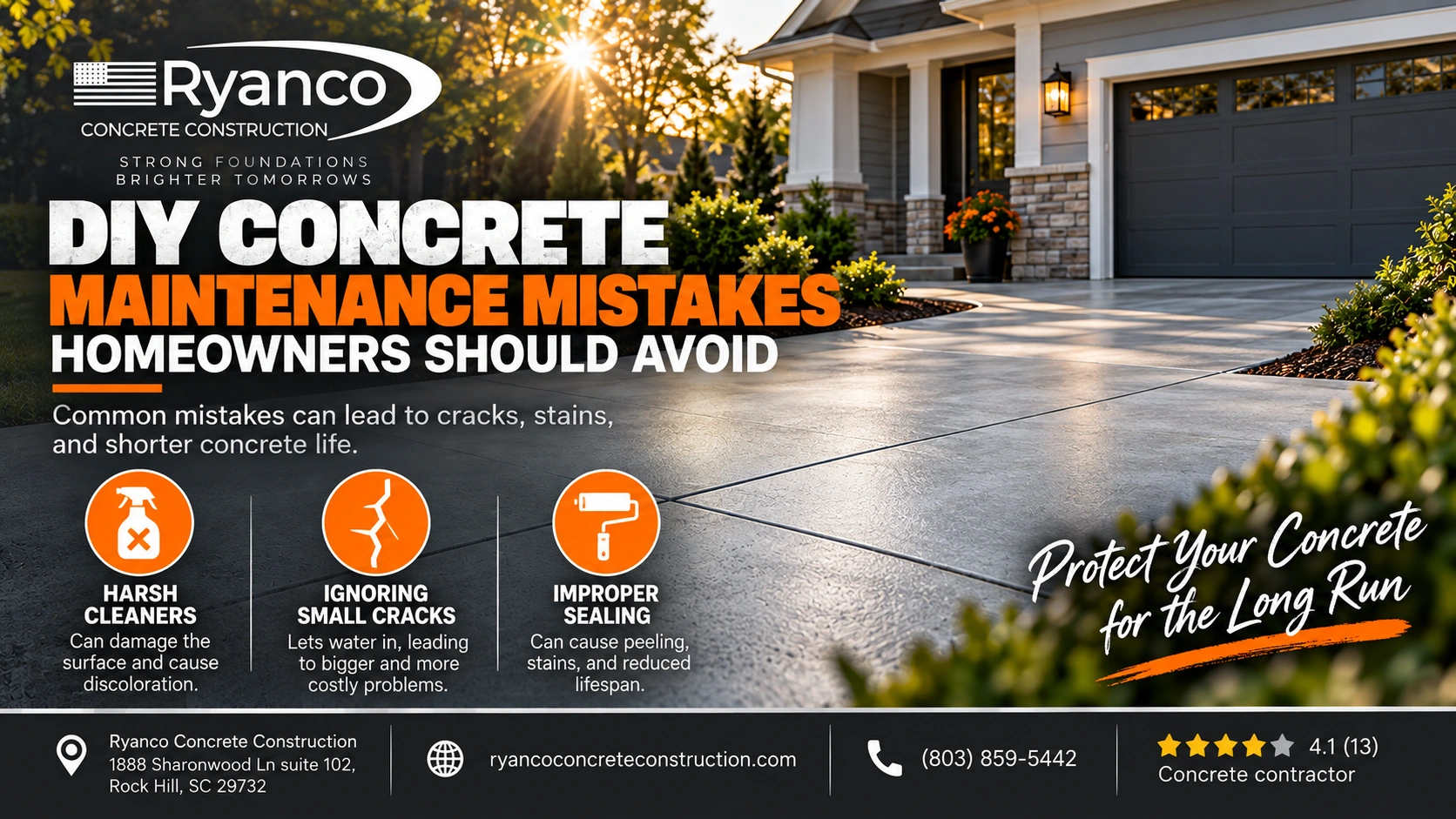
Concrete driveways, patios, sidewalks, and walkways do not require complicated upkeep, but the wrong maintenance approach can sometimes create more problems than it solves. Aggressive cleaning, incorrect pressure washing, ignoring drainage problems, sealing over damaged concrete, or repeatedly covering cracks without understanding why they formed can all reduce the effectiveness of routine maintenance.
Some of the most common DIY concrete maintenance mistakes happen because homeowners are trying to protect the surface but use a method that does not match the concrete’s condition. Concrete sealing can be useful for suitable surfaces, but it is only one part of maintenance and should not be treated as a way to repair existing damage.
The safest approach is usually simple: keep concrete reasonably clean, monitor cracks and surface changes, control water where possible, use products intended for the surface, and have deterioration professionally evaluated when it moves beyond routine upkeep.
What Are the Most Common DIY Concrete Maintenance Mistakes?
Most maintenance problems do not come from homeowners doing nothing at all. They often come from doing too much, using the wrong product, or treating a symptom without considering what caused it.
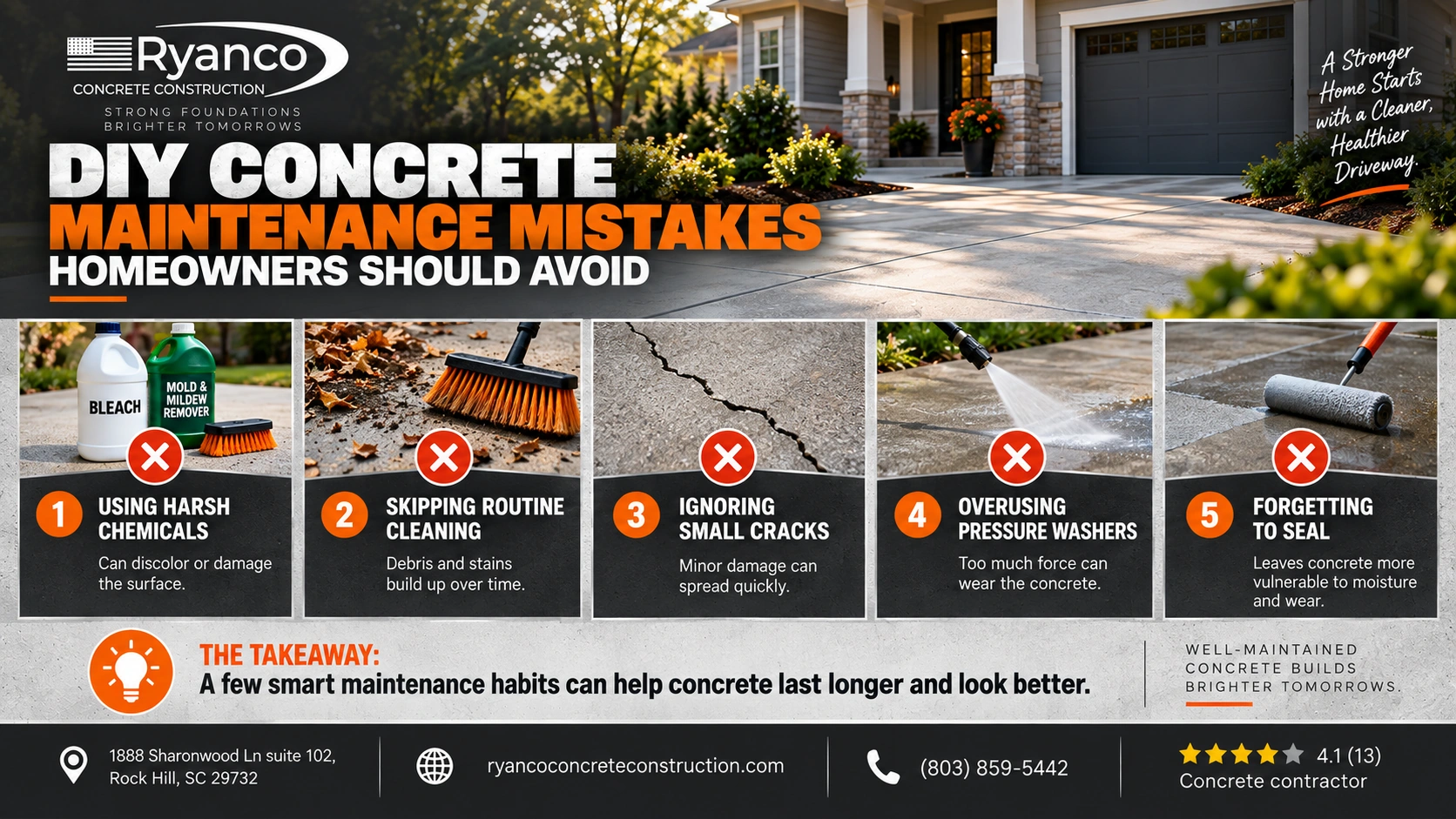
Common mistakes include:
- Using harsh cleaners without checking whether they are appropriate for concrete
- Pressure washing too aggressively
- Holding a pressure-washer nozzle too close to the surface
- Ignoring small cracks that continue widening or moving
- Letting water repeatedly collect beside or on the slab
- Applying sealer over dirty, damp, or deteriorated concrete
- Applying too much sealer
- Assuming every sealer works on every concrete finish
- Covering visible damage without determining why it developed
- Using aggressive tools to remove stains or ice
- Treating spalling, settlement, or uneven slabs as simple cosmetic problems
- Assuming every crack can be permanently fixed with a store-bought filler
Routine maintenance should preserve the surface rather than significantly alter it.
RyanCo’s current maintenance guidance recommends regular cleaning and periodic sealing, while its repair services distinguish ordinary maintenance from problems such as cracking, chips, uneven slabs, and worn surfaces that may require repair.
A useful rule is to stop treating the problem as routine maintenance when the concrete itself begins moving, breaking apart, or noticeably deteriorating.
Can Using the Wrong Cleaner Damage Concrete?
Yes. The wrong cleaner or cleaning method can affect the appearance or condition of a concrete surface.
Concrete may look extremely durable, but different surfaces can have different finishes, sealers, stains, coatings, and levels of wear. A cleaner suitable for unfinished exterior concrete may not be appropriate for decorative, stained, polished, or sealed concrete.
Homeowners should be especially careful with highly acidic or aggressive cleaning products.
A strong product may remove a stain but also alter the surface texture, affect a decorative finish, damage an existing sealer, or create a visibly different patch from the surrounding concrete.
More cleaning power is not always better
When a mild cleaning method does not immediately remove a stain, it can be tempting to increase chemical strength or scrubbing pressure.
That approach can create a second problem.
Before using a specialty cleaner, check whether it is intended for the type of concrete and finish you have. Testing it on a small, less visible area can also help reveal unwanted color or finish changes.
RyanCo’s own sealed-concrete guidance recommends routine sweeping and occasional washing with a mild detergent for normal upkeep rather than assuming aggressive treatment is necessary.
Be careful with pressure washing
Pressure washing can be useful for some exterior concrete, but excessive pressure or poor technique may roughen or mark the surface.
Potential mistakes include:
- Holding the nozzle extremely close
- Concentrating the spray in one spot
- Using excessive pressure on already deteriorated concrete
- Washing directly into damaged joints or loose material
- Trying to blast away spalling or scaling
- Using aggressive pressure on decorative finishes or coatings
If the concrete is already flaking, pitting, or crumbling, pressure washing should not be used as a substitute for determining why the surface is deteriorating.
Cleaning should remove dirt. It should not remove part of the concrete.
What Happens When You Ignore Small Cracks?
Not every small crack means a concrete slab is failing.
Concrete naturally develops some cracks because of drying shrinkage, temperature changes, movement, and other normal stresses. The important question is whether a crack remains stable or begins changing.
Ignoring a fine, unchanged crack may have little consequence in some situations. Ignoring a crack that widens, allows one side of the slab to move, collects water, or appears alongside settlement can be more concerning.
Small cracks deserve closer attention when they:
- Continue getting wider
- Develop vertical displacement
- Reappear after previous filling
- Allow water to repeatedly collect
- Extend through several sections
- Occur near a sinking or lifting slab
- Develop next to crumbling concrete
- Appear alongside drainage problems
The mistake is not necessarily failing to fill every tiny crack immediately.
The bigger mistake is repeatedly applying a cosmetic filler while ignoring signs that the slab itself is moving.
RyanCo’s concrete repair page specifically addresses cracks and uneven slabs and notes that weather, soil movement, and wear can contribute to concrete deterioration.
If movement is continuing, identifying the cause becomes more important than simply making the crack less visible.
Can Improper Sealing Cause Problems?
Yes. Concrete sealing can be beneficial when the concrete and product are suitable, but incorrect application can create appearance and performance problems.
RyanCo currently describes concrete sealing as a protective treatment intended to help resist moisture, stains, UV exposure, and weather-related wear.
That does not mean more sealer automatically provides more protection.
Sealing dirty concrete
Applying a sealer over dirt, stains, residue, or contamination can trap those materials beneath the finished surface.
Preparation requirements vary by product, but the concrete generally needs to meet the manufacturer’s requirements before application.
Sealing damp concrete when the product requires a dry surface
Some sealing systems have specific moisture requirements.
Applying a product under unsuitable conditions can contribute to poor bonding, cloudiness, whitening, or uneven appearance.
Applying too much sealer
Heavy application can sometimes create a thick, uneven, glossy, or slippery surface rather than improving protection.
Multiple heavy coats are not necessarily better than applying the product according to its intended coverage.
Using the wrong sealer
Different products are designed for different goals.
Some penetrate concrete and reduce water absorption. Others form a film and may enhance color or appearance. Decorative concrete, broom-finished driveways, patios, and other surfaces may have different requirements.
Sealing over deterioration
This is one of the most important mistakes to avoid.
A sealer does not repair:
- Deep cracks
- Uneven slabs
- Spalling
- Crumbling edges
- Active settlement
- Severe scaling
- Failed joints
Sealing over damaged concrete may hide part of the problem temporarily, but it does not restore missing material or correct movement below the slab.
Existing deterioration should be evaluated before deciding whether sealing is appropriate.
What Maintenance Tasks Can Homeowners Safely Handle?
Most routine concrete maintenance is straightforward.
Homeowners can generally focus on observation, cleaning, drainage, and keeping the surrounding area reasonably clear.
Sweep dirt and debris
Regular sweeping keeps leaves, soil, mulch, and other debris from accumulating on the surface or in joints.
Organic debris that stays wet can also contribute to staining.
Clean ordinary spills
Removing spills reasonably soon can make them easier to manage.
Use a product appropriate for the concrete and its finish rather than automatically reaching for the strongest cleaner available.
Monitor cracks
Take photographs of cracks that concern you.
Comparing photos over several months can help determine whether the crack is stable or visibly changing.
Watch drainage
Look at the property during or after rain.
Water repeatedly collecting in the same area can provide useful clues about slab slope, settlement, clogged drainage paths, erosion, or surrounding grading.
Try to keep gutters, downspouts, landscape drainage, and other water sources from continually directing concentrated water toward slab edges.
Keep joints reasonably clear
Leaves, dirt, weeds, and debris can build up in concrete joints.
Keeping accessible joints clear allows you to see whether filler is deteriorating or whether the concrete edges are beginning to break.
Inspect the surface seasonally
Walk your driveway, patio, sidewalk, and other slabs a few times each year.
Look for:
- New cracks
- Flaking
- Spalling
- Pitting
- Uneven panels
- Broken edges
- Standing water
- Stains
- Failed sealer
- Joint deterioration
You do not need to repair every imperfection.
The purpose of these checks is to recognize meaningful changes early.
When Should You Call a Concrete Professional?
Routine cleaning and observation are different from concrete repair.
Once the concrete is moving, breaking apart, creating a hazard, or repeatedly failing after previous DIY treatments, professional evaluation becomes more useful.
Consider calling a concrete professional when you notice:
- A crack becoming noticeably wider
- One side of a crack sitting higher than the other
- Sinking or lifted slabs
- Significant spalling or surface loss
- Crumbling edges
- Multiple recurring cracks
- Water pooling because a slab has shifted
- A previous repair repeatedly failing
- Loose or broken sections
- Exposed aggregate over a large area
- Damage affecting vehicle or pedestrian use
- A sealer that is peeling, whitening, or failing across a large area
- Damage you cannot confidently identify
At this stage, continued DIY maintenance may only cover the symptoms.
Professional concrete repair may involve crack treatment, leveling, resurfacing, chip repair, or another approach based on the actual condition of the concrete. RyanCo’s current repair service specifically covers cracks, uneven slabs, worn surfaces, and other cosmetic or functional deterioration.
For homeowners in Rock Hill, the same principle applies whether the damaged surface is a driveway, patio, sidewalk, walkway, or another slab.
A local property may have a combination of traffic, drainage, soil movement, shade, vegetation, and exposure conditions affecting the concrete. Evaluating the actual surface is more useful than assuming that one DIY product will solve every problem.
FAQs
Can pressure washing damage concrete?
It can if excessive pressure, an aggressive nozzle, or poor technique is used. Older, decorative, sealed, or already deteriorated concrete may be especially sensitive. Use an approach appropriate for the surface rather than assuming maximum pressure provides better cleaning.
Should every concrete crack be filled?
Not automatically. Small stable cracks and cracks caused by active slab movement are different problems. If a crack is widening, changing elevation, or repeatedly returning after repair, professional evaluation may be more useful than repeated filling.
Can I apply concrete sealer myself?
Some products are marketed for homeowner application, but successful sealing depends on choosing an appropriate product and following its preparation, moisture, coverage, and application requirements. RyanCo notes that DIY sealing is possible but recommends professional application for proper results.
Can sealer fix cracked concrete?
No. Concrete sealer is primarily protective. It does not level slabs, rebuild missing concrete, correct settlement, or repair significant cracks.
How do I know if concrete damage is more than cosmetic?
Movement is an important clue. Widening cracks, vertical displacement, sinking slabs, deep spalling, crumbling sections, or recurring repairs can indicate that more than appearance is involved.
Is it okay to use strong chemicals on a concrete driveway?
Use caution. Concrete finishes, coatings, stains, and sealers can react differently to cleaning chemicals. Check product compatibility and start with an appropriate mild cleaning approach rather than assuming stronger chemicals are always more effective.
Should I repair or seal concrete first?
Existing deterioration should generally be evaluated before sealing. Sealing can protect suitable concrete but does not rebuild damaged areas. The appropriate sequence depends on the type of damage and the sealing system being considered.
Avoid Costly Maintenance Mistakes With RyanCo Concrete Construction
Maintaining concrete does not mean constantly repairing or coating it. Good maintenance starts with keeping surfaces clean, watching for meaningful changes, managing water, and using appropriate products without creating unnecessary damage.
When cracks keep growing, slabs become uneven, surfaces begin spalling, or previous DIY fixes stop working, the problem may have moved beyond routine maintenance.
At RyanCo Concrete Construction, we help property owners in Rock Hill and surrounding communities evaluate damaged concrete and determine whether sealing, repair, resurfacing, leveling, or another solution makes sense for the condition of the surface.
If you are unsure whether your concrete needs maintenance or professional repair, having the surface evaluated can help you avoid spending more time and money on treatments that do not address the underlying problem.
