
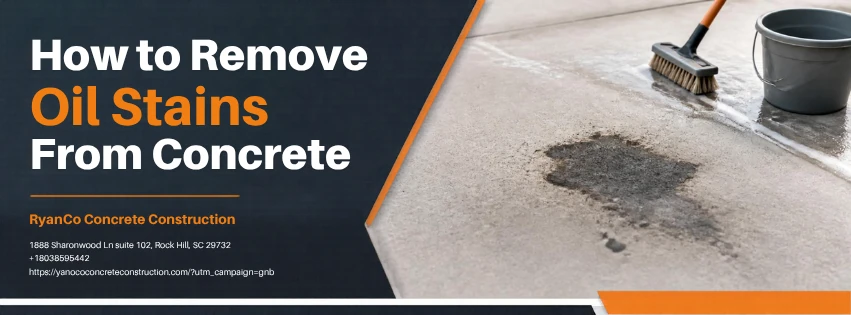
Oil stains on a driveway or garage slab can become much harder to remove when they are allowed to sit. Concrete may look solid, but its surface contains pores that can allow oil and other contaminants to work below the visible surface.
If you are trying to learn how to remove oil stains from concrete, the first step is determining whether the spill is still fresh or has already soaked in. Fresh oil should generally be absorbed before more intensive cleaning begins. Older stains may require a cleaner or degreaser specifically intended for concrete and possibly more than one treatment.
The goal is not necessarily to make the stain disappear in one aggressive cleaning session. Using extremely harsh chemicals, abrasive tools, or excessive pressure can alter the concrete surface or damage an existing finish. A gradual approach that starts with the least aggressive suitable method is usually more sensible.
Why Does Oil Stain Concrete?
Concrete is not completely nonporous.
Small pores and capillaries throughout the material can allow liquids to penetrate beneath the surface. When motor oil, transmission fluid, cooking grease, or another oily material lands on unsealed concrete, some of it may remain on top while some begins working into those pores.
This is one reason a fresh spill and an old stain often require different approaches.
A fresh spill may still contain a significant amount of liquid sitting at or near the surface. If it is absorbed promptly, less material may be left behind to penetrate deeper.
An older stain has had more time to migrate into the concrete. Simply wiping the surface may no longer remove enough oil to make much difference.
The stain can also look darker when the concrete is dry because the absorbed oil changes how light interacts with that area.
Several factors influence how noticeable an oil stain becomes:
- How long the oil remained on the surface
- Whether the concrete is sealed
- How porous the concrete is
- The type of finish
- The amount of oil spilled
- Whether previous stains are present
- How quickly cleanup began
- Weather and moisture exposure
Decorative or colored concrete deserves additional caution because an aggressive cleaner can alter the surrounding appearance even if it reduces the stain.
How Do You Remove Fresh Oil Stains From Concrete?
The first goal with a fresh spill is to remove as much free oil as possible before washing the area.
Start by keeping people, pets, and vehicles away from the spill so it does not get tracked across a larger portion of the driveway or garage floor.
Absorb the excess oil
Covering the spill with an appropriate oil-absorbing material can help pull up liquid that has not yet penetrated deeply.
The absorbent should be allowed to collect the oil rather than immediately being scrubbed across the concrete. Scrubbing a fresh puddle can spread the contamination into a larger area.
Once the absorbent has done its job, sweep or collect it carefully and dispose of oil-contaminated material according to applicable local requirements.
If the material quickly becomes saturated, another application may be useful.
Clean the remaining residue
After the free oil has been absorbed, a mild cleaning approach may help remove remaining surface residue.
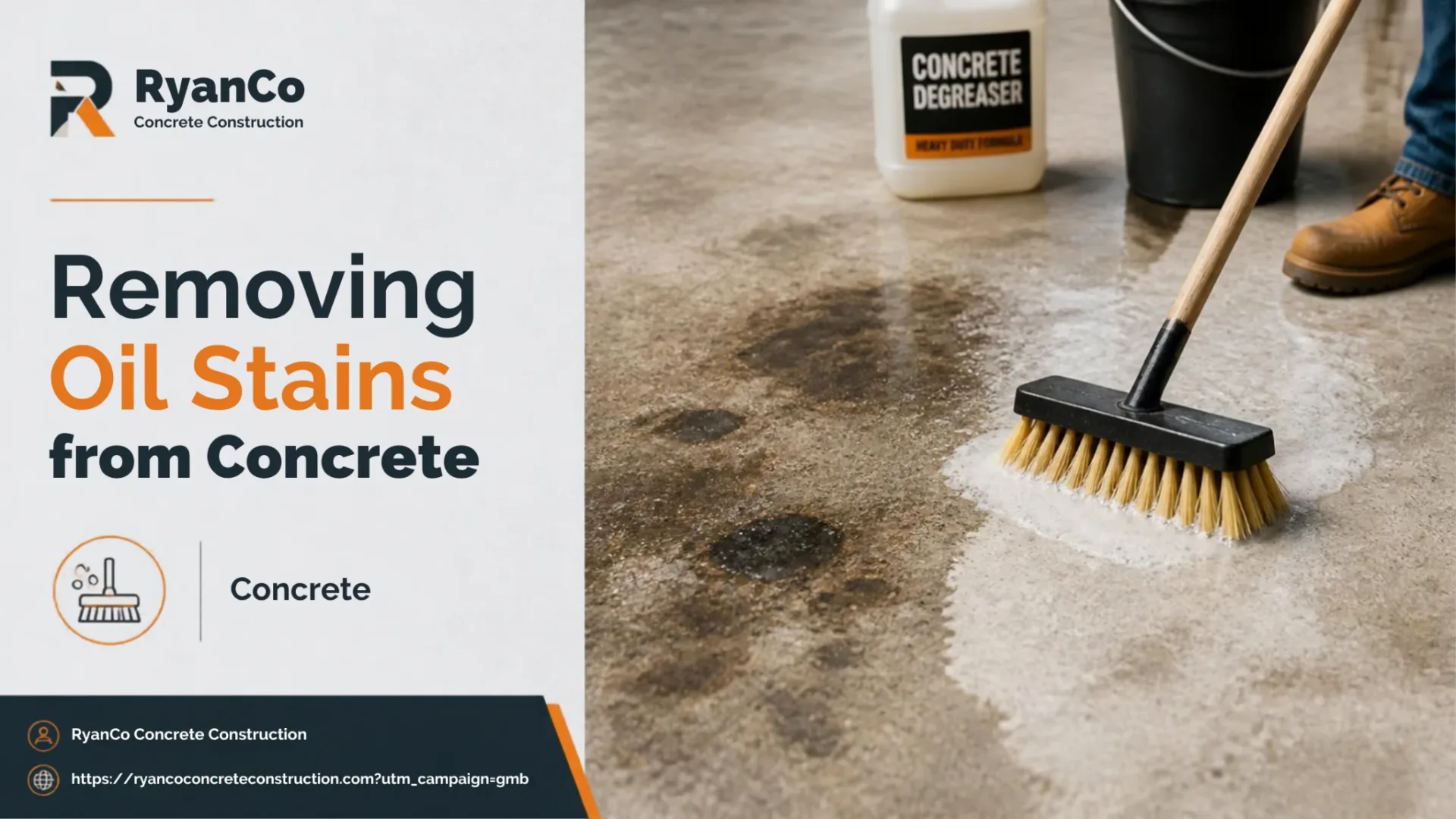
A concrete-compatible detergent or degreasing cleaner can be applied according to its instructions. Agitation with a suitable nylon-bristle brush may help work the cleaner across the affected surface.
Rinse according to the cleaner manufacturer’s directions and allow the concrete to dry before deciding whether another treatment is necessary.
Do not judge the result while the slab is still wet. Wet concrete naturally appears darker and can make it difficult to see how much staining remains.
Avoid forcing the oil deeper or spreading it
Immediately spraying a fresh oil puddle with a powerful stream of water can spread oily water across a much larger area.
Absorption first, followed by appropriate cleaning, generally gives homeowners more control over the mess.
How Can You Clean Older Oil Stains?
Older stains often require more patience because the oil is no longer sitting primarily on the surface.
A dark stain that has been present for weeks, months, or longer may have penetrated into the concrete pores. In those situations, ordinary soap and water may improve the appearance without completely removing the discoloration.
Start with a concrete-compatible degreaser
A commercial degreaser specifically labeled for concrete can help break up petroleum-based residue.
Follow the product’s instructions carefully rather than assuming that leaving the product on longer or applying more will produce a better result.
Some concrete oil-stain products are specifically formulated for moderate or heavy petroleum staining and are designed to be scrubbed and rinsed after application.
Expect repeat treatments
Deep staining may not respond completely to one cleaning cycle.
It is usually better to repeat an appropriate treatment according to manufacturer guidance than to jump immediately to a much harsher chemical.
Allow the concrete to dry between treatments so you can accurately judge whether the stain is improving.
Older stains may remain visible
Sometimes cleaning significantly lightens a stain without returning the concrete to exactly the same color as the surrounding slab.
That does not necessarily mean the cleaning failed.
Oil that has penetrated deeply can be difficult to extract completely. Weathering, previous cleaning, and differences in concrete porosity may also leave some color variation.
For a large, old, or highly visible stain, professional evaluation may be worthwhile before using increasingly aggressive treatments.
What Cleaning Products Can Be Used on Concrete?
The correct cleaning product depends on the stain and the type of concrete surface.
For oil and grease, a cleaner or degreaser intended specifically for concrete is generally more appropriate than experimenting with unrelated household chemicals.
The American Cement Association notes that stain-removal methods should be selected according to the type of stain and specifically identifies degreasers as one option for oil staining.
Possible cleaning approaches can include:
- Mild detergent for light surface residue
- Concrete-compatible degreaser
- Commercial oil-stain remover
- Absorbent products designed for petroleum spills
- Specialty concrete cleaning products used according to their label
Before using any cleaner, check whether the concrete has been sealed, stained, colored, coated, polished, or given another decorative treatment.
A product that works acceptably on plain exterior concrete may affect a decorative finish differently.
Test an inconspicuous area
When you are uncertain how a cleaner will affect the surface, test a small, less visible area first.
Allow that test area to dry fully before comparing it with the surrounding concrete.
This can reveal unintended lightening, etching, dulling, or sealer damage before the product is applied across a prominent section.
Follow product safety instructions
Concrete cleaners vary considerably.
Some require gloves, eye protection, ventilation, particular dilution ratios, or specific rinse procedures. Follow the manufacturer’s instructions rather than combining products or inventing a stronger cleaning mixture.
What Oil-Stain Cleaning Mistakes Should You Avoid?
Trying to remove the stain quickly can sometimes make the appearance worse.
Do not mix cleaning chemicals
Combining household or commercial chemicals can create dangerous reactions or fumes.
Use one appropriate product as directed rather than mixing cleaners in an attempt to increase strength.
Do not automatically reach for aggressive acids
Acidic products can alter or etch concrete surfaces.
Certain professional preparation processes use acid-based materials for specific purposes, but that does not make them the right first choice for an ordinary driveway oil stain.
If you do not know what a chemical will do to the concrete or existing finish, avoid experimenting with it.
Do not scrub aggressively with damaging tools
A harsh wire brush or abrasive tool can leave scratches or visibly change the texture of the surface.
A suitable nylon-bristle brush is generally less likely to leave metallic marks or aggressively alter the concrete.
Do not use maximum pressure simply because a stain is stubborn
Pressure washing may help with some cleaning situations, but excessive concentrated force can roughen vulnerable concrete, damage a coating, or make existing surface deterioration more noticeable.
An oil stain that does not respond to moderate cleaning may need a better stain-removal method not simply more water pressure.
Do not seal over oil contamination
Sealer should not be used to hide an oil stain.
The surface generally needs to be clean and appropriately prepared before sealing. Oil and other contaminants can interfere with the intended appearance or performance of a coating or sealer.
Do not assume every dark patch is oil
Tire marks, moisture, organic stains, rust, previous coatings, and other contaminants can sometimes resemble oil staining.
If cleaning does not behave as expected, confirming the source of the discoloration may be more useful than continuing to apply stronger products.
Can Concrete Sealing Help Prevent Future Stains?
Concrete sealing can make certain surfaces more resistant to oil and other spills, but it should not be described as making concrete completely stain-proof.
A suitable sealer can reduce how readily some liquids penetrate the surface, giving homeowners more opportunity to clean spills before they soak deeply into the concrete.
That can be particularly useful for:
- Driveways
- Garage slabs
- Patios with grills or outdoor kitchens
- Concrete around vehicles or equipment
- Other surfaces regularly exposed to spills
The effectiveness depends on the type of sealer, application, condition of the concrete, traffic, exposure, and ongoing maintenance.
Before applying a sealer, the concrete should be evaluated and prepared according to the product requirements. Oil stains, dirt, previous coatings, moisture issues, or deteriorating concrete may need attention first.
Sealer also does not repair cracks, spalling, settlement, or damaged concrete.
Think of sealing as a protective maintenance option, not a repair method and not a guarantee that future spills will leave no mark.
Cleaning spills promptly remains important even on sealed concrete.
When Should You Consider Professional Help?
Many small, fresh oil spots can be managed with routine cleaning.
Professional help becomes more useful when the stain is extensive, very old, located on decorative concrete, or resistant to several appropriate cleaning attempts.
Consider having the surface evaluated when:
- The oil covers a large section of the driveway
- Repeated cleaning has made little improvement
- The concrete is stamped, stained, polished, or decorative
- An existing sealer or coating appears damaged
- Previous cleaning has left light spots or etched areas
- The surface is already flaking or spalling
- You are unsure which cleaning product is compatible with the finish
- You plan to seal the concrete after cleaning
- The driveway has cracks or other deterioration in addition to staining
For Rock Hill property owners, oil stains are especially common on surfaces used for vehicle parking and routine driveway traffic. Before making an older driveway look better through increasingly aggressive cleaning, consider its overall condition.
If the surface is also cracked, uneven, worn, or deteriorating, cleaning may be only one part of the maintenance decision.
A professional can help determine whether the concrete simply needs cleaning and protection or whether its overall condition deserves additional attention.
FAQs
What is the easiest way to remove a fresh oil stain from concrete?
Begin by absorbing as much free oil as possible rather than immediately washing it across the driveway. After the liquid has been collected, use a concrete-compatible cleaner or degreaser according to its instructions and allow the surface to dry before assessing the remaining stain.
Can old oil stains be removed from concrete?
Older stains can often be lightened or removed, but they may require a specialty concrete degreaser and multiple treatments. Oil that has penetrated deeply may be more difficult to remove completely than a fresh spill.
Does dish soap remove oil stains from concrete?
A detergent may help with light or fresh oily residue, particularly after the excess oil has been absorbed. Set-in petroleum stains may respond better to a degreaser formulated specifically for concrete.
Can I pressure wash an oil stain off my driveway?
Pressure washing may help rinse or clean some residue, but pressure alone may not remove oil that has penetrated the concrete. Excessive pressure can also affect vulnerable surfaces, coatings, or finishes, so stronger pressure should not be treated as the default solution.
Should I use bleach on an oil stain?
Bleach is not specifically designed to dissolve petroleum oil. Use a concrete-compatible oil or grease cleaner rather than experimenting with unrelated chemicals, and never mix cleaning products unless the manufacturer explicitly directs it.
Does concrete sealer prevent oil stains?
A suitable sealer can improve resistance to oil and make some spills easier to clean, but it does not make concrete completely stain-proof. Spills should still be removed promptly.
Can I seal a driveway that already has oil stains?
Oil and other contaminants should generally be removed before sealing so the surface is properly prepared. Sealing over visible contamination can affect the finished appearance or the sealer’s performance.
Why can I still see an oil stain after cleaning?
Oil may have penetrated below the immediate surface, particularly if the stain is old. Some stains require repeat treatment, and very deep staining may remain partially visible even after appropriate cleaning.
Keep Driveway Stains Easier to Manage With RyanCo Concrete Construction
Oil stains are easiest to deal with when spills are addressed quickly and the cleaning method matches the condition of the concrete.
Fresh oil can often be absorbed before deeper staining develops, while older spots may need a concrete-compatible degreaser and more than one cleaning attempt. The goal is to reduce the stain without damaging the surrounding finish through excessive pressure, harsh chemicals, or unnecessary abrasion.
At RyanCo Concrete Construction, we help homeowners and property owners in Rock Hill and surrounding communities maintain and protect concrete driveways, patios, walkways, and other surfaces.
If your concrete is heavily stained, already deteriorating, or being prepared for sealing, our team can evaluate the condition of the surface and help determine whether cleaning, sealing, driveway work, or another concrete service makes the most sense.
Protecting concrete starts with treating the surface you have not using the most aggressive cleaning method available.
