
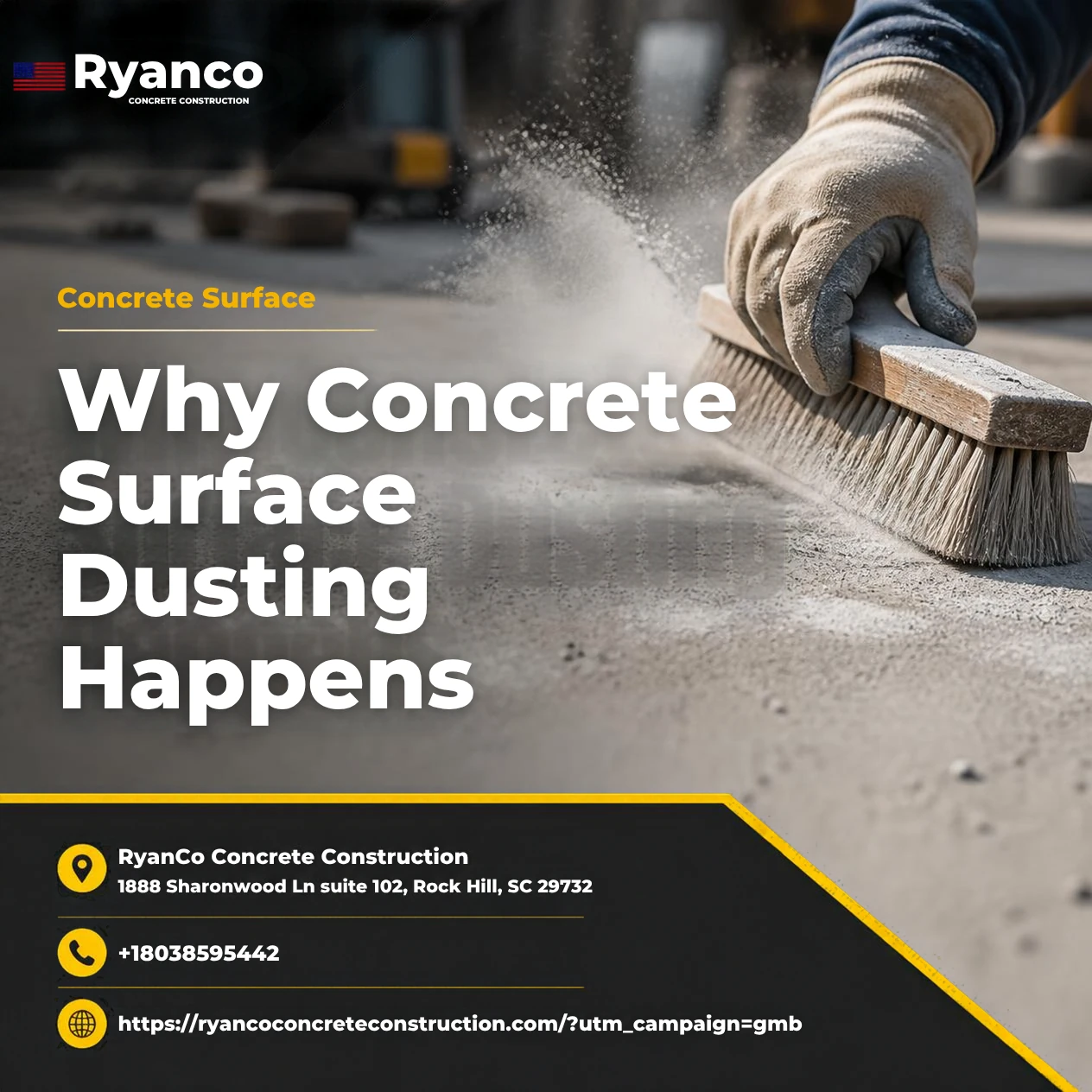
A concrete driveway, patio, garage floor, walkway, or slab should not continually produce fine powder simply from being walked or swept. When the top layer begins breaking down into a loose, chalky material, the condition is commonly known as concrete surface dusting.
Dusting usually means the surface layer is weaker than it should be. Improper finishing, excess water near the surface, finishing while bleed water is still present, inadequate curing, or exposure of fresh concrete to unfavorable conditions can all contribute.
The severity can vary considerably. A lightly dusty surface may primarily be a maintenance concern, while concrete that scratches easily, continuously sheds material, or shows deeper deterioration deserves a closer evaluation.
The important step is determining why the surface is weak before choosing a treatment. Cleaning away the powder alone does not necessarily correct the underlying problem.
What Is Concrete Surface Dusting?
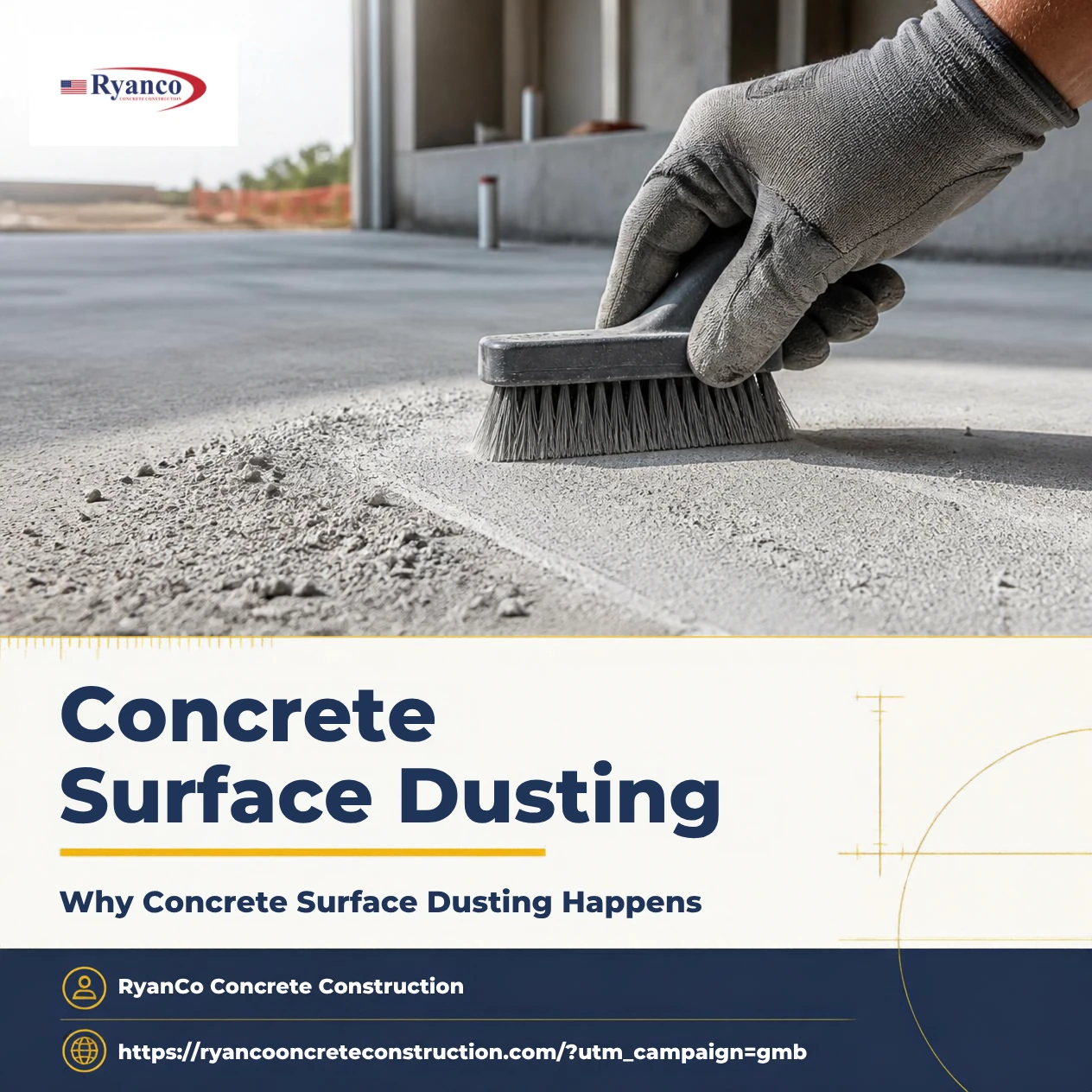
Concrete surface dusting is the formation of fine, loose powder as the hardened surface gradually breaks down.
You may first notice it when sweeping a garage floor or walking across a slab. Even after the surface has been cleaned, another layer of gray or whitish powder may appear.
NRMCA describes a dusting surface as one that powders under traffic and can often be scratched relatively easily because its wearing surface is weak.
Dusting can occur on several types of concrete, including:
- Garage floors
- Basement slabs
- Driveways
- Patios
- Walkways
- Sidewalks
- Commercial floors
- Other finished slabs
The dust itself is generally material from the concrete surface rather than ordinary household dirt.
That distinction matters.
If a slab becomes dusty because soil or construction debris is being tracked onto it, cleaning should solve the problem. If sweeping the slab actually removes fine particles of the concrete itself, the surface condition deserves more attention.
Why Does Concrete Surface Dusting Happen?
Concrete dusting usually develops because the top portion of the slab is weaker than the concrete underneath.
Several conditions can contribute.
Finishing While Bleed Water Is Still Present
Fresh concrete often releases some water toward the surface after placement. This is called bleed water.
Finishing concrete while that water is still sitting at the surface can work excess moisture back into the upper layer of the slab. That creates a higher water-to-cement ratio near the surface and can result in weaker concrete.
The slab underneath may remain relatively sound while the top layer becomes softer and more susceptible to abrasion.
This is one of the most important reasons proper finishing timing matters.
Adding Water During Finishing
Spraying or sprinkling water onto concrete simply to make finishing easier can weaken the surface.
The added water may become incorporated into the cement paste at the top of the slab, reducing surface strength.
Similarly, broadcasting dry cement onto bleed water in an attempt to absorb moisture can create an undesirable surface layer.
The goal during finishing is not simply to make the slab look smooth at the moment it is poured. The finishing process also affects how that surface performs after it hardens.
Inadequate Curing
Concrete continues developing its properties after finishing.
Proper curing helps maintain suitable moisture and temperature conditions so the cement can continue hydrating and the concrete can develop strength.
If the surface dries too quickly or receives inadequate curing, the top layer may not develop the durability expected from the slab.
A poorly cured surface can therefore become more vulnerable to wear, abrasion, dusting, and other defects.
Fresh Concrete Exposed to Bad Weather
New concrete is more vulnerable before it has developed sufficient strength.
Rain, snow, freezing conditions, or strong drying winds can negatively affect an inadequately protected surface.
For example, rain striking vulnerable fresh concrete may disturb the surface paste. Allowing freshly placed concrete to freeze can also weaken the surface.
Weather protection is therefore part of proper installation rather than something that only matters after the concrete has fully hardened.
Condensation During Finishing
Dusting can sometimes occur when moisture condenses on a cool concrete surface and is then worked into the concrete during finishing.
This may be more relevant for interior floors, basements, garages, or enclosed construction spaces where temperature and humidity differ significantly.
The visible moisture may look similar to ordinary bleed water but can still contribute to a weak surface if it is incorporated during finishing.
Carbonation During Construction
Certain enclosed construction conditions can also weaken a fresh concrete surface.
Combustion equipment such as improperly vented heaters or engines can release carbon dioxide. Under particular conditions, that gas may react with fresh concrete and reduce surface hardness.
This is one reason proper ventilation and construction practices matter when concrete is installed in enclosed areas.
Excessive Water in the Concrete
Concrete needs enough water for placement and hydration, but adding unnecessary water can reduce strength.
A mixture with excessive water can also bleed more heavily, making proper finishing more difficult.
Dusting is therefore rarely just a cleaning issue. It often traces back to how the concrete was mixed, placed, finished, protected, or cured.
What Are the Signs of a Dusting Concrete Surface?
The most obvious sign is powder that repeatedly returns after cleaning.
Homeowners may sweep the slab and notice a fine gray residue on the broom, shoes, tires, furniture, or nearby surfaces.
Other warning signs can include:
- A chalky appearance
- Fine powder forming under foot traffic
- Concrete that scratches unusually easily
- A soft or weak-feeling surface
- Persistent gray residue after sweeping
- Increasing roughness
- Fine surface material rubbing off by hand
- Visible wear in frequently traveled areas
Traffic can make dusting easier to notice because repeated abrasion removes additional weak material.
For example, a garage floor may show dusting more heavily where vehicle tires regularly travel. A commercial floor may produce more powder along walking or equipment routes.
Do not confuse every powdery deposit with dusting
White powder on concrete can also be caused by efflorescence.
Efflorescence occurs when moisture transports soluble salts toward the surface and leaves deposits behind as the water evaporates.
Dusting is different because the concrete surface itself is deteriorating.
If the material returns because the slab is wearing away rather than because mineral deposits are forming on top, the treatment approach may be different.
A professional evaluation can help distinguish between these conditions when the cause is unclear.
Does Concrete Dusting Get Worse Over Time?
It can.
If the surface layer is weak, normal foot traffic, tires, sweeping, equipment, and cleaning can continue wearing that material away.
As more of the weak layer disappears, the surface may become increasingly rough or uneven.
The progression depends on factors such as:
- Depth of the weak surface layer
- Amount of traffic
- Indoor or outdoor exposure
- Moisture conditions
- Cleaning methods
- Overall concrete quality
- Whether additional deterioration is present
A small amount of light dusting may stabilize once the weakest surface material wears away.
In other cases, the powder continues returning because deterioration extends deeper.
Watch for changes such as increasing roughness, visible aggregate, pitting, flaking, deeper erosion, or widespread material loss.
If those symptoms develop, the condition may involve more than light dusting.
It is also important not to use increasingly aggressive cleaning as the surface weakens. Heavy pressure washing, harsh abrasion, or aggressive grinding without understanding the condition may remove even more material.
Can Concrete Surface Dusting Be Fixed?
Sometimes, but there is no single treatment appropriate for every dusty concrete surface.
The correct option depends on the severity of the deterioration, the type of slab, its intended use, and how deep the weak material extends.
Cleaning and Evaluation
For mild dusting, the first step may be removing loose material and evaluating the surface underneath.
This helps determine whether the dusting is limited to a thin layer or whether the concrete remains weak after the loose material has been removed.
Cleaning by itself should not be confused with repair. If the powder keeps returning, the cause still needs attention.
Surface Treatments
Certain concrete densifiers, hardeners, coatings, or other professionally selected treatments may be appropriate for some sound but dusty surfaces.
Their suitability depends on the concrete condition and intended environment.
A treatment that works on an interior warehouse floor may not necessarily be the correct choice for an exterior driveway.
Surface preparation also matters. Applying a product over loose or unstable concrete can prevent proper performance.
Resurfacing
More extensive but relatively shallow deterioration may sometimes be addressed through resurfacing.
The weak material must be removed and the remaining concrete needs to provide a suitable base for the new surface.
Resurfacing cannot correct deeper slab movement, significant structural cracking, settlement, or other unrelated problems.
Repair or Replacement
If dusting occurs alongside severe deterioration, deep surface weakness, spalling, cracking, or widespread material loss, more significant repair may be necessary.
In some cases, replacing badly deteriorated concrete may provide a more practical long-term solution than repeatedly treating a failing surface.
The decision should be based on how much sound concrete remains, not simply on how dusty the slab appears.
How Can Proper Concrete Finishing Help Prevent Dusting?
Good concrete finishing is one of the most important ways to reduce the likelihood of a weak, dusty surface.
Timing matters.
Finishing operations should account for bleed water and the condition of the concrete rather than being rushed simply to complete the surface sooner.
Important principles include:
- Avoiding unnecessary water during finishing
- Allowing bleed water to disappear before appropriate finishing operations
- Avoiding dry cement sprinkled onto wet concrete
- Using a suitable concrete mixture for the project
- Protecting fresh concrete from damaging weather
- Providing appropriate curing
- Matching the finish to how the slab will be used
A driveway, garage slab, decorative patio, and interior floor may require different finishing approaches.
For example, broom finishes can provide texture for exterior walking and driving surfaces, while smooth troweled finishes may be used in other environments.
Professional concrete finishing is therefore not only about appearance. The finishing process influences surface texture, durability, wear resistance, and how the concrete performs during normal use.
Correct finishing cannot eliminate every possible concrete problem, but it can reduce preventable surface defects caused by poor timing or improper practices.
When Should You Call a Concrete Professional?
Light surface dusting does not always mean an entire slab must be replaced.
However, persistent or significant dusting should be evaluated when the concrete continues losing material despite routine cleaning.
Consider professional evaluation when:
- Powder returns quickly after cleaning
- The surface scratches very easily
- Large areas are affected
- Traffic is rapidly wearing the surface away
- The concrete has become rough or uneven
- Aggregate is becoming exposed
- Dusting occurs alongside scaling or spalling
- Deep cracks are also present
- The slab is settling or moving
- Previous treatments have failed
- You do not know whether the problem is dusting, efflorescence, scaling, or another surface defect
A concrete professional can evaluate whether the deterioration is limited to the finished surface or extends deeper into the slab.
If the surface is significantly deteriorated, concrete repair may involve resurfacing, localized restoration, or another approach based on the condition of the existing concrete.
For homeowners and property owners in Fort Mill, concrete dusting can affect garage floors, patios, slabs, walkways, driveways, and other finished surfaces. The appropriate response depends on where the concrete is located, how it is used, and how far deterioration has progressed.
The goal is not simply to stop seeing powder temporarily. It is to determine whether a weak surface can be stabilized or whether repair offers a better long-term solution.
FAQs
Why is my concrete producing dust?
A dusty concrete surface usually indicates that the top layer is weaker than it should be. Improper finishing, excess surface water, inadequate curing, unfavorable weather exposure, or other installation conditions can contribute.
Is concrete dusting normal?
A properly finished and cured concrete surface should not continuously produce significant powder during ordinary use. Very minor surface residue may occur for other reasons, but persistent concrete material rubbing away deserves attention.
Is concrete dusting the same as efflorescence?
No. Dusting involves deterioration of the concrete surface itself. Efflorescence consists of soluble mineral deposits left behind when moisture moves through concrete and evaporates at the surface.
Can you seal dusty concrete?
A sealer or coating should not simply be placed over loose, deteriorating material. The surface needs to be evaluated and properly prepared first. Some surfaces may benefit from an appropriate treatment after weak material has been addressed, but the right system depends on the concrete condition.
Can pressure washing fix concrete dusting?
No. Pressure washing removes material but does not strengthen weak concrete. Aggressive pressure can potentially remove additional surface material from concrete that is already deteriorating.
Does dusting mean the concrete needs replacement?
Not automatically. Some surface problems can be treated or resurfaced when the underlying concrete remains sound. Replacement becomes more likely when deterioration is deep, widespread, or accompanied by other substantial slab problems.
Can poor curing cause concrete dusting?
Yes. Inadequate curing can leave the concrete surface less durable and more vulnerable to abrasion. Proper curing helps concrete develop surface hardness and wear resistance.
Can dusting develop years after concrete is poured?
A weak surface may become more noticeable over time as traffic and abrasion gradually remove material. The underlying weakness may have originated during placement, finishing, or curing even if obvious dusting did not appear immediately.
Get a Lasting Solution for Dusting Concrete With RyanCo Concrete Construction
A dusty concrete surface is more than an inconvenience when the powder is coming from the slab itself. Persistent dusting can indicate that the finished surface is weaker than intended and may continue wearing under everyday traffic.
At RyanCo Concrete Construction, we help homeowners and property owners in Fort Mill and surrounding communities evaluate worn, weak, and deteriorating concrete surfaces.
Whether the issue involves finishing, surface wear, resurfacing, or more extensive concrete repair, our team can assess the existing slab and discuss an appropriate next step based on its actual condition.
The right solution starts with determining how deep the deterioration goes rather than simply sweeping away the powder each time it returns.
