
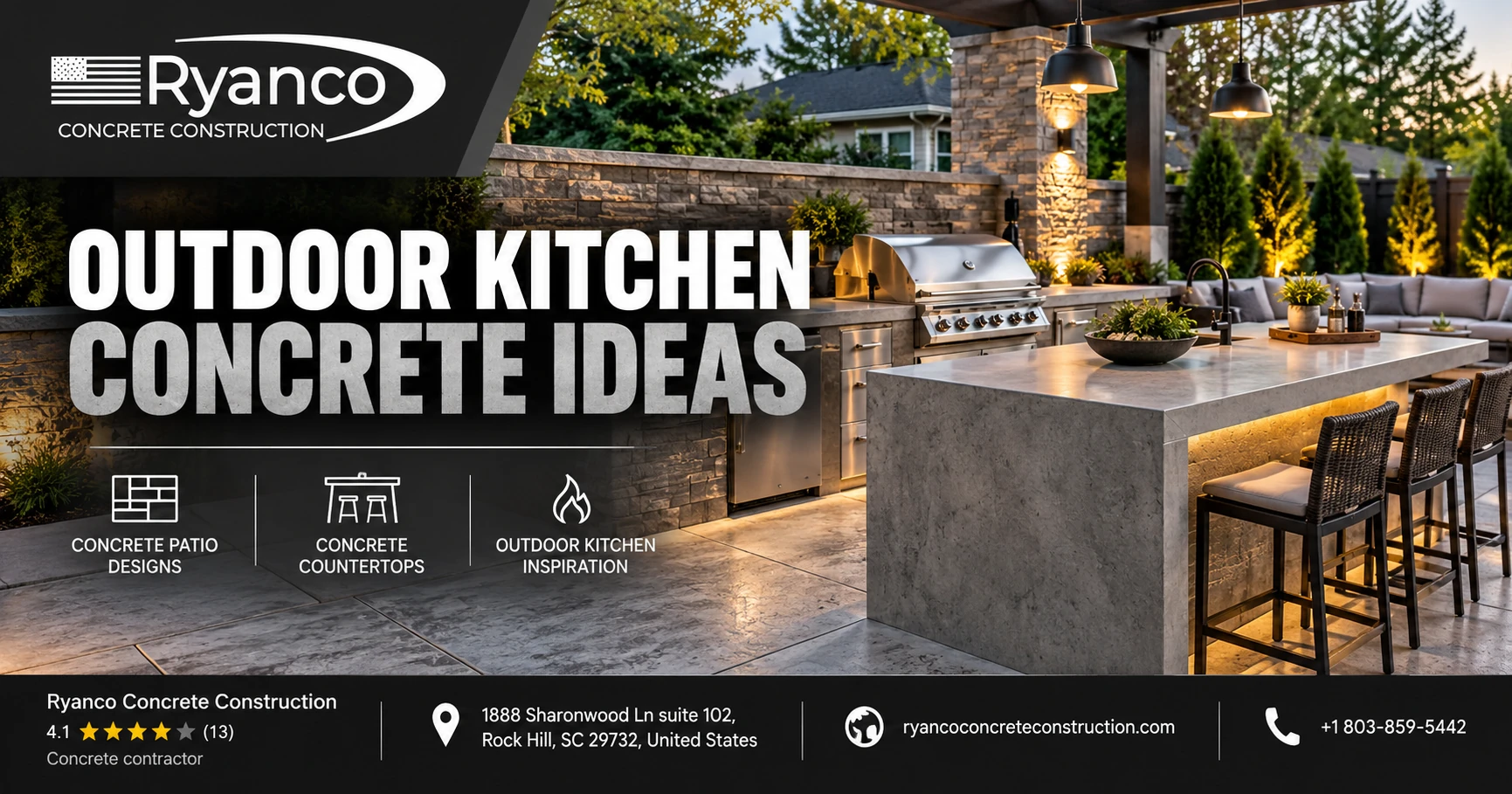
A well-designed outdoor kitchen should feel like more than a grill sitting on a patio. The best spaces connect cooking, dining, seating, landscaping, and entertaining into one backyard layout that feels comfortable to use.
Concrete works especially well as a design foundation because it can appear in several parts of the space. Homeowners can use it for the patio beneath the kitchen, countertops and serving areas, walkways, seating zones, decorative borders, and nearby gathering areas.
It also offers considerable design flexibility. Concrete can be kept simple with a traditional textured finish or customized with color, exposed aggregate, stamping, borders, and other decorative treatments. Concrete countertops can also be formed in different shapes, colors, textures, and edge styles to complement the rest of an outdoor kitchen.
The most successful design does not necessarily use concrete everywhere. Instead, it uses concrete strategically alongside stone, brick, wood, metal, landscaping, and outdoor furnishings to create an outdoor room that feels connected to the home.
Why Use Concrete in an Outdoor Kitchen?
Concrete can serve as both a structural surface and a design material, which makes it particularly useful around outdoor kitchens.
A concrete patio creates a stable foundation for grills, tables, chairs, cabinetry, and other outdoor features. Unlike a loose surface, it provides a continuous area where furniture can be positioned without individual units shifting underfoot.
The appearance can also range from simple to highly decorative.
A basic textured finish may work well for a casual backyard kitchen, while stamped or colored concrete can create a more customized entertaining area. Exposed aggregate can introduce natural stone texture, and contrasting borders can help separate one part of the patio from another.
Concrete countertops add another possibility. Their shape, color, texture, and edge details can be customized, giving homeowners opportunities to coordinate countertop design with the patio or surrounding hardscape.
Ryanco Concrete Construction currently offers several exterior finishing styles, including stamped concrete, exposed aggregate, broom finishes, and other decorative treatments in the Rock Hill and Fort Mill area.
Homeowners considering the surface beneath an outdoor kitchen can also explore Ryanco’s concrete patio services.
Concrete Patio Ideas for Outdoor Kitchens
Think of the patio as the floor of an outdoor room.
Instead of choosing the concrete finish first, begin by deciding where cooking, dining, walking, and seating will happen. Then design the patio around those activities.
One option is a large continuous patio with the outdoor kitchen positioned along one edge. This leaves the center open for a dining table and provides flexibility for furniture arrangements.
An L-shaped or wraparound patio can create a more defined outdoor room. One section might contain the kitchen while another becomes the main dining or conversation area.
For larger backyards, the concrete can also connect several destinations. A main patio might hold the outdoor kitchen, while a concrete walkway leads toward a fire pit, garden, pool, or secondary seating space.
Changes in color or finish can subtly distinguish areas without introducing physical barriers. For example, a neutral main slab could have a darker border around the cooking area or a different texture near the seating zone.
The goal should be visual organization without making the patio feel overly divided.
Concrete Countertop Ideas for Outdoor Cooking Spaces
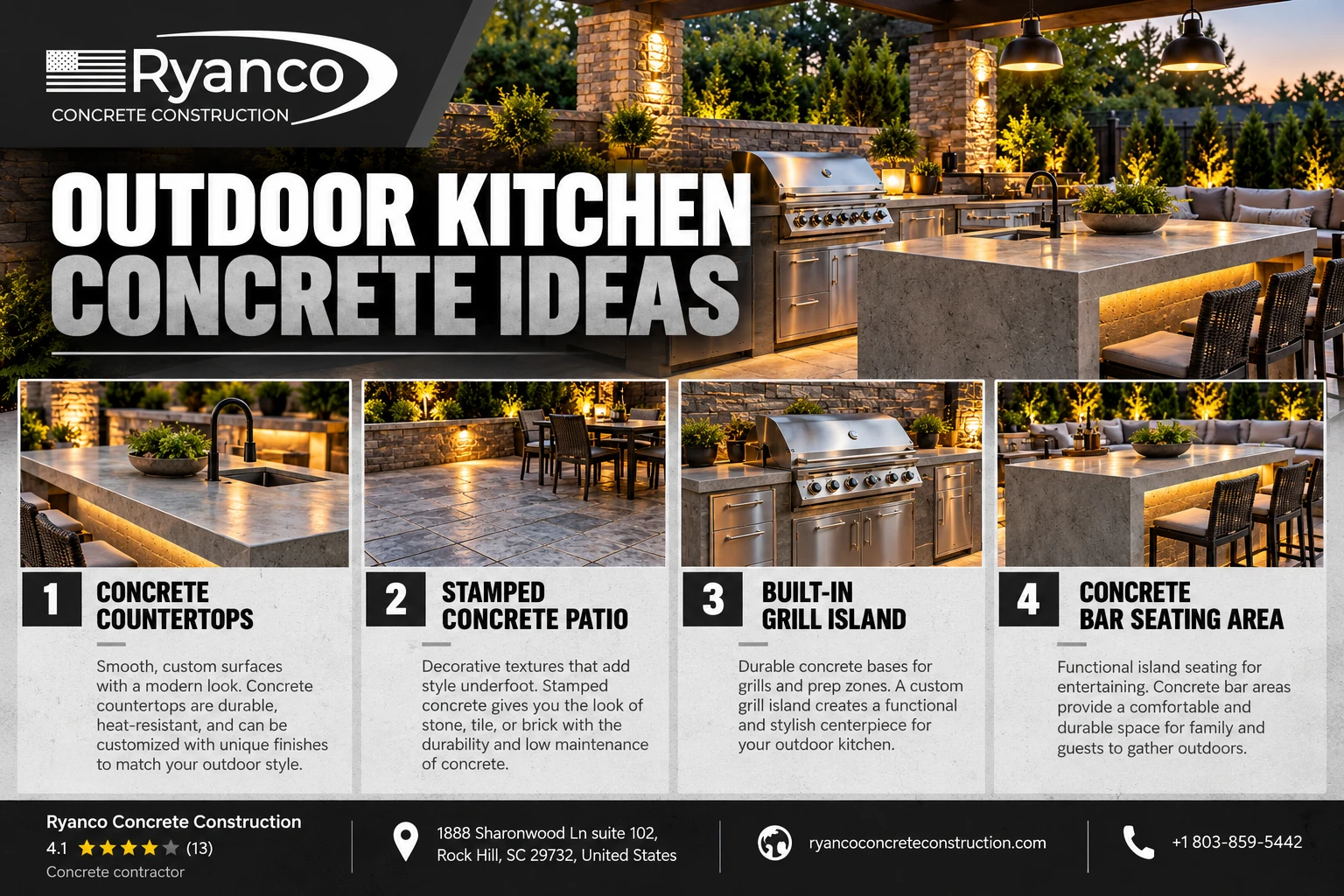
Concrete countertops can become one of the strongest visual features in an outdoor kitchen.
A simple straight counter works well for compact spaces and can provide room for preparation beside a grill. Larger kitchens might use an L-shaped counter to increase workspace while helping define the cooking area.
An island or peninsula can serve several functions at once. The cooking side can provide preparation space, while the opposite side becomes a casual serving or seating area.
Concrete countertops can also be personalized through color, texture, aggregate exposure, edge design, and other decorative treatments. Because concrete can be formed rather than cut only into predetermined slab dimensions, it provides considerable flexibility for custom shapes.
Visually, homeowners can either coordinate the countertop with the patio or deliberately create contrast.
A warm tan patio might pair with a darker charcoal countertop. A gray patio could work with a lighter countertop and natural stone veneer beneath it.
The countertop does not have to match the patio exactly. Often, a related but contrasting color creates more depth.
How to Use Stamped or Decorative Concrete
Decorative concrete can help an outdoor kitchen feel integrated with the architecture and landscaping instead of looking like equipment placed on a plain slab.
Stamped concrete can introduce patterns inspired by stone, slate, brick, or wood. This can work especially well when the goal is to create the character of a traditional hardscape while maintaining a concrete surface.
Exposed aggregate provides a different look. Rather than imitating another material, it reveals the aggregate within the concrete and creates visible texture.
Color can also transform a relatively simple patio. Warm browns and tans can complement stone, brick, and wood, while grays and charcoal tones can create a cleaner contemporary appearance.
Borders offer another way to add detail without covering the entire patio with a decorative pattern.
For example, homeowners might use a simple main field surrounded by a darker stamped border. Another option is to use decorative concrete only around the kitchen or dining area while leaving the rest of the patio more restrained.
Ryanco’s decorative concrete services provide a useful next step for homeowners comparing finish possibilities.
Best Concrete Colors and Finishes for Outdoor Kitchens
The right concrete color usually comes from the permanent materials already around the backyard.
Look at the home’s siding, brick, stone veneer, roofing, trim, retaining walls, and major landscape materials before choosing a color.
Warm beige, sandstone, taupe, and muted brown tones often coordinate naturally with wood and warm stone.
Light and medium grays can suit contemporary outdoor kitchens with stainless steel appliances, black fixtures, or modern furniture.
Charcoal works well as an accent but can become visually heavy when used across a very large patio.
Homeowners who want more variation can combine a base color with a darker border or subtle decorative accents.
Finish selection should consider function as well as appearance.
Cooking spaces are active areas where people carry food, move between appliances, and occasionally encounter wet surfaces. A practical outdoor finish should therefore balance visual interest with comfortable footing and cleanability.
Highly detailed decorative finishes can make sense in accent zones, while simpler textures may be easier to live with across high-traffic areas.
How to Create Defined Cooking, Dining, and Seating Zones
One of the most useful outdoor kitchen design principles is organizing the space by activity.
Outdoor-kitchen planning guidance commonly separates the kitchen into preparation, cooking, and serving zones rather than treating the entire counter as one undifferentiated workspace.
The larger patio can follow the same principle.
The cooking zone contains the grill, preparation surfaces, and kitchen equipment.
The dining zone provides space for a table or counter seating without blocking people working around the kitchen.
The seating zone creates a place to relax after food has been prepared.
Concrete can help distinguish these spaces visually. A border, saw-cut pattern, color change, or decorative finish can create separation without walls.
Recent outdoor-living design examples also show how geometry can break a large hardscape into distinct spaces for cooking, dining, and gathering instead of creating one oversized rectangle.
Good zoning should still allow the spaces to feel connected. Guests should be able to move naturally between the kitchen, table, and seating area without crossing directly through the cook’s workspace.
Concrete Ideas for Fire Pits and Gathering Areas
An outdoor kitchen often becomes more useful when the entertaining area extends beyond cooking and dining.
A nearby fire feature can create a second destination where guests gather before or after a meal.
The fire area does not have to be part of the exact same slab. A short concrete walkway can connect the kitchen patio to a separate circular or rectangular gathering area.
If both spaces use concrete, repeating one design element can tie them together. That might mean using the same base color, border color, exposed aggregate, or decorative texture.
Another option is contrast.
The kitchen area might use a clean rectangular layout while the gathering area uses a circular form or more natural stone-inspired finish.
Permanent fire features require appropriate placement and clearances for the specific appliance, surrounding structures, combustible materials, and applicable local requirements. Those details should be planned with the appropriate contractor or equipment manufacturer rather than treated only as a decorative decision.
How to Coordinate Concrete With Stone, Brick, and Wood
Outdoor kitchens often look more inviting when they combine several materials rather than relying on one finish everywhere.
Concrete and stone work especially well together because both can provide substantial visual weight without needing to match exactly.
For example, a simple concrete patio could surround an outdoor kitchen faced with natural or manufactured stone.
Brick can introduce warmth and traditional character. A brick home might use brick accents on the outdoor kitchen while keeping the patio concrete, creating continuity without making every surface identical.
Wood brings warmth to spaces that otherwise contain a great deal of masonry. Pergolas, privacy screens, furniture, ceiling details, and cabinetry can soften concrete and stone.
Metal also plays an important role. Stainless steel appliances, dark fixtures, railings, and outdoor lighting can create contrast against neutral concrete.
A useful design rule is to limit the number of dominant materials. Repeating two or three materials throughout the space generally creates a more connected result than introducing a different finish at every opportunity.
Low-Maintenance Outdoor Kitchen Design Ideas
Low-maintenance outdoor kitchens tend to rely on simple layouts and durable finishes rather than complicated decorative details.
A continuous concrete patio eliminates many individual joints found in unit-based paving systems. Choosing a moderate texture can also provide visual character without creating excessively deep areas where dirt and debris can collect.
Keep the color palette straightforward.
One main concrete color with one accent is often easier to maintain visually than several contrasting colors and patterns.
Think carefully about landscaping immediately beside cooking areas as well. Plants can soften the landscape, but excessive leaf drop or organic debris directly beside counters and grills can create additional cleanup.
Drainage should be part of the design from the beginning. Ryanco notes that grading and proper base preparation are important for preventing water and settlement problems in concrete flatwork.
Furniture selection matters too. Tables, stools, and seating designed for exterior use can reduce the amount of seasonal maintenance required throughout the overall space.
Low maintenance does not have to mean plain. The goal is to put decorative detail where it has the most visual impact instead of adding complexity across every surface.
How to Choose a Concrete Design That Fits Your Backyard
Start with how you actually plan to use the space.
A homeowner who mostly grills for a small family may need a relatively compact kitchen and dining patio. Someone who regularly entertains larger groups may benefit from separate cooking, dining, and conversation areas.
Next, consider the scale of the backyard.
A large outdoor kitchen can overwhelm a small yard, while a tiny cooking station may feel lost on a very large patio. The kitchen, patio, landscaping, and furniture should feel proportional to one another.
Then look at the home itself.
Repeat colors, shapes, or materials already present in the architecture. A traditional brick home may work well with warmer concrete colors and stone-inspired textures. A contemporary home may suit straighter lines, larger geometric sections, and a simpler gray palette.
Consider future plans as well. If a fire feature, pergola, hot tub, additional seating area, or landscape project may be added later, planning circulation and available space now can prevent the patio from feeling crowded.
Homeowners around Rock Hill can explore Ryanco Concrete Construction’s Rock Hill concrete services when considering how a patio or decorative concrete project might fit their property. Ryanco’s current site identifies patios, flatwork, and decorative finishes among its Rock Hill-area concrete services.
The strongest outdoor kitchen concrete ideas balance appearance with everyday use. Choose a practical layout first, then use concrete colors, textures, borders, countertops, landscaping, and complementary materials to give the space its personality.
FAQs
Is concrete a good surface for an outdoor kitchen patio?
Concrete can provide a stable, continuous surface for grills, counters, tables, seating, and foot traffic. It can also be finished in several ways, allowing the patio to range from simple and functional to highly decorative.
Can concrete be used for outdoor kitchen countertops?
Yes. Concrete countertops can be customized in shape, color, texture, finish, and edge design, making them suitable for many outdoor kitchen styles. Appropriate construction, finishing, and maintenance should be considered for exterior exposure.
What concrete finish works well around an outdoor kitchen?
The right finish depends on the desired appearance, maintenance preferences, and how the space will be used. Broom finishes provide a straightforward textured surface, while stamped concrete, exposed aggregate, and colored finishes can add more decorative character.
Should an outdoor kitchen patio use one concrete color?
Not necessarily. One primary color can keep the design cohesive, while a contrasting border or accent area can help define cooking, dining, or seating zones. Using too many unrelated colors may make the space feel visually busy.
Can stamped concrete work with an outdoor kitchen?
Yes. Stamped concrete can help create a stone-, brick-, slate-, or wood-inspired appearance around an outdoor kitchen. Homeowners should choose the texture and finish with both appearance and practical outdoor use in mind.
How should I plan an outdoor kitchen before installing the patio?
Identify the cooking, preparation, serving, dining, and seating areas first. Consider appliance locations, furniture, circulation, drainage, landscaping, and future additions before finalizing the concrete layout. Ryanco Concrete Construction can help homeowners evaluate patio and decorative concrete options for outdoor living projects.
