

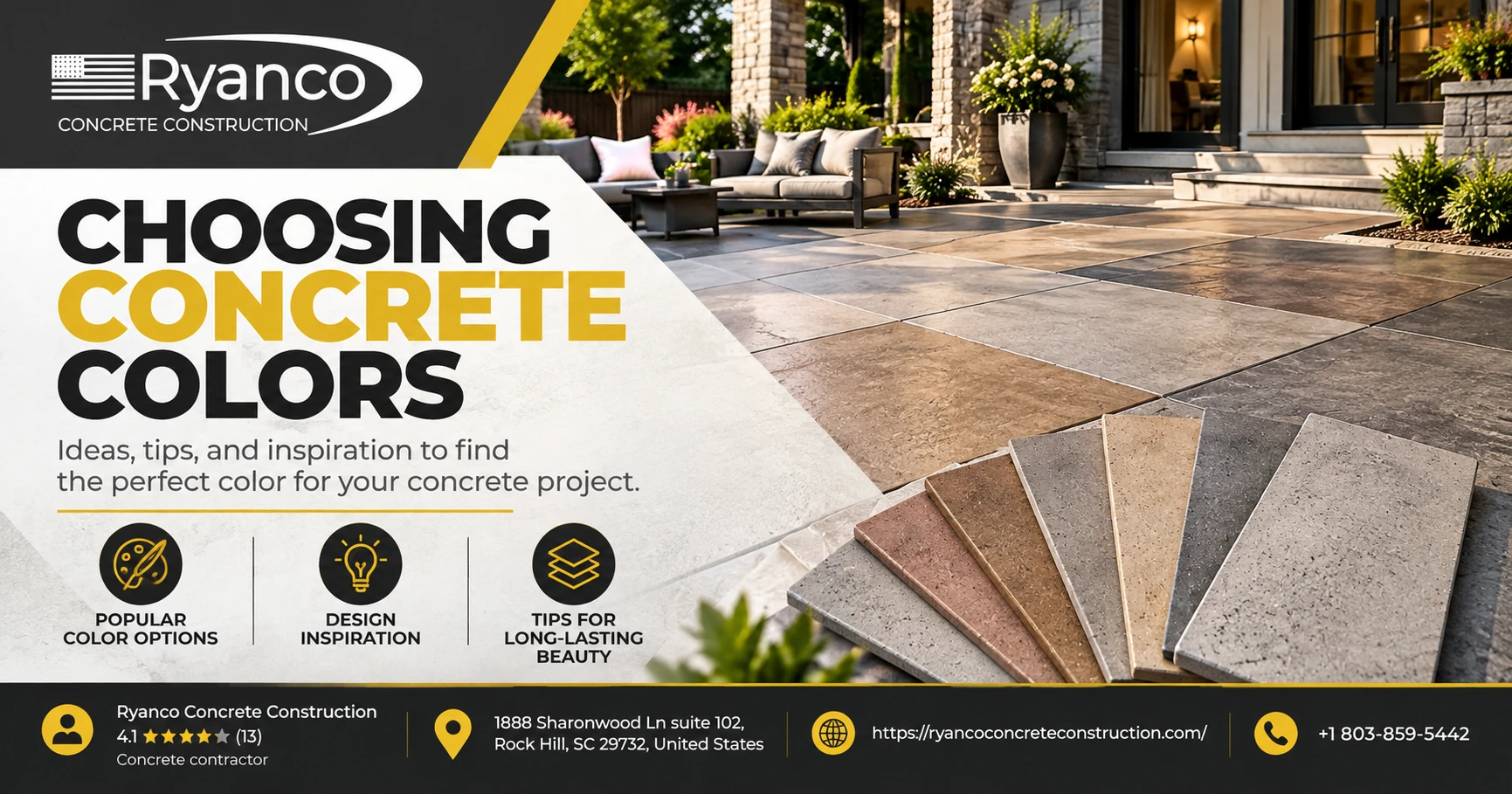
Choosing concrete colors can be more complicated than selecting a shade from a sample card. The same tan, gray, brown, or charcoal can look very different depending on the home beside it, the amount of sunlight it receives, the texture of the concrete, the coloring method, and whether the surface is sealed.
That is why a good concrete color should be evaluated as part of the entire property rather than as an isolated design decision.
For most homeowners, the safest approach is to start with permanent materials already around the project. Brick, siding, stone, roofing, trim, retaining walls, pool coping, and landscaping can provide useful color direction. From there, you can decide whether the concrete should quietly blend into those materials or create deliberate contrast.
Physical samples and test areas are also important. Concrete Network recommends against relying only on printed color charts because cement color, aggregates, water content, finishing, and coloring methods can all affect the final result.
Homeowners exploring broader finish possibilities can also review Ryanco Concrete Construction’s decorative concrete services.
What Concrete Colors Are Available?
Concrete can be colored in far more shades than standard gray.
Earth tones remain among the most common choices for residential exterior concrete because they coordinate naturally with brick, stone, wood, landscaping, and other building materials. Beige, sand, tan, buff, brown, taupe, terra cotta, charcoal, and multiple shades of gray are widely available.
More distinctive colors are possible as well. Depending on the coloring system, concrete can incorporate reds, greens, blues, darker blacks, and custom blended shades.
The available palette depends partly on how the concrete is colored.
Integral pigments commonly produce soft earth tones and muted colors because the pigment is blended throughout the fresh concrete. Acid stains generally create translucent, variegated earth tones such as tans, browns, terra cottas, and softer blue-green shades. Water-based stains offer a considerably wider color range.
Stamped concrete often combines a main base color with darker or lighter accent colors to reproduce the variation found in stone, slate, brick, or other materials.
Instead of starting with the question, “What color do I like?” begin with, “What color family works with this property?”
That usually produces a more cohesive result.
How Should You Choose a Concrete Color?
Start by identifying the permanent colors around the concrete.
Look at the home from several angles. Pay attention to siding, brick, stone veneer, trim, roofing, doors, retaining walls, existing walkways, and other hardscape.
You do not need to match every material.
Instead, look for undertones. A brick home may contain tan, brown, cream, charcoal, or red tones that can be repeated subtly in the concrete. A gray-sided home might pair naturally with soft gray concrete, but a warmer taupe can also keep the property from feeling too monochromatic.
Landscaping matters too.
Warm stone colors often work well with natural planting beds and wooded properties. Gray and charcoal palettes can complement contemporary landscaping with straight lines and dark architectural accents.
Next, consider how prominent the concrete will be. A large driveway occupies much more of the visual field than a narrow walkway. Large surfaces often benefit from quieter colors, while smaller accents can support stronger contrast.
Finally, review actual samples whenever possible.
Manufacturers’ charts are useful starting points, but field conditions can affect color. Concrete Network recommends creating or reviewing physical samples because cement, aggregate, mix proportions, curing, and finish can alter the result.
Should Concrete Match or Contrast With Your Home?
Concrete does not need to match the house exactly.
In many cases, an exact match can make the exterior look overly uniform. A related shade usually works better.
For example, a warm brick home may look balanced with sandstone, buff, taupe, or warm gray concrete rather than trying to reproduce the brick color exactly.
A light-colored contemporary home could use medium gray concrete to create subtle contrast. Dark borders might then repeat black windows, railings, or exterior fixtures.
Contrast works best when it looks intentional.
If the concrete is significantly darker or lighter than the home, repeat that color somewhere else in the landscape or architecture. Furniture, edging, stonework, planters, or exterior accents can help connect the surfaces visually.
Stamped-concrete color guidance similarly recommends selecting colors that coordinate with the home and its surrounding architectural elements rather than treating the pavement separately.
When uncertain, choosing a related neutral is generally easier to live with long term than a dramatic color that competes with the house.
How Do Sunlight and Shade Affect Concrete Color?
Always evaluate concrete colors where the finished project will actually be located.
A shade viewed indoors or under showroom lighting may look considerably different outdoors.
Direct sunlight can make lighter colors appear brighter and can reveal subtle variations within decorative finishes. Deep shade can make the same concrete look darker, cooler, or more muted.
The direction of the light also changes throughout the day.
A patio shaded in the morning may receive strong afternoon sun. A walkway beneath trees may look darker than an exposed driveway even if both use the same color.
Dark surfaces also tend to absorb more solar heat than lighter ones. This can matter on patios, pool decks, and other areas where people may walk barefoot or spend extended periods outside. Light exterior colors are commonly used around pools partly because they reflect more sunlight.
When reviewing a sample, look at it in morning light, midday sun, shade, and late afternoon if possible.
That provides a more realistic impression than making the decision from one photograph or indoor color card.
What Colors Work Best for Patios and Outdoor Living Spaces?
Outdoor living spaces usually benefit from colors that complement landscaping and furniture without becoming the dominant feature.
Warm neutrals such as sand, beige, buff, tan, and muted brown can create a relaxed look and pair naturally with wood, stone, greenery, and traditional home exteriors.
Gray remains another flexible choice.
Light and medium gray can work especially well with contemporary architecture, black fixtures, stainless steel outdoor kitchens, and modern furniture.
For a natural-stone appearance, consider using more than one tone. A neutral base color with subtle darker accents can create depth and variation instead of making the patio look completely uniform.
Stamped concrete frequently uses this approach. A lighter main color establishes the background while darker accent or antiquing colors define the texture.
Large patios usually benefit from restraint. Too many unrelated colors, borders, and decorative treatments can make the space visually busy.
One main color family with a complementary accent is often enough.
How Do Stains and Integral Colors Differ?
Integral color and concrete stain affect the material in different ways.
Integral pigments are mixed into fresh concrete before placement. Because the pigment extends throughout the slab rather than sitting only at the surface, normal surface abrasion does not simply remove the underlying color. Integral colors are commonly available in earth tones and softer shades.
Stains are applied to the concrete surface.
Acid stains react with the concrete and typically create translucent, variegated colors. Their palette tends to favor natural earth tones.
Water-based stains can offer a much broader range and may create effects ranging from translucent to more opaque depending on the product.
Staining is particularly useful when homeowners want to add or change color on existing concrete or create more visual variation.
Homeowners considering this approach can review Ryanco Concrete Construction’s stained concrete services for additional information.
The method should be chosen based on whether the concrete is new or existing, the appearance desired, exposure conditions, and maintenance expectations.
Can Concrete Color Fade Over Time?
The answer depends heavily on the coloring method and surface system.
Integral pigments are known for strong color stability because the pigment is distributed through the concrete rather than applied only to the surface. Concrete Network notes that integral pigments are chemically stable and resistant to weather and ultraviolet fading.
That does not mean colored concrete will always look identical to the day it was installed.
Surface wear, dirt, efflorescence, sealers, weather exposure, and normal aging can change the way color appears.
Stained or decorative surfaces may also change visually as sealers wear. Some sealers deepen color or create a wet-look effect, so the concrete may appear different as that coating ages.
Exterior dyes deserve special attention because some products are not sufficiently UV stable for outdoor use.
Ask which coloring product is being used and whether it is appropriate for the exposure conditions of your project rather than assuming every coloring system performs the same way outdoors.
How Do Texture and Finish Affect the Final Color?
Texture changes the way light reaches the concrete, which can significantly affect how a color appears.
A smooth surface reflects light differently from a broom finish, exposed aggregate, or heavily stamped texture.
Deep stamped patterns also create natural shadows. When darker release colors or stains settle into textured areas, the surface can appear much more varied than the original base color.
Exposed aggregate introduces another variable because the visible stone contributes its own colors to the finished surface.
Sealers can change appearance too.
Some sealers intensify color and create a darker or more saturated “wet look,” while others have less effect on the original tone. Concrete Network notes that certain acrylic sealers can enhance colored finishes and alter their apparent depth.
That means a color sample should ideally represent the actual finish and sealer being considered.
A smooth sample of beige concrete may not accurately demonstrate how the same pigment will look after stamping, antiquing, and sealing.
What Concrete Color Mistakes Should You Avoid?
The first mistake is choosing from a screen or printed chart alone.
Digital displays, printer settings, concrete ingredients, and lighting can all alter how a sample color appears.
The second is trying to match another material too precisely.
Concrete naturally contains variation, and attempting to reproduce an exact brick, siding, or stone shade can be disappointing. Coordinating colors are usually more forgiving.
Another mistake is choosing an extreme shade without considering the size of the surface. A color that looks attractive on a small sample may feel overwhelming across a large driveway or patio.
Do not ignore texture either. Stamping, exposed aggregate, staining, and sealing can all change the apparent color.
And avoid assuming that a stain will produce exactly the same result on every slab. Existing concrete conditions influence how surface-applied stains react or absorb. Test applications are strongly recommended before committing to the entire surface.
How to Choose a Color That Will Age Well
Timeless concrete colors usually come from the property itself rather than from a short-lived trend.
Look for a shade already present in the house, stonework, landscape, or other permanent material and use it as a starting point.
Then keep the main concrete area relatively restrained.
Browns, tans, warm grays, cool grays, taupes, sandstone tones, and similar neutrals are common for residential concrete because they adapt to changing furniture, planting, and exterior décor.
If you want a stronger color, consider using it as an accent rather than throughout the entire slab.
A dark border around a neutral patio or subtle secondary color within stamped texture can provide visual interest without dominating the property.
Most importantly, review samples under real site conditions.
For larger decorative projects, ask whether the contractor can provide a physical sample, previous project examples, or a small test area using the proposed finish. Concrete guidance recommends mockups and trial applications because they provide a more reliable expectation of final color than charts alone.
Homeowners planning colored concrete in the area can also review Ryanco Concrete Construction’s Fort Mill concrete services. Ryanco currently identifies decorative, stained, stamped, and colored concrete options among its Fort Mill offerings.
A color that works with the home today and can accommodate future landscaping, furniture, and exterior updates will usually age better than a highly specific trend.
FAQs
What is the most popular color for concrete?
Neutral earth tones and grays are widely used for residential concrete because they coordinate easily with common building and landscape materials. Concrete color guidance identifies natural earth tones among the most popular homeowner choices.
Should concrete be lighter or darker than the house?
Either can work. The goal is coordination rather than a strict rule. Light concrete can create contrast beside darker homes, while medium or darker concrete may provide definition beside lighter siding. Consider undertones and surrounding materials before choosing.
Does concrete look lighter after it dries?
Concrete appearance changes as it cures and dries, and sealers or decorative treatments can alter the apparent depth of color afterward. For colored projects, rely on properly prepared cured samples rather than judging fresh concrete.
Can you stain concrete a different color later?
Many existing concrete surfaces can be stained or recolored if they are properly prepared and compatible with the intended coloring system. The final result depends on the existing concrete, previous coatings, porosity, and chosen stain. A test area is recommended.
Should I choose a concrete color from a photo?
Photos are useful for inspiration but should not be the final decision tool. Camera settings, lighting, screens, concrete ingredients, and finishing methods can all change color appearance. Review physical samples whenever practical.
What is the safest concrete color if I am unsure?
A neutral tone that coordinates with permanent materials around the home is usually the easiest starting point. Bring siding, brick, stone, and landscape colors into the decision, then review physical samples in the actual project location before finalizing the color.
