
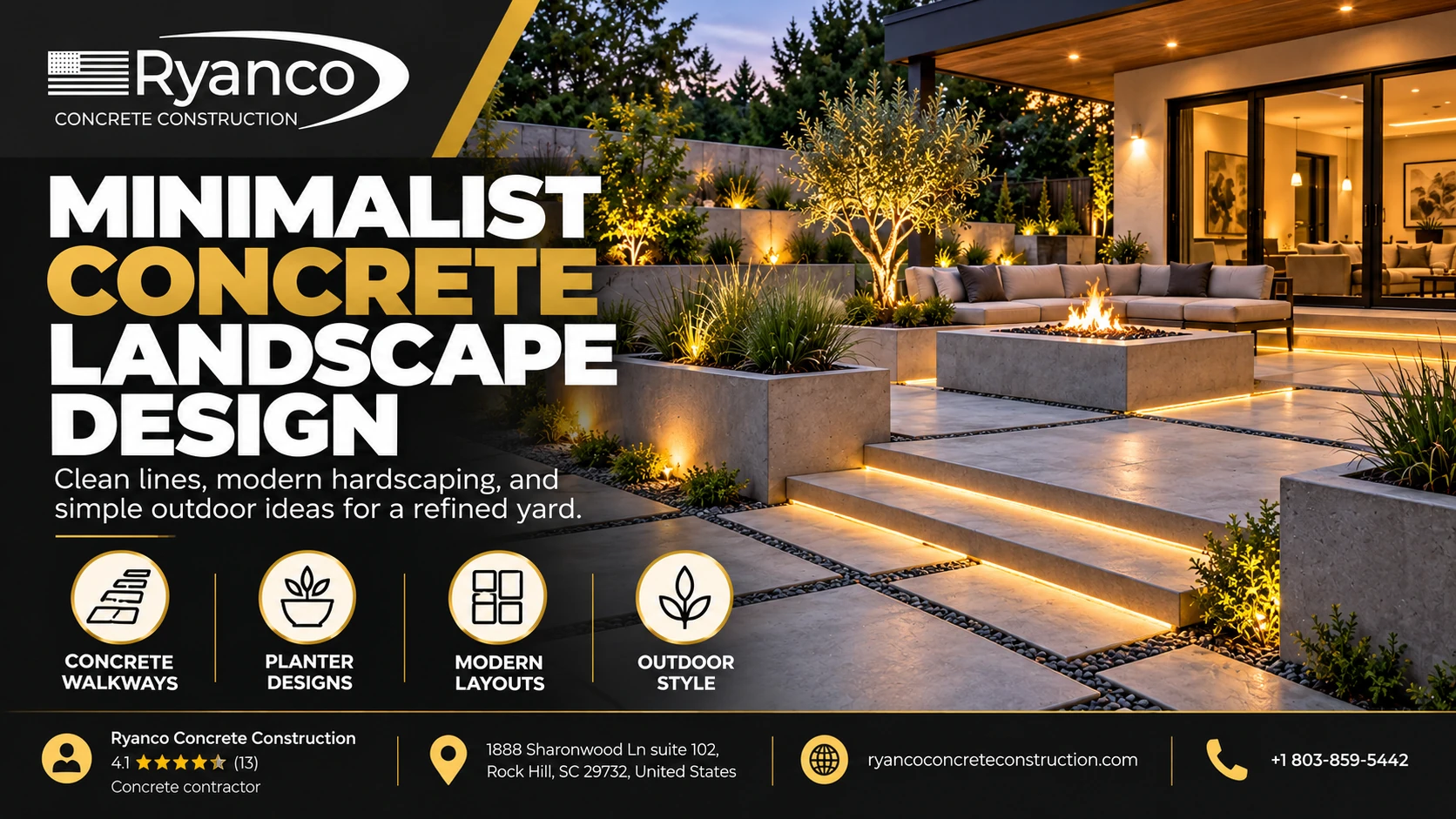
Minimalist concrete landscape design is less about making a yard empty and more about making every element feel intentional. Instead of filling an outdoor space with many materials, colors, borders, and decorative details, a minimalist plan relies on clear geometry, repeated forms, restrained colors, and a balanced mix of hardscape and planting.
Concrete works especially well for this approach because it can create patios, walkways, borders, steps, and defined outdoor zones without introducing a different material for every function. Contemporary landscape examples frequently combine concrete with gravel, lawn, ornamental grasses, wood, and simple planting beds to create contrast while keeping the overall composition calm.
What Makes a Concrete Landscape Design Feel Minimalist?
A minimalist landscape usually has a limited material palette and a clear visual hierarchy.
Concrete may form the main patio and walkway system, while gravel, grass, or planting beds provide contrast. Instead of changing colors and finishes repeatedly, the same concrete tone may appear throughout the yard to connect different areas.
Geometry is another major feature. Straight lines, rectangular planting beds, broad steps, and large concrete sections create order. Even when curves are used, they are usually deliberate rather than scattered through the design.
Contemporary landscape references commonly use concrete, gravel, geometric planting beds, and restrained plant palettes together. The effect comes from proportion and repetition rather than ornament.
Minimalism also depends on what is left out. Too many stamp patterns, colors, edging materials, plant varieties, or small decorative objects can compete for attention.
Homeowners who want to explore customized finishes without making the space visually busy can review Ryanco Concrete Construction’s decorative concrete services.
How to Use Clean Lines in Outdoor Spaces
Clean lines help organize the yard and make different outdoor zones feel connected.
Start with the architecture of the house. Exterior walls, windows, doors, rooflines, and existing walkways can provide reference lines for new concrete. Extending those lines into the landscape often makes the outdoor space feel like a continuation of the home.
A walkway might run directly from the driveway to the front entry instead of wandering through several curves. A patio edge can align with the back wall of the house. Rectangular planting beds can repeat the dimensions of nearby concrete sections.
Contemporary path design often favors direct routes, straight lines, smooth textures, and materials such as concrete, gravel, and metal.
Clean does not mean perfectly symmetrical. An offset walkway or asymmetrical patio can still look minimalist if the geometry is simple and repeated elsewhere.
Minimalist Concrete Patio Ideas
A minimalist patio works best when the layout is simple enough to let furniture, landscaping, and the home provide most of the character.
One approach is a single rectangular slab with a light broom finish. The patio can then be divided into dining and lounge areas through furniture placement rather than multiple surface patterns.
Another option is a series of large concrete sections separated by narrow gravel or planted joints. This creates rhythm while reducing the visual weight of one uninterrupted slab.
A floating-patio look can also work in contemporary yards. Large concrete areas separated by river rock or gravel create clear boundaries while preserving a restrained material palette.
Light gray, warm gray, taupe, sand, and other neutral tones usually provide enough variation without dominating the yard.
How Concrete Curbing Can Define Landscape Zones
Concrete curbing can create clear edges between lawn, gravel, mulch, planting beds, driveways, and walkways.
That makes it useful in minimalist landscapes, where strong boundaries help each material read as a deliberate shape rather than blending into neighboring areas.
A low concrete edge can separate a rectangular planting bed from the lawn. A straight curb can contain decorative gravel beside a walkway. Curved curbing can still work, but broader, simpler arcs usually fit minimalist design better than many small bends.
Ryanco’s current curbing service describes concrete curbing as a way to define gardens, walkways, and other landscape areas, with options for smooth, colored, or stamped finishes. It also notes that curbing can help manage water flow in appropriate applications.
Homeowners considering permanent landscape borders can review Ryanco Concrete Construction’s concrete curbing services.
Best Concrete Colors for a Minimalist Look
Neutral colors generally work best because they allow plants, architecture, and furniture to stand out.
Light gray creates a crisp, contemporary base and pairs easily with dark metal, wood, green planting, and light-colored homes.
Medium gray adds stronger contrast and can work well with white siding, black windows, charcoal roofing, or steel landscape accents.
Warm gray and taupe soften the look of concrete and often coordinate well with natural stone, wood fences, and warmer exterior colors.
Sand and muted beige can create a minimalist landscape without making it feel cool or industrial.
The most effective color usually relates to a permanent material already on the property. Concrete does not need to match the home exactly, but repeating an undertone from brick, stone, siding, or roofing can make the yard feel more cohesive.
How to Combine Concrete With Gravel, Grass, and Plants
Minimalist landscapes become more inviting when hard concrete is balanced with softer or more textured materials.
Gravel is one of the easiest companions. It can fill narrow joints between concrete sections, border a path, surround a planting bed, or create a low-maintenance transition between hardscape and vegetation.
Current contemporary landscape examples often pair concrete pavers or slabs with gravel and restrained planting because each material defines a clear zone without overwhelming the others.
Grass provides a stronger color contrast. Narrow lawn strips between concrete pads can emphasize geometry, while a simple rectangular lawn can soften a broad patio.
Plants should be chosen with the same restraint as the hardscape. Instead of installing many unrelated species, repeat a smaller number of plants in groups. Ornamental grasses, structured shrubs, groundcovers, and a few architectural plants can create texture without visual chaos.
How to Use Repetition and Simple Geometry
Repetition is one of the easiest ways to make a minimalist landscape feel intentional.
If a walkway uses large rectangular concrete pads, repeat similar proportions in a patio or stepping path. If one planting bed is edged with a straight concrete border, use the same detail elsewhere instead of introducing a new edging material.
Squares and rectangles are particularly effective because they create a clear visual rhythm. Large uniform paving sections can also make an outdoor space feel more organized and, in some layouts, visually larger.
Repetition also applies to plants and furnishings. Using the same planter shape, grass variety, or lighting style in several locations can make the yard feel calmer.
A row of rectangular concrete pads can pass through loosely planted grasses. A highly structured patio can face a more natural tree line. Minimalist design often works best when precise hardscape is balanced against softer landscape forms.
Use a small vocabulary of shapes, then repeat it consistently.
Minimalist Walkway and Border Ideas
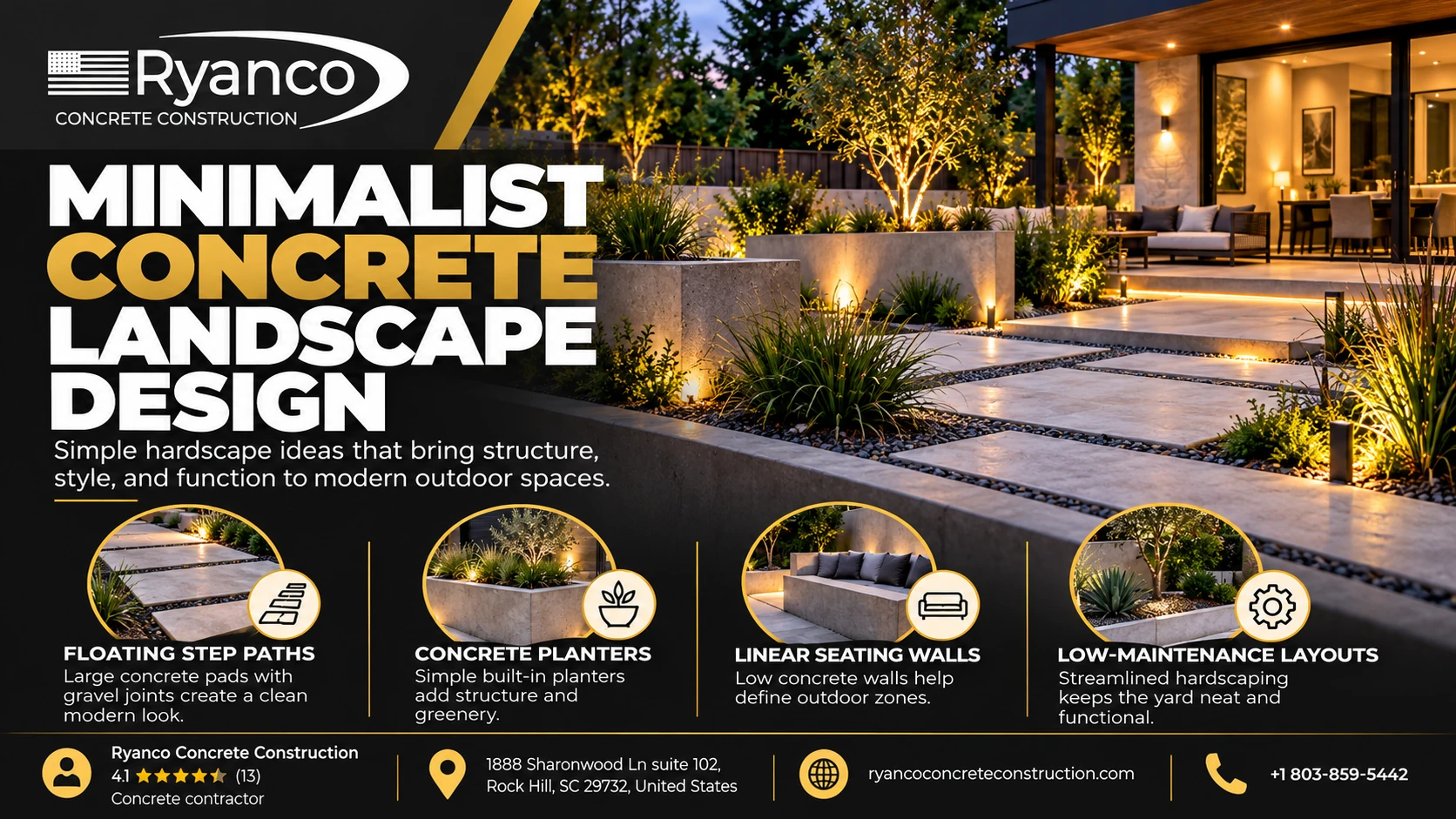
A minimalist walkway should make the route obvious without demanding too much attention.
Large rectangular concrete pads set in gravel create a clean stepping pattern. Concrete sections surrounded by grass can produce a softer variation of the same idea.
For higher-traffic routes, a continuous poured walkway may be more practical. Straight edges and a simple broom or lightly textured finish can keep the appearance clean while providing a comfortable walking surface.
Contemporary walkway references frequently use direct paths, offset rectangular pavers, gravel, and simple metal or concrete edging.
Borders should be equally restrained.
A low concrete curb can define mulch or gravel without creating a tall visual barrier. Where several planting areas are present, repeating the same border height and finish helps unify the yard.
Consider how the walkway looks from inside the house as well. Strong geometric paths can become part of the view through large windows and doors, making the landscape feel connected to the architecture.
What Design Mistakes Can Make a Minimalist Yard Feel Too Harsh?
The biggest mistake is confusing minimalism with removing everything soft.
A yard dominated by large concrete surfaces, bare walls, and dark furniture can feel severe if there is not enough planting, texture, shade, or warmth to balance the hardscape.
Another problem is using only one texture. Even when the color palette is limited, gravel, grasses, wood, foliage, and stone can introduce subtle variation.
Scale matters too. Oversized slabs may look impressive in a large yard but overwhelm a compact property. Tiny concrete pads can create the opposite problem, making a large landscape feel fragmented.
Avoid excessive symmetry when it does not serve the space. Minimalist design should feel ordered, not forced.
Color can also make a yard harsher. Large areas of very dark concrete may feel visually heavy and can absorb more heat in sunny locations. Warm neutrals or lighter grays may create a softer result.
Finally, do not sacrifice function for a clean photograph. Walkways still need practical routes, patios need comfortable furniture space, and drainage needs to work.
How to Balance Hardscape and Softscape Elements
Start by identifying what the concrete needs to accomplish.
Patios provide usable living space. Walkways connect destinations. Borders separate materials. Steps manage grade changes. Once those functional areas are defined, use planting and other softscape elements to frame them.
Avoid covering every available part of the yard with hardscape. Leaving deliberate areas for lawn, planting beds, trees, or groundcover can make the concrete feel more important because it has visual breathing room.
Use plants to soften transitions. Ornamental grasses beside a straight walkway can introduce movement. Low shrubs can frame a patio without blocking views. A specimen tree can provide shade and become the main natural focal point.
Gravel works well between the two categories. It has the clean visual character of a hardscape but a softer texture than a solid slab.
Contemporary projects often use concrete, gravel, planting, and wood together because each material can define a distinct zone while remaining part of one composition.
For homeowners around Fort Mill, Ryanco Concrete Construction’s Fort Mill concrete services can provide a local starting point when planning concrete features within a larger landscape.
The most successful minimalist concrete landscape design does not try to make concrete disappear. It gives the material a clear role, then surrounds it with enough texture, planting, and open space to make the entire yard feel balanced.
FAQs
Is concrete good for minimalist landscaping?
Yes. Concrete works well in minimalist landscapes because it can create patios, walkways, borders, and defined zones with consistent color and geometry. The best results usually balance the concrete with plants, gravel, lawn, wood, or other softer materials.
What colors work best for minimalist concrete landscapes?
Light gray, medium gray, warm gray, taupe, sand, and muted beige are versatile choices. The best color should coordinate with permanent materials on the home and surrounding landscape rather than following a trend in isolation.
Can concrete curbing look modern?
Yes. Simple concrete curbing with clean lines and a restrained finish can define lawn, gravel, and planting beds without adding unnecessary decoration. Ryanco currently offers smooth, colored, and stamped curbing options for landscape borders.
How do you keep a concrete landscape from looking too plain?
Use contrast through texture rather than adding many colors. Gravel, ornamental grasses, shrubs, wood, stone, lighting, and carefully selected furniture can add warmth while preserving a minimalist composition.
Are straight walkways always better for minimalist yards?
No. Straight routes are common because they reinforce clean geometry and direct circulation, but a simple broad curve can work when it responds to the house, grade, trees, or another site feature. The important factor is intentionality.
How many materials should a minimalist landscape use?
There is no fixed number, but a limited palette is easier to coordinate. Concrete plus one or two supporting materials such as gravel, wood, grass, or stone is often enough to create contrast without making the yard feel visually crowded.
