
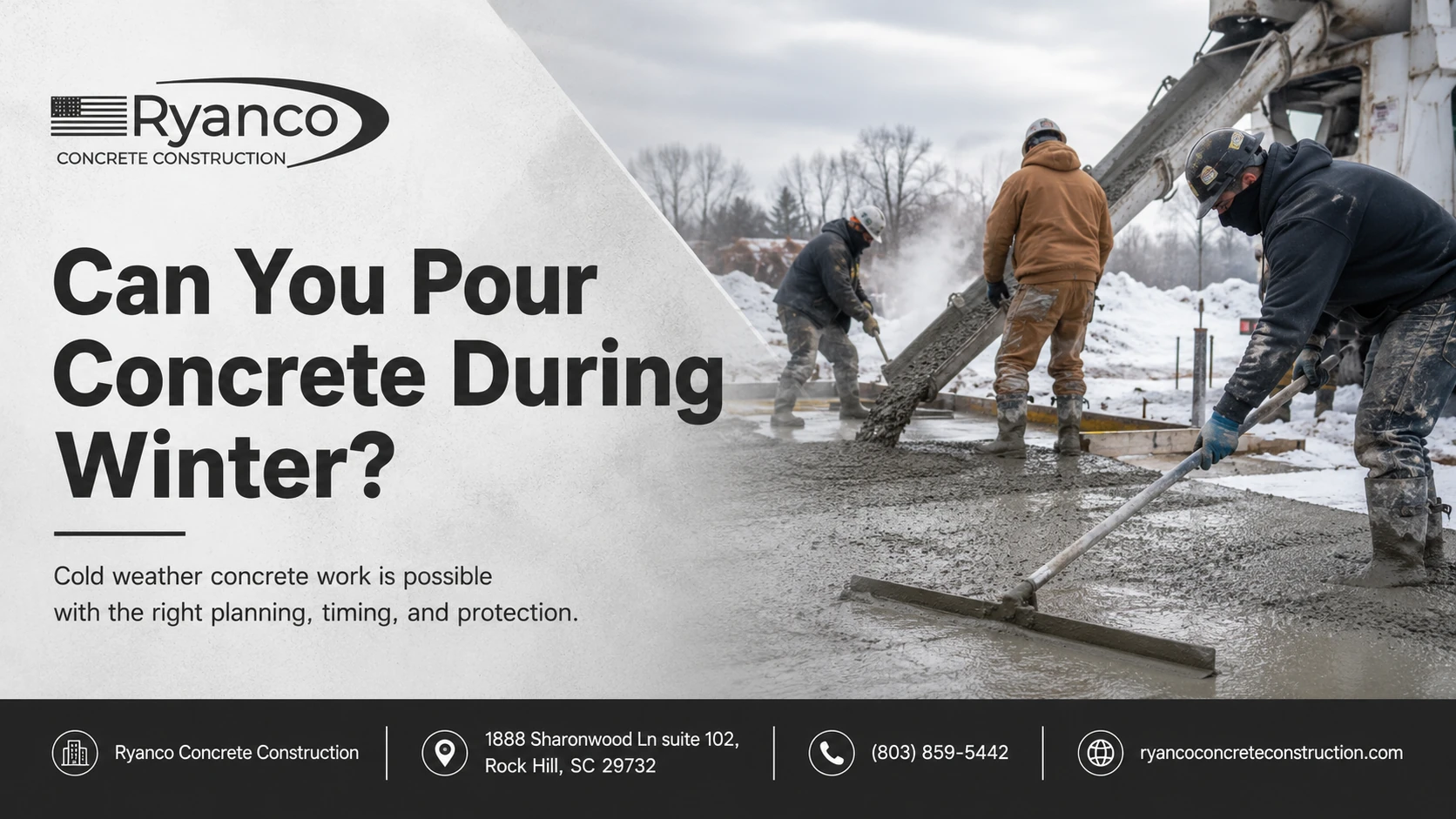
Yes, concrete can often be poured during winter, but colder weather makes planning, placement, and curing more important. A driveway, patio, sidewalk, or slab does not automatically need to wait until spring simply because temperatures have dropped.
The bigger question is whether conditions can be managed safely during placement and the critical early period afterward. Cold temperatures slow the chemical reactions that help concrete develop strength, while frozen ground, snow, ice, and sudden overnight temperature drops can interfere with a successful installation. Industry guidance emphasizes protecting fresh concrete from early freezing and maintaining conditions that allow normal strength development.
For homeowners wondering can you pour concrete during winter, the answer depends on the specific project, forecast, site conditions, concrete mixture, and protective methods available. A professional contractor should evaluate the full weather window rather than relying only on the daytime temperature.
Can You Pour Concrete During Winter?
Concrete work can continue during colder months when the contractor can properly prepare the site and protect the concrete after it is placed.
Winter concrete installation usually requires more planning than the same project under moderate conditions. Contractors may adjust the timing of the pour, coordinate a suitable concrete mixture, prepare the base carefully, and use insulating materials or other protective measures after finishing.
The type of project matters too. A small sidewalk, large driveway, backyard patio, and structural slab may have different exposure, access, finishing, and curing requirements.
A contractor also needs to consider what happens after the concrete truck leaves. Temperatures may be acceptable during afternoon placement but fall sharply overnight. Because concrete develops strength over time rather than becoming fully durable as soon as the surface looks hard, those later conditions matter.
The practical answer is therefore yes, winter concrete is possible, but only when the entire placement and early curing period can be managed appropriately.
What Happens to Concrete in Cold Weather?
Concrete hardens through hydration, a chemical reaction between cement and water. Temperature affects how quickly that reaction occurs.
When conditions become colder, concrete generally sets and develops strength more slowly. NRMCA cold-weather guidance notes that lower temperatures increase setting time and reduce the early rate of strength development.
That slower development can affect several parts of a project.
Finishing may take longer. The concrete may need protection for a longer period. Contractors may need to delay loading or other follow-up work. A cold overnight period may also become more important because the concrete may still be developing the early strength needed to better resist freezing.
Cold air is only one concern. The surface receiving the concrete matters as well.
Concrete should not be placed directly on frozen subgrade. If frozen soil later thaws and shifts, the slab may lose uniform support and become more vulnerable to settlement or cracking. Industry guidance also calls for removing snow and ice before placement.
That is why winter concrete planning starts below the finished surface, not just with the temperature of the air.
Why Does Temperature Matter When Concrete Is Curing?
Freshly placed concrete may look solid relatively quickly, but strength development continues long after the visible surface has firmed.
Cold temperatures slow that process.
During warmer, controlled conditions, hydration progresses more quickly and the concrete gains early strength faster. In colder weather, the same development can take longer, which increases the importance of maintaining appropriate conditions after placement.
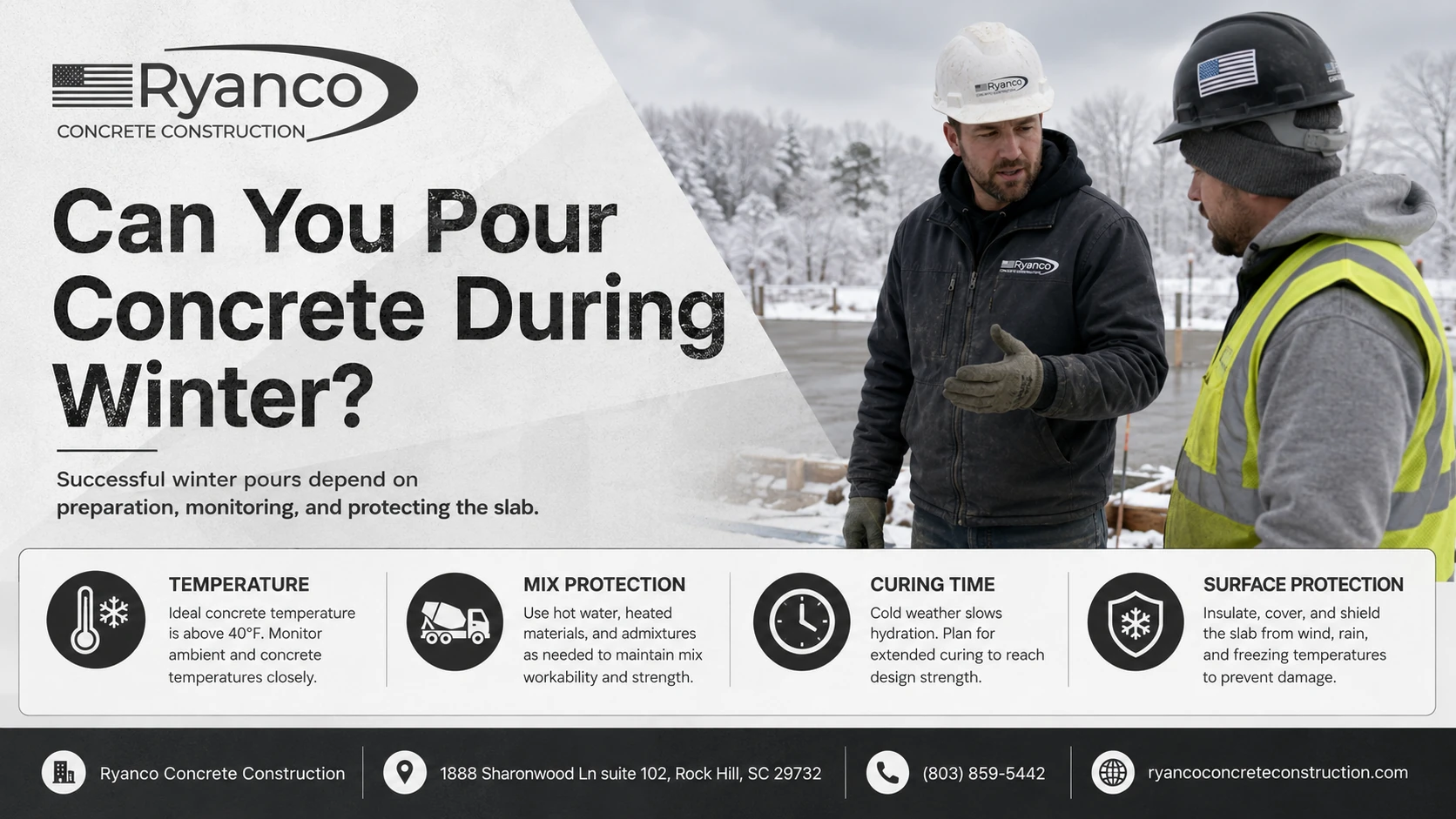
The goal of winter protection is not simply to keep the surface comfortable to touch. It is to prevent harmful early freezing and support the chemical process that develops the concrete’s intended strength and durability.
ACI guidance for cold-weather concreting identifies several objectives, including preventing early freezing damage, maintaining curing conditions that support strength development, limiting rapid temperature changes, and providing adequate protection while the concrete is young.
For homeowners, this means curing instructions should be taken seriously even if a new driveway or patio appears finished. Appearance does not tell you how much internal strength has developed.
Your contractor should provide guidance on when the surface can be walked on, driven on, loaded, uncovered, or otherwise put into normal use.
What Are the Risks of Pouring Concrete During Winter?
Cold-weather concrete can perform well when properly managed, but winter introduces several risks that contractors need to account for.
Common concerns include:
- Early freezing: Fresh concrete that freezes before developing adequate early strength can suffer permanent damage.
- Frozen ground: Concrete placed over frozen soil may lose support as the ground thaws.
- Snow and ice: Frozen moisture on the base, forms, or work area can interfere with preparation and placement.
- Slower strength development: Cold temperatures can extend the period during which concrete needs protection.
- Rapid temperature changes: Abrupt cooling can create additional stress in newly placed concrete.
- Changing forecasts: Conditions that appear acceptable at the start of the day may become unfavorable overnight.
- Wet or unstable subgrade: Winter precipitation can leave the base saturated, muddy, or difficult to compact properly.
- Finishing delays: Slower setting can affect the timing of finishing operations and extend the workday.
NRMCA guidance specifically recommends protecting concrete from frost, freezing, and low-temperature conditions that could reduce strength, and advises against placing concrete on frozen materials or surfaces containing snow and ice.
These risks do not mean every winter project should be postponed. They mean the contractor needs a clear plan before placement begins.
Can Concrete Freeze Before It Cures?
Yes. Fresh concrete can freeze before it has developed enough early strength to resist damage.
NRMCA guidance notes that fresh concrete can freeze when its own temperature falls low enough and recommends protecting it until it reaches sufficient early compressive strength. Early-age freezing can significantly reduce the concrete’s future strength and durability.
This is one reason homeowners should not focus only on whether the forecast technically shows a freezing air temperature.
The temperature of the concrete itself, the surrounding surfaces, wind exposure, protection methods, project thickness, and duration of the cold period can all influence the situation.
The risk is highest during the early stage after placement because the material has not yet developed much strength.
Once concrete has gained sufficient strength, it is better able to tolerate normal winter exposure. That does not mean curing is complete or that the slab is ready for unrestricted use. It simply means the risk associated with early freezing changes as the concrete matures.
A professional contractor plans protection around the actual project rather than waiting to see whether freezing becomes a problem afterward.
How Do Contractors Pour Concrete in Cold Weather?
Professional cold-weather concrete work focuses on controlling as many variables as possible.
It begins with site preparation. Contractors need a stable base free of frost, snow, ice, and standing water. If the subgrade is frozen, placement may need to be delayed or the site may need appropriate preparation before work can continue.
The concrete mixture itself may also be selected with colder conditions in mind. Depending on project specifications, suppliers and contractors may use mixture adjustments or approved accelerating admixtures to support earlier setting and strength development. NRMCA guidance identifies accelerating admixtures as one tool commonly used in cold-weather concrete work.
Scheduling can make a difference as well. A contractor may select a more favorable portion of the day while also reviewing expected conditions overnight and during the next several days.
After placement and finishing, protection may include insulating blankets, enclosures, or other methods intended to retain heat and prevent the concrete from cooling too quickly.
Good winter concrete work therefore involves several coordinated steps: preparing the site, choosing an appropriate placement window, using suitable materials, finishing correctly, and protecting the concrete afterward.
There is no single winter trick that makes every pour safe.
Does Concrete Take Longer to Cure in Winter?
Concrete generally develops early strength more slowly in colder conditions.
That can mean winter projects require longer periods of protection or more conservative guidance about loading and use. However, there is no single winter curing timeline that applies to every driveway, patio, sidewalk, or slab.
Several factors affect how quickly concrete develops strength, including the mixture, concrete temperature, slab thickness, weather, insulation, wind exposure, moisture conditions, and the type of project.
It is also helpful to distinguish setting from curing and strength development.
Concrete can become firm enough to walk on or finish well before it reaches the strength expected later in its service life. A surface that looks dry and hard is not necessarily ready for a vehicle, heavy equipment, or another substantial load.
NRMCA guidance shows that colder concrete develops strength more slowly than comparable concrete under warmer conditions.
Rather than relying on a generic number of winter days, homeowners should follow the contractor’s project-specific instructions for access, loading, protection, and normal use.
When Is It Too Cold to Pour Concrete?
There is not one air-temperature number that automatically answers this question for every project.
Concrete industry standards use temperature conditions to define when cold-weather practices become necessary, but whether a specific residential project should proceed depends on much more than the number displayed by a weather app.
A contractor may consider the current temperature, expected overnight lows, ground condition, wind, precipitation, project dimensions, concrete mixture, and available protection.
For example, a cold but stable day with a properly prepared unfrozen base and appropriate protection may be manageable. A somewhat warmer day followed by freezing precipitation, saturated soil, or a sharp overnight drop may create a less favorable window.
The condition of the ground can sometimes be the deciding factor. Pouring over a frozen or unstable base may create problems later when that ground thaws.
This is why responsible contractors sometimes postpone a winter pour even when the daytime weather appears acceptable. The decision should account for the full conditions the concrete will experience during its early development.
Should You Delay a Concrete Project Because of Cold Weather?
Sometimes delaying is the right decision. Other times, it is unnecessary.
A winter project may be worth postponing when the ground is frozen, snow or ice cannot be properly cleared, heavy precipitation is expected, adequate protection is not available, or the forecast creates too much uncertainty during early curing.
On the other hand, a well-prepared project may move forward when conditions are manageable and proper cold-weather practices can be used.
Homeowners can make better decisions by asking the contractor practical questions: What does the overnight forecast look like? Is the subgrade ready? How will the new concrete be protected? What conditions would cause the pour to be rescheduled? When can the finished surface safely be used?
Waiting until spring simply because it is winter can unnecessarily delay a useful project. Pouring simply because the calendar is open can create avoidable risk.
The better approach is to schedule around actual conditions.
What Fort Mill Homeowners Should Know About Winter Concrete Projects
For homeowners in Fort Mill, winter concrete planning should focus on the specific property, project, and upcoming weather window.
A new driveway may require substantial grading and base preparation. A patio in a protected backyard may have different access and exposure. Sidewalks and slabs may also vary in thickness, drainage requirements, surrounding soil, and expected loads.
RyanCo’s Fort Mill service page confirms that the company handles concrete pouring, flatwork, driveways, patios, sidewalks, slabs, and other concrete projects in the area.
It is also important to distinguish new installation from repair.
If you want to add a new driveway, patio, sidewalk, or slab, the main question is whether conditions are suitable for preparing the site, placing fresh concrete, and protecting it during early curing.
If an existing surface already has cracks, spalling, settlement, uneven areas, or other deterioration, the appropriate next step may instead involve concrete repair. Repair work has its own material, temperature, surface-preparation, and curing requirements, so the solution should be based on the condition of the existing concrete.
Winter does not automatically rule out either type of project. It simply makes a site-specific evaluation more important.
FAQs
Can concrete be poured if temperatures may fall below freezing?
Possibly. A forecast that includes freezing conditions does not automatically make every pour impossible, but fresh concrete needs appropriate protection from harmful early freezing. The contractor should consider the timing, concrete temperature, ground conditions, expected duration of the cold, and available protective methods before proceeding.
Does concrete take longer to cure during winter?
Cold temperatures generally slow setting and early strength development, so concrete may require protection for longer than it would under moderate conditions. The actual timeline varies by mix, project, weather, and protection methods.
Is concrete poured during winter weaker?
Not automatically. ACI guidance states that concrete placed in cold weather can achieve the intended strength and durability when it is properly proportioned, produced, placed, cured, and protected. Problems are more likely when fresh concrete freezes or curing conditions are poorly controlled.
What happens if temperatures drop after concrete is poured?
A temperature drop can slow strength development and, if conditions become severe enough while the concrete is still vulnerable, increase the risk of freezing damage. Contractors should monitor forecasts and have suitable protection available before placement begins.
Can you pour a driveway during winter?
A driveway can sometimes be poured successfully during winter when the subgrade is unfrozen and stable, weather conditions are manageable, and the concrete can be properly protected. Because driveways eventually carry vehicle loads, follow the contractor’s instructions before driving on the finished surface.
Can concrete be placed on frozen ground?
Concrete should not be placed directly on frozen subgrade. When frozen soil later thaws, it can shift or settle and reduce support beneath the slab. Industry guidance calls for removing snow and ice and avoiding placement on frozen ground.
Should homeowners wait until spring to pour concrete?
Not necessarily. Spring may provide convenient conditions for some projects, but winter work can still be possible when the site, forecast, concrete mixture, and protection plan are appropriate. The decision should be based on actual conditions instead of the season alone.
Plan Your Winter Concrete Project With RyanCo Concrete Construction
Cold weather does not have to put every driveway, patio, sidewalk, or slab project on hold. What matters is whether the site can be prepared correctly and whether the fresh concrete can be placed, finished, and protected under suitable conditions.
At RyanCo Concrete Construction, we provide concrete services for homeowners and property owners in Fort Mill and surrounding communities. Before a winter pour, our team can evaluate the project, site conditions, and expected weather to help determine whether it makes sense to proceed or choose a different installation window.
If you are planning new concrete this winter, contact RyanCo Concrete Construction to discuss the project and the conditions needed for a successful installation.
