
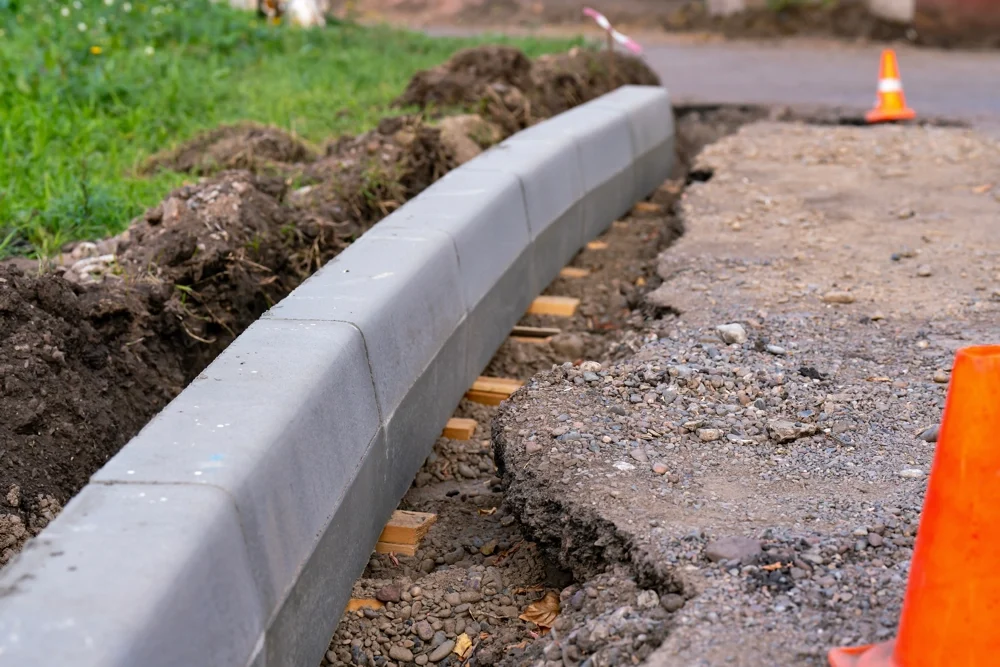
Concrete borders can make landscaping look more organized while solving practical problems around lawns, flower beds, gravel areas, walkways, and other outdoor spaces. Instead of allowing grass, mulch, stone, and planting beds to blend into one another, a permanent border creates a clear transition between materials.
For homeowners, the appeal is not only visual. Concrete borders can help contain landscaping materials, create cleaner mowing edges, reduce repeated edging work, and give planting beds a more finished appearance. Because concrete can follow straight lines or curves and can be colored or textured, the border can also coordinate with patios, driveways, walkways, and other hardscape.
The best concrete borders for landscaping are designed around the property rather than added as decoration everywhere. Shape, height, color, finish, drainage, and surrounding materials should all be considered before choosing a final style.
Homeowners considering permanent landscape edging can review Ryanco Concrete Construction’s concrete curbing services for the service side of the project.
What Are Concrete Landscape Borders?
Concrete landscape borders are permanent concrete edges used to separate different areas of a yard.
They may divide lawn from mulch, define flower beds, contain decorative gravel, edge a walkway, outline a driveway, or create a transition between hardscape and planting.
Unlike individual plastic strips or thin metal edging, concrete curbing can create a continuous border. Depending on the installation method, it can follow straight sections, broad curves, circles, and other landscape shapes. Decorative concrete guidance also notes that continuous concrete edging can be customized with colors and patterns to coordinate with brick, stone, and other landscape materials.
The border itself can be understated or decorative.
Some homeowners prefer a simple smooth or lightly textured curb that disappears visually into the landscape. Others use color, stamping, or a more pronounced profile so the border becomes part of the design.
Concrete borders should not be confused with the finished edge of a patio or sidewalk slab. Landscape curbing is typically its own defined feature used to separate and organize surrounding areas.
What Are the Benefits of Concrete Borders?
The biggest advantage is definition.
A clearly edged planting bed looks intentional even when the landscaping itself is relatively simple. Mulch, flowers, shrubs, and lawn each occupy a recognizable zone instead of gradually spreading into one another.
Concrete also creates a more permanent border than many lightweight edging materials. Plastic edging can shift or become damaged, while thinner metal products can bend or move depending on installation and site conditions. Concrete Network specifically identifies permanence, customization, and the ability to follow landscape curves as advantages of concrete curbing.
Another benefit is coordination.
Concrete borders can visually connect garden beds with a concrete walkway, driveway, patio, or porch. The exact color does not need to match, but repeating a related tone or texture can help the yard feel more planned.
Borders can also help contain loose landscape materials. Mulch and decorative stone are less likely to migrate directly into the lawn when a defined edge separates the two areas.
The overall benefit is a landscape that looks cleaner while requiring less repeated reshaping of bed edges.
How Concrete Borders Help Define Landscape Beds
Planting beds often lose their original shape over time.
Grass grows toward the mulch. Soil spreads outward. Mulch is kicked or washed toward the lawn. Repeated trimming can slowly change the edge until a once-clear bed line becomes irregular.
Concrete creates a fixed boundary.
Around a front foundation bed, a continuous curb can establish a clear line between lawn and landscaping. Around a tree or island bed, a curved border can preserve the intended shape. Along a side yard, a straight edge can create a cleaner separation between gravel and turf.
The shape should respond to the planting and architecture.
Straight or gently angled borders often complement contemporary homes. Broad curves can work well around traditional landscapes, mature shrubs, and larger planting beds.
Avoid adding unnecessary small waves or tight curves simply to make the border decorative. Complicated shapes can make the landscape feel busier and may be harder to coordinate with mowing and planting.
A strong border should clarify the landscape rather than compete with it.
Can Concrete Borders Reduce Lawn Maintenance?
Concrete borders can make certain lawn-maintenance tasks easier, particularly around planting beds.
A well-positioned border creates a defined mowing edge. Instead of repeatedly cutting a fresh separation between grass and mulch, homeowners have a permanent boundary to work against.
Concrete Network notes that properly installed landscape curbing can allow mowing close to the edge, potentially reducing the amount of string trimming required around landscaped areas.
The actual maintenance benefit depends on the border profile.
A low or mower-friendly edge may simplify lawn care more than a tall curb that requires trimming along its face. Bed shape matters too. Broad curves are generally easier to mow around than a series of tight turns.
Concrete borders do not eliminate all maintenance.
Grass can still grow near or over edges, weeds can appear in nearby beds, mulch still needs replenishment, and the concrete itself may eventually need cleaning or maintenance.
The advantage is consistency: the homeowner no longer has to recreate the landscape edge every season.
What Shapes and Layouts Work Best?
The best layout usually reflects the architecture of the house and the shape of the yard.
Straight borders create a structured look. They work well beside modern homes, rectangular lawns, driveways, walkways, and formal planting beds.
Broad curves create a softer transition. They can wrap around trees, foundation beds, garden islands, or landscaping that already uses more natural forms.
Concrete edging is particularly useful for curves because a continuous border can follow the designed shape without requiring numerous short individual pieces.
Circular or oval borders can define specimen trees or isolated planting areas, although the scale should fit the yard. Very small circles around large mature trees may look cramped and can interfere with root zones.
Think about mowing before finalizing curves.
If a riding or push mower needs to follow the border, broad transitions are usually easier to maintain than tight corners.
The simplest shape that accomplishes the design goal is often the strongest choice.
What Colors and Finishes Are Available?
Concrete landscape borders do not have to remain plain gray.
Color can be introduced to coordinate with brick, stone, siding, driveways, patios, or other landscape features. Concrete curbing can also be finished with smooth surfaces, textures, or decorative patterns depending on the system being installed.
Neutral colors are usually the easiest to integrate.
Gray works well around contemporary homes and existing concrete. Tan, buff, warm gray, and muted brown can complement mulch, stone, brick, and traditional landscaping.
Darker colors can create stronger definition but may become visually dominant if used around every planting bed.
Stamped or textured finishes add another level of detail. A border might imitate stone or brick or simply use texture to distinguish it from adjacent concrete.
Homeowners considering more customized colors and surface treatments can review Ryanco Concrete Construction’s decorative concrete services. Ryanco currently offers multiple finishing approaches, including stamped and exposed-aggregate finishes for exterior concrete.
For most landscapes, the border should complement the yard rather than become its strongest feature.
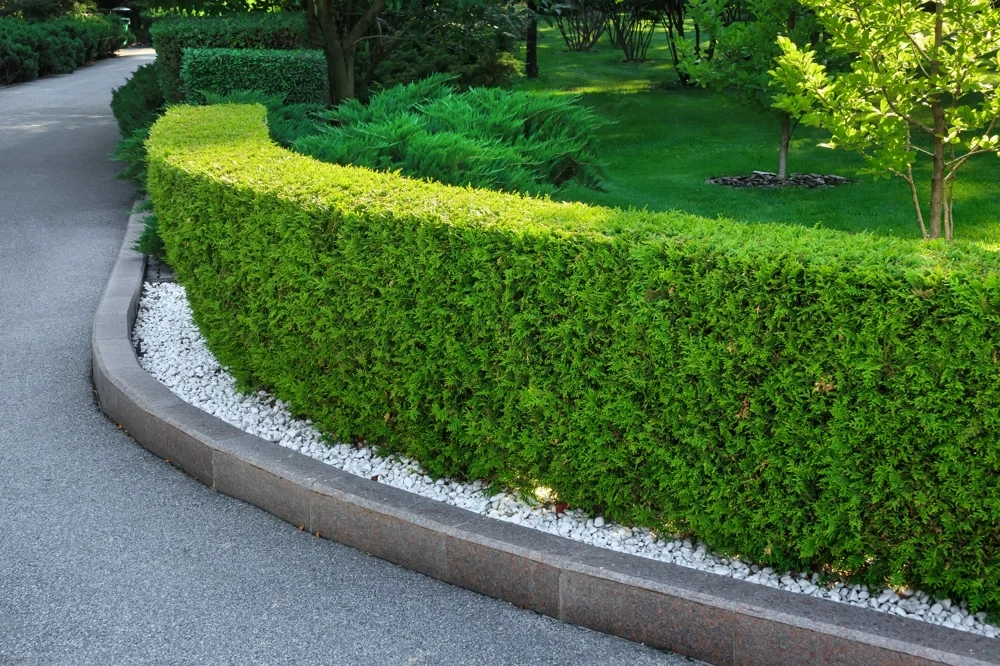
How Do Concrete Borders Compare With Plastic or Metal Edging?
Plastic, metal, and concrete can all define landscape beds, but they create different appearances and maintenance expectations.
Plastic edging is generally lightweight and flexible. It can work for simple landscape projects but may shift, become exposed, or sustain damage over time depending on the product and installation.
Metal edging creates a thin, crisp line that can suit modern landscapes. Because the edge is visually narrow, it can almost disappear between grass and planting beds.
Concrete creates a more substantial and permanent-looking separation.
It can also become a decorative feature through color, texture, profile, and stamping. Concrete Network specifically presents concrete as an alternative for homeowners who are tired of damaged or visually undesirable plastic or metal edging.
Concrete’s tradeoff is permanence.
Changing the shape of a planting bed is easier when lightweight edging can simply be removed and repositioned. A concrete curb requires more effort to alter or remove.
That makes concrete especially appropriate when the overall landscape layout is already established and the homeowner wants a long-term edge.
Can Concrete Borders Improve Drainage or Soil Control?
Concrete borders can help contain soil, mulch, and decorative stone, but drainage requires more careful planning.
A border may help reduce soil or mulch washing into adjacent lawn or pavement during ordinary rainfall. In some layouts, curbing can also help guide shallow surface water when the grade and surrounding drainage system are designed for that purpose.
However, concrete borders can also interfere with drainage if they are installed in the wrong location.
A continuous raised curb placed across the natural path of runoff could trap water inside a planting bed or redirect it toward an undesirable area.
For that reason, landscape borders should not be treated as drainage systems by themselves.
Ryanco’s current flatwork guidance emphasizes proper grading as important for preventing pooling and water-related problems around concrete surfaces.
If drainage is a concern, look at the entire property. Downspouts, slopes, soil conditions, walkways, driveways, patios, swales, drains, and curbing all influence where water travels.
The border should support that drainage plan rather than accidentally block it.
How to Match Concrete Borders With Other Hardscape Features
The easiest way to coordinate concrete borders is to repeat something already present in the property.
That might be color.
A warm-gray patio could be paired with a slightly darker warm-gray curb. A tan stamped walkway might use a simpler border in the same general color family.
Texture is another option.
The landscape border could repeat a stamped detail found on the patio without copying the entire patio design. A plain curb can also provide a useful contrast beside decorative hardscape.
Shape matters as well.
A home with straight concrete walkways and rectangular planting beds may look more cohesive with straight or broadly geometric curbing. A curved patio or informal garden might work better with softer border shapes.
Concrete borders can also create transitions around patio edges. Decorative-concrete guidance notes that borders can define boundaries and create a natural transition between a patio and the surrounding landscape.
Avoid trying to match every hardscape feature perfectly.
A landscape usually feels more natural when materials are coordinated rather than identical. Repeating one or two elements is often enough to visually connect the space.
How to Choose the Right Border Style for Your Landscape
Start with function.
Decide what the border needs to separate. Lawn and mulch may require a different profile from gravel beside a walkway or a bed that regularly experiences runoff.
Next, choose the shape.
Use the house, existing hardscape, trees, planting beds, and mowing routes to determine whether straight lines, broad curves, or a combination makes sense.
Then consider height and profile.
A low edge can blend into the lawn and simplify mowing. A more pronounced curb may create stronger visual separation or help contain deeper landscape material.
Choose color and texture last.
Look at the home’s brick, siding, stone, driveway, patios, and walkways. Select a border that relates to those materials without introducing unnecessary visual competition.
Also consider how established the landscape is. Because concrete borders are relatively permanent, they make the most sense when you are confident about the location and shape of beds.
For homeowners planning landscape concrete around Rock Hill, Ryanco Concrete Construction’s Rock Hill concrete services provide a local path for exploring available concrete work.
The right border should make the yard easier to understand at a glance. Lawn, planting, gravel, and hardscape should each have a clear place, with the concrete providing definition rather than becoming the entire design.
FAQs
Are concrete landscape borders worth it?
They can be worthwhile for homeowners who want a permanent-looking edge, clearer landscape-bed definition, and less repeated manual edging. Their value depends on the landscape layout, budget, desired appearance, and whether the homeowner expects to change bed shapes frequently.
Can you mow next to concrete curbing?
Many concrete curbing designs are intended to create a defined mowing edge, although ease of mowing depends on the curb’s height and profile. Lower mower-friendly designs may reduce the need for repeated string trimming.
Does concrete landscape edging crack?
Concrete can crack as it responds to movement, weather, soil changes, and other stresses. Control joints and proper installation are used to help manage cracking, although they cannot guarantee that a border will never develop a crack.
Can concrete borders be colored or stamped?
Yes. Concrete landscape edging can be colored and textured, and some systems can use stamped patterns to coordinate with brick, stone, patios, or other hardscape. The available options depend on the specific installation system.
Is concrete edging better than plastic edging?
Neither is universally better. Plastic is lightweight and easier to reposition, while concrete provides a more permanent and substantial border. Homeowners who expect their landscape layout to remain consistent may prefer concrete’s durability and finished appearance.
Can concrete borders help with drainage?
They can influence surface-water movement and help contain soil or landscape material, but they should not be considered a complete drainage solution. Proper grading and site drainage should be planned first so curbing does not trap or redirect water toward unwanted areas.
If permanent landscape borders fit your property’s design and maintenance goals, Ryanco Concrete Construction can help homeowners evaluate curbing styles, finishes, and placement alongside patios, walkways, and other concrete features.
