
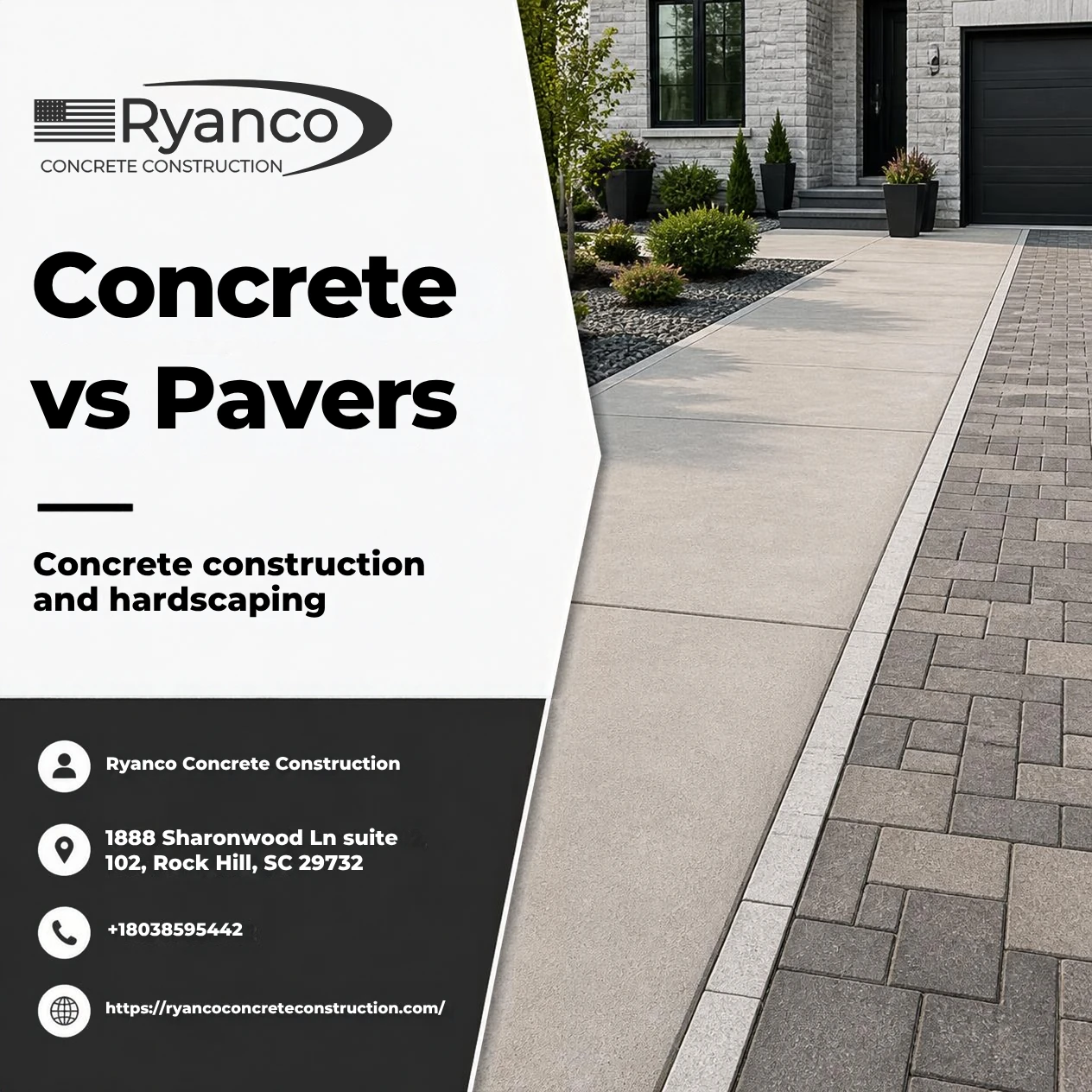
Choosing between concrete and pavers for a patio or outdoor living space is rarely just a question of appearance. Homeowners also need to compare upfront cost, maintenance, durability, repair needs, installation conditions, and how each surface will fit the property over time.
Concrete creates a continuous, solid surface that can be finished in many ways, from a simple broom texture to decorative colors and stamped patterns. Pavers are individual units, usually made from concrete, brick, or stone, that are installed over a prepared base in a repeating or custom pattern. Both can create attractive patios, walkways, seating areas, and other outdoor spaces.
For most homeowners, the better choice depends on budget, design goals, how much maintenance feels reasonable, and the conditions around the home. This comparison explains the practical differences so you can decide which material fits your project without assuming one option is right for every property.
Concrete vs Pavers: What Is the Difference?
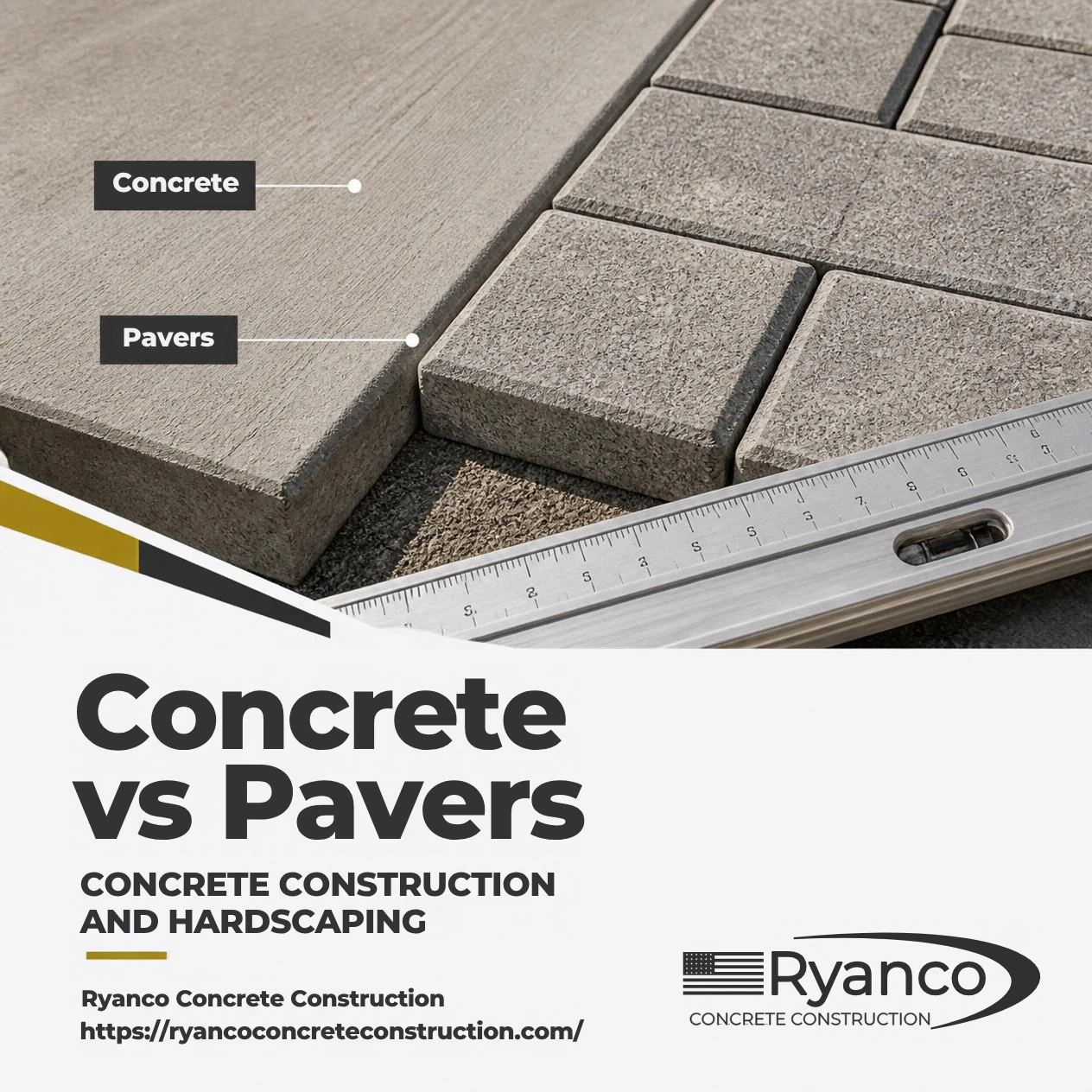
The main difference between concrete and pavers is how the finished surface is constructed.
A concrete patio is poured as a slab. After the base is prepared, forms are installed, concrete is placed, and the surface is finished. Control joints are added to help manage normal shrinkage and movement. Depending on the project, the surface may be broom finished, colored, stamped, textured, or otherwise customized.
Pavers are manufactured or natural units installed individually over a compacted base and bedding layer. The joints between the units are typically filled with sand or another appropriate joint material. Because the surface is made of separate pieces, pavers can move slightly without behaving exactly like one large rigid slab.
That structural difference affects nearly every other comparison. Concrete tends to create a smoother, more unified surface. Pavers provide a segmented surface with visible joints and many pattern possibilities.
If you are considering a poured patio, Ryanco Concrete Construction’s concrete patio services can help you understand how concrete may fit your outdoor space.
Which Option Costs More Upfront?
Pavers often cost more upfront than standard poured concrete because installation is more labor intensive. Each unit must be placed, aligned, cut where necessary, and fitted into the chosen pattern over a carefully prepared base.
Basic concrete is usually more economical because a larger area can be formed, poured, and finished as a continuous surface. However, decorative upgrades can narrow the price difference. Stamping, integral color, specialty stains, borders, multiple finishes, and more complicated layouts can increase the cost of a concrete patio.
The final price of either option also depends on factors beyond the surface material. Demolition, excavation, grading, access, drainage corrections, base preparation, project size, curves, steps, retaining edges, and site obstacles can significantly affect the estimate.
Homeowners should compare complete proposals instead of assuming a material will always be cheaper. Ask what preparation, drainage, edging, finishing, cleanup, and related work are included. A low surface price does not necessarily mean a lower total project cost.
Which Surface Requires Less Maintenance?
Concrete typically has fewer joints to maintain because it is installed as a continuous slab. Routine care often involves cleaning the surface, managing stains, monitoring cracks and joints, and resealing when the finish or application calls for it.
Pavers have more joints, which creates additional maintenance considerations. Joint material can erode or wash out over time, weeds or organic growth may appear in neglected joints, and individual units can settle if the base moves. Periodic cleaning, joint maintenance, and resetting may be needed.
Your tolerance for small recurring maintenance tasks matters. Homeowners who want a more continuous surface with fewer individual joints may prefer concrete. Those who are comfortable maintaining joints in exchange for easy access to individual units may prefer pavers.
How Do Concrete and Pavers Compare in Durability?
Both materials can be durable when installed correctly, but they respond to stress differently.
Concrete is strong in compression and works well for patios, walkways, slabs, and other flatwork when the subgrade, base, thickness, joint layout, and curing are appropriate. Because it is rigid, however, movement below the slab can contribute to cracking or settlement.
Pavers distribute the surface into many smaller units. Individual pieces can accommodate limited movement more readily than a large slab. If the base settles unevenly, though, the paver surface may develop low spots, uneven joints, or loose areas.
Durability also depends on how the space is used. A patio used for furniture and foot traffic has different demands than an area supporting a heavy outdoor kitchen, hot tub, vehicle, or other concentrated load.
Neither material should be judged only by the surface product. Base preparation, drainage, installation quality, edge support, and surrounding soil conditions are critical to long-term performance.
Which Option Offers More Design Flexibility?
Both materials provide considerable design flexibility, but they achieve it differently.
Pavers are available in many shapes, sizes, colors, textures, and laying patterns. Homeowners can create borders, contrasting sections, geometric layouts, curves, and combinations that resemble traditional brick or natural stone. The individual-unit appearance is part of the design.
Concrete starts as a continuous surface, but decorative finishing can dramatically change its appearance. Stamped patterns can imitate stone, brick, slate, or other textures. Color, stains, borders, exposed aggregate, and different finishing techniques can create a wide range of looks.
Homeowners exploring custom finishes can also review Ryanco Concrete Construction’s decorative concrete options for ideas that go beyond plain gray concrete.
How Do Repairs Differ Between Concrete and Pavers?
Repairability is one of the clearest differences between the two systems.
When one or several pavers become stained, cracked, or uneven, those individual pieces can often be removed and replaced or reset. That can make localized repairs relatively straightforward, especially when matching replacement units are available.
Concrete repairs are different because the surface is continuous. Small cracks may be repaired or sealed depending on their cause and condition, but patched areas may remain visible because new material can differ in color and texture from the surrounding slab. More extensive damage may require replacing a section.
However, easy replacement does not eliminate the need to find the underlying cause. If settlement, poor drainage, or base failure caused the problem, simply resetting a paver or patching concrete may not provide a lasting solution.
Which Surface Handles Weather Changes Better?
Outdoor surfaces experience temperature changes, rain, sunlight, moisture, and occasional freezing conditions. Concrete and pavers respond differently because one is a rigid slab and the other is a system of individual units.
Concrete expands and contracts as temperatures change. Properly planned control and isolation joints help manage movement and give the slab designated locations to respond to normal stresses. Good curing and drainage are also important.
Pavers naturally contain joints throughout the surface. Those joints allow some movement between individual units, which can be useful when temperatures and soil conditions change. However, water can also enter through joints, making proper base construction and drainage important.
Heavy rainfall can create problems for either material when the site is poorly graded. Standing water, erosion, or saturated soil can weaken support beneath the surface.
The better weather performer is therefore not determined by material alone. Proper slope, base preparation, drainage, joint planning, and installation quality often make the larger difference.
How Do Concrete and Pavers Compare for Patio Use?
For patio use, both materials can create comfortable and attractive outdoor living areas.
Concrete provides a stable, continuous surface for tables, chairs, grills, planters, and foot traffic. Fewer joints can make furniture easier to position and create a smooth transition through entertaining areas. Decorative finishes can also help the patio coordinate with the home and surrounding landscape.
Pavers create a textured, detailed appearance that many homeowners associate with traditional hardscaping. Different patterns can visually separate dining, seating, and walking zones without changing materials.
Consider how you plan to use the patio. A simple grilling and seating area may need different features than a large entertainment space with a fire feature, outdoor kitchen, steps, or multiple elevations.
Homeowners in the area can explore Ryanco Concrete Construction’s Fort Mill concrete services when planning a patio or other residential concrete project around local property conditions.
Which Option Offers Better Long-Term Value?
Concrete can provide strong value when homeowners want a durable, relatively low-maintenance surface with the option to add decorative finishes. A properly constructed patio can remain functional for many years, although cracks, stains, or surface wear may eventually require attention.
Pavers may justify a higher initial investment for homeowners who value individual-unit aesthetics and the ability to remove or replace localized sections. Their repair flexibility can be especially useful when access beneath the patio may be needed later.
Maintenance costs should be considered along with installation costs. Paver joints may require attention, while decorative concrete may require periodic sealing depending on the finish.
Instead of looking for a universal winner, compare the expected ownership experience. Consider installation price, maintenance habits, repair preferences, design priorities, and how the patio fits into your overall property plan.
How to Choose Between Concrete and Pavers
Start by deciding what matters most for your project.
If budget is the primary concern, compare standard poured concrete with the specific paver system you are considering. Avoid comparing basic concrete with premium pavers or highly decorative concrete with an entry-level paver product because those are not equivalent choices.
Next, define the look you want. Decide whether you prefer a continuous surface or visible individual units. Gather examples of colors, patterns, textures, borders, and nearby landscaping so the finished patio works with the home instead of looking like an isolated addition.
Think about maintenance. Concrete generally means fewer joints, while pavers may require periodic joint attention or resetting. Also consider repair expectations. Pavers can often be replaced individually, while concrete repairs may remain more visible.
A contractor should evaluate those conditions before giving you a final proposal. The best material on paper can still perform poorly when the base or drainage is not appropriate for the property.
Ryanco Concrete Construction can help homeowners evaluate concrete patio options, decorative finishes, and site preparation needs before a project begins. A site-specific plan is more useful than choosing a material based only on photos or a general price comparison.
FAQs
Is concrete cheaper than pavers for a patio?
Standard poured concrete is often less expensive upfront than professionally installed pavers because pavers require more individual placement and labor. Decorative concrete can cost more than basic concrete, so the actual difference depends on the finish, pattern, site preparation, and project complexity.
Do pavers last longer than concrete?
Both can provide long service lives when installed over a properly prepared base. Pavers have the advantage of individual replaceability, while concrete provides a continuous rigid surface. Drainage, soil movement, workmanship, and maintenance often affect lifespan as much as the material itself.
Are pavers easier to repair than concrete?
Pavers are generally easier to repair locally because individual units can be lifted, reset, or replaced. Concrete repairs may be structurally effective but remain visible because matching the color and texture of an existing slab can be difficult.
Does concrete require less maintenance than pavers?
Concrete usually has fewer joints to maintain, making routine upkeep simpler for many homeowners. Pavers may require joint sand replacement, weed control, cleaning, or resetting over time. Concrete still needs cleaning, crack monitoring, and appropriate sealing when required.
Which is better around an outdoor living area?
That depends on the design and how the space will be used. Concrete provides a smooth, continuous surface with many finishing options, while pavers offer detailed patterns and easier localized replacement. Furniture placement, drainage, appearance, and maintenance preferences should all influence the choice.
Should I choose concrete or pavers for my home?
Choose based on your budget, design preferences, maintenance expectations, repair priorities, and site conditions. If you are leaning toward concrete, Ryanco Concrete Construction can evaluate your property and discuss patio and decorative concrete options that fit the space, intended use, and long-term plan.
