

Proper drainage protects concrete by directing rainwater away from the surface and reducing moisture buildup in the soil beneath it. When water drains effectively, it helps limit erosion, uneven settlement, cracking, and other conditions that can shorten the lifespan of concrete.
For homeowners in Rock Hill, SC, managing water around driveways, patios, sidewalks, and other concrete surfaces is an important part of property maintenance. Heavy rainfall, poor grading, and improperly directed runoff can create problems even when the concrete was originally installed correctly. Understanding how drainage protects concrete helps homeowners recognize water-related risks and maintain their outdoor surfaces.
Why Does Drainage Matter for Concrete?
Drainage matters because it controls how rainwater moves across concrete surfaces and through the surrounding soil. Without proper drainage, water can accumulate, erode supporting material, and contribute to conditions that cause cracking or uneven settlement.
Concrete is designed to withstand ordinary exposure to weather. However, its performance also depends on the stability of the soil and base materials beneath it.
When drainage is inadequate, repeated moisture exposure can affect those supporting materials and increase the likelihood of damage.
Proper drainage helps:
- Move rainwater away from concrete surfaces and nearby structures.
- Reduce standing water after storms.
- Prevent soil erosion around slab edges.
- Maintain more consistent support beneath concrete.
- Limit moisture entering existing cracks and joints.
- Protect nearby landscaping and drainage areas.
- Reduce conditions that contribute to premature deterioration.
Drainage is not a guarantee that concrete will never crack. Temperature changes, loading, soil movement, and construction conditions can also affect its performance.
However, controlling water is one of the most important steps homeowners can take to reduce avoidable moisture-related problems.
How Water Can Damage Concrete Over Time
Water does not necessarily damage concrete simply by touching its surface. Most exterior concrete is expected to experience rain, humidity, and changing weather conditions.
Problems develop when water repeatedly collects, enters vulnerable areas, or affects the ground supporting the slab.
Moisture entering cracks and joints
Concrete naturally contains pores, and cracks or joints can provide additional pathways for water.
When moisture moves through these openings, it may reach the base material beneath the slab.
If that supporting material becomes unstable or erodes, the concrete may experience additional stress.
Repeated wetting and drying
Outdoor concrete experiences changing moisture conditions throughout the year.
These cycles can contribute to movement and surface wear, particularly when the concrete already has defects or inadequate protection.
However, moisture exposure alone does not mean deterioration is inevitable.
Concrete quality, installation practices, environmental conditions, and maintenance all influence performance.
Freeze-thaw damage
When water enters saturated concrete and freezes, expansion can place pressure on its internal structure.
Repeated freeze-thaw cycles may contribute to scaling or surface deterioration, especially in concrete that lacks adequate freeze-thaw resistance.
Rock Hill generally experiences milder winters than northern regions, but occasional freezing temperatures can still occur.
Damage to underlying materials
Some of the most serious water-related problems begin beneath the visible concrete.
Excessive moisture may weaken susceptible soils, while concentrated water movement can wash away loose supporting material.
Over time, this can contribute to settlement, uneven pavement, and cracking.
Why Standing Water Can Be a Problem
Standing water is one of the most noticeable signs that a concrete surface may not be draining effectively.
A small puddle after rainfall does not automatically indicate structural damage. However, recurring or persistent water accumulation can reveal underlying drainage problems.
Water collecting in low spots
Depressions in a driveway, patio, or walkway can prevent rainwater from draining naturally.
These low areas may result from an uneven surface, inadequate grading, or settlement after installation.
Repeated pooling can increase moisture exposure in the same location.
Moisture entering existing damage
Where cracks or deteriorated joints are present, accumulated water has more time to enter openings.
If moisture reaches vulnerable supporting soil, it may contribute to further movement or deterioration.
Staining and surface deposits
Standing water can leave behind dirt, minerals, and organic material as it evaporates.
These deposits can affect the appearance of concrete, particularly on decorative surfaces.
Shaded, persistently damp areas may also develop algae or other biological growth.
Slippery walking conditions
Moisture combined with algae, dirt, or certain surface finishes can create slippery conditions.
This is especially important for patios, walkways, steps, and other areas with regular foot traffic.
Identifying the underlying cause
Homeowners should observe where water collects and how long it remains after rainfall.
A blocked drain may be responsible in some situations. In others, the cause may involve insufficient slope or surrounding runoff entering the area.
The best solution depends on identifying why water is accumulating rather than simply removing the puddle.
How Poor Drainage Contributes to Soil Erosion
Soil erosion occurs when flowing water removes soil or other loose material from an area.
Around concrete surfaces, erosion can become a significant concern because slabs depend on properly prepared and stable supporting ground.
Runoff along concrete edges
Water frequently follows the edges of driveways, patios, and walkways.
When runoff becomes concentrated, it may gradually remove soil beside the concrete.
Over time, this can expose the slab edge or create small channels in the surrounding landscape.
Erosion beneath the slab
If water moves underneath concrete and carries away supporting material, empty spaces or weakened areas may develop.
These conditions can leave portions of the slab without consistent support.
When vehicles, furniture, or foot traffic place additional loads on the affected area, cracking or settlement may become more likely.
Drainage problems on sloped properties
Properties with significant elevation changes may experience faster-moving runoff during storms.
Without appropriate drainage paths, water can wash soil downhill and concentrate around paved areas.
Depending on the property, swales, properly designed drains, or erosion-resistant landscaping may help manage runoff.
Why surface repairs are not always enough
Adding soil to an eroded area may temporarily improve its appearance.
However, if water continues flowing through the same location, the replacement soil may wash away again.
Correcting the runoff pattern is essential to addressing recurring erosion.
Can Water Cause Concrete to Settle or Crack?
Yes. Water can contribute to concrete settlement and cracking when it weakens or removes the materials supporting the slab.
However, not every concrete crack is caused by drainage problems.
Concrete can also crack because of shrinkage, temperature changes, excessive loading, poor subgrade preparation, or other structural and environmental conditions.
How settlement develops
Concrete slabs typically rest on a prepared base and underlying soil.
When supporting soil loses stability or material is washed away, portions of the slab may no longer receive uniform support.
This can lead to uneven settlement.
Why uneven support matters
Concrete performs well under compression but is less resistant to tensile stress.
When one section of a slab is supported differently from another, bending stresses can develop.
If those stresses become excessive, cracking may occur.
Warning signs of moisture-related settlement
Possible indications include:
- Concrete sections that appear lower than neighboring slabs.
- Cracks developing near areas with recurring puddles.
- Gaps forming between the concrete and surrounding soil.
- Water collecting along joints that previously drained.
- Uneven surfaces become more noticeable over time.
These signs do not establish the cause by themselves.
A professional evaluation can help determine whether drainage, soil conditions, or another issue is contributing to movement.
How Slope Helps Move Water Away From Concrete
Slope is one of the primary ways concrete surfaces manage rainfall.
A properly planned slope encourages water to move toward an appropriate drainage area instead of remaining on the slab.
Understanding surface grading
Grading refers to shaping the ground or finished surface to establish the intended elevation and drainage pattern.
For concrete driveways, patios, and walkways, the correct grade depends on surrounding structures, existing elevations, and the property’s natural drainage conditions.
A consistent slope helps water move across the surface without creating unnecessary low points.
Directing runoff away from buildings
Concrete located next to a home should be designed so water does not collect against the foundation.
For example, a patio directly beside a house may need to direct surface runoff toward an appropriate drainage feature.
The exact grading arrangement depends on the property’s layout and applicable requirements.
Why one slope does not fit every project
There is no universal slope specification that works for every concrete surface.
Important considerations include:
- Distance between the concrete and nearby buildings.
- Existing ground elevations.
- Accessibility and walking safety.
- Garage or doorway thresholds.
- Surrounding landscaping.
- Intended runoff collection areas.
- Local drainage requirements.
Excessively steep surfaces can create access problems or cause runoff to move too quickly.
Insufficient slope can leave water trapped in shallow depressions.
The goal is to create a practical drainage path that moves water safely without causing erosion elsewhere.
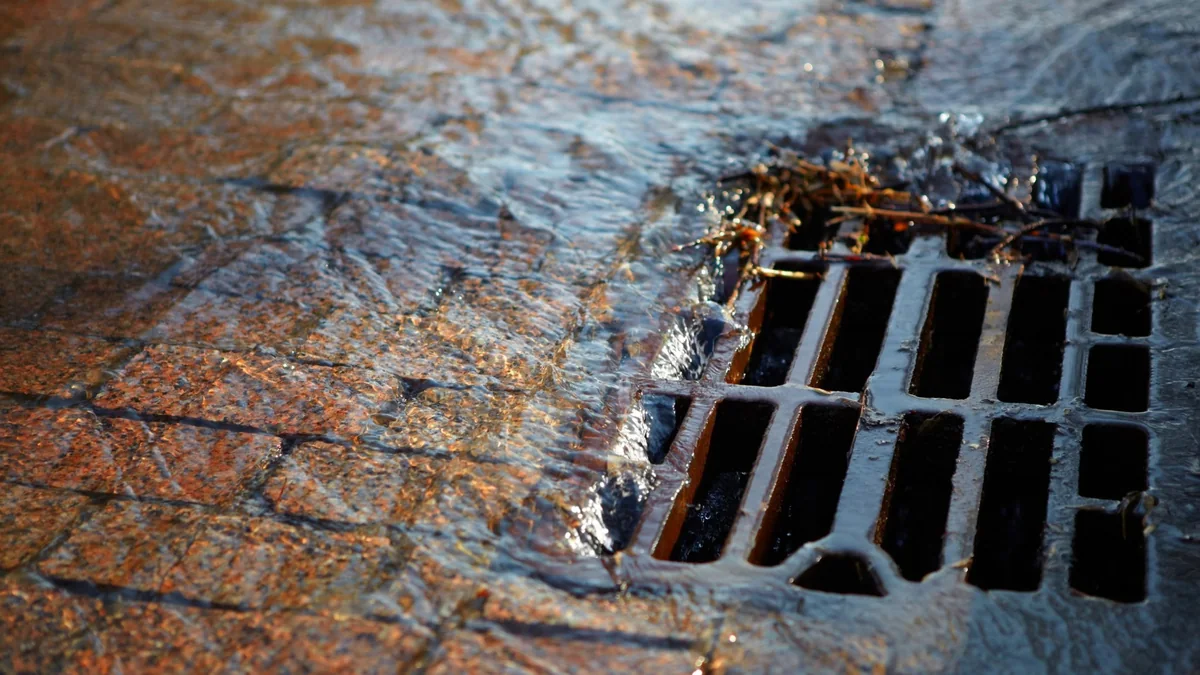
When drainage features may be needed
Some properties cannot rely on surface slope alone.
A channel drain, swale, catch basin, or another properly designed drainage feature may be necessary where buildings or terrain restrict natural runoff.
These systems must direct collected water toward a suitable outlet.
Moving water away from one area should not create a new drainage problem somewhere else.
How Gutters and Downspouts Affect Concrete Surfaces
Gutters and downspouts affect concrete because they control where rainwater from the roof reaches the ground.
A properly functioning gutter system can reduce concentrated water flow near patios, walkways, driveways, and foundations.
Roof runoff can concentrate large amounts of water
During heavy rainfall, a roof collects water across a substantial surface area.
Gutters direct this water toward downspouts.
If a downspout releases water directly beside a concrete slab, runoff may repeatedly saturate the surrounding soil or erode material near its edges.
Poorly placed downspouts
A downspout that empties onto a driveway or walkway may create persistent wet areas.
Depending on the surface slope, the water may travel across the concrete or collect in an existing depression.
Repeated discharge in one location may contribute to staining, erosion, or moisture infiltration.
Clogged gutters
Leaves and debris can block gutters, allowing water to spill over their edges.
Overflowing gutters may concentrate water against nearby concrete or the ground supporting it.
Regular cleaning helps maintain the intended drainage path.
Underground drainage connections
Some properties use buried downspout pipes to transport runoff away from buildings.
These systems need appropriate pipe slope, capacity, and discharge locations.
Blocked or damaged underground lines can cause water to back up and collect near the surface.
Coordinating drainage systems
Homeowners should consider roof runoff and surface drainage together.
A concrete patio may have an appropriate slope but still experience water problems if a nearby downspout constantly releases additional runoff onto it.
Managing the complete flow of water is often more effective than addressing each surface independently.
Can Concrete Sealing Help With Moisture Protection?
Yes. Concrete sealing can help reduce water absorption and protect the surface against certain forms of moisture-related deterioration.
However, sealing does not correct poor drainage, improper grading, soil erosion, or standing water caused by low spots.
Sealing and drainage serve different purposes.
What concrete sealing does
Depending on the product, concrete sealers may penetrate the surface or form a protective coating.
Appropriate sealers can help reduce water absorption, limit staining, and protect certain decorative finishes.
The level of protection depends on the sealer type, concrete condition, application, and exposure.
What concrete sealing cannot fix
A sealer cannot:
- Correct a driveway or patio that slopes in the wrong direction.
- Prevent water from flowing toward a foundation.
- Restore soil that has washed away beneath a slab.
- Eliminate low spots caused by settlement.
- Repair structural cracking.
- Replace a properly designed drainage system.
Some film-forming sealers can also affect surface traction, so product selection is important for exterior walking areas.
Why drainage should be considered first
If a patio constantly collects water because of poor grading, applying a sealer does not remove the underlying cause.
The same water will continue accumulating unless the drainage condition changes.
Addressing drainage problems first can provide a better foundation for an appropriate surface protection plan.
At Ryanco Concrete Construction, we offer concrete sealing services for homeowners looking to reduce moisture absorption, protect decorative finishes, and maintain exterior concrete surfaces.
Sealing can be a useful part of concrete maintenance, but it works best alongside appropriate water management.
What Signs Suggest a Drainage or Concrete Problem?
Concrete surfaces often show warning signs before significant deterioration becomes visible.
Homeowners can identify possible issues by observing their properties during and after rainfall.
Recurring puddles
Water that repeatedly collects in the same location may indicate a low spot, settlement, or inadequate slope.
Watch whether the affected area remains wet after nearby surfaces have dried.
Soil erosion near slab edges
Missing soil, exposed concrete edges, or small channels in landscaping can indicate concentrated runoff.
These conditions deserve attention because soil loss may eventually affect slab support.
Cracks near wet areas
Cracking close to recurring puddles or saturated soil may suggest a possible relationship between moisture and movement.
However, cracks have multiple potential causes, and their location alone cannot establish the reason.
Uneven concrete surfaces
One slab sitting lower than an adjacent section may indicate settlement.
Changes in elevation can also interrupt drainage paths and create new areas where water accumulates.
Surface discoloration
Persistent staining, mineral deposits, or biological growth can indicate repeated moisture exposure.
While discoloration is not necessarily structural damage, it can help reveal areas that remain wet.
Water near the foundation
Rainwater accumulating where concrete meets a house is an important warning sign.
The drainage path should be evaluated to determine whether runoff is moving toward the building.
When to seek professional evaluation
If homeowners notice widening cracks, significant movement, recurring erosion, or water entering nearby structures, professional assessment is appropriate.
The goal is to identify both the visible damage and the contributing conditions.
Where concrete damage has already developed, Ryanco Concrete Construction provides concrete repair services for cracked, chipped, or uneven surfaces.
Concrete Protection in Rock Hill
Concrete drainage planning in Rock Hill, South Carolina, should account for local rainfall, terrain, surrounding development, and property-specific water movement.
Rainstorms can produce concentrated runoff, particularly where large roofs, paved driveways, and other hard surfaces direct water toward the same area.
Even relatively level properties can experience drainage problems when low areas prevent rainfall from escaping.
Managing rainfall around concrete
Homeowners should examine how rainwater moves across their entire property.
A driveway may receive runoff from an adjacent lawn, while a patio may collect water from a nearby roof.
Identifying these sources can help explain why a concrete surface remains wet after a storm.
Protecting supporting soil
Proper grading and drainage are particularly important where water repeatedly collects beside concrete.
Keeping runoff from concentrating along slab edges can help reduce soil loss.
Stable supporting ground is an important part of long-term concrete performance.
Local stormwater considerations
The City of Rock Hill maintains a Stormwater Division responsible for stormwater infrastructure and addressing drainage concerns.
The city also identifies stormwater and erosion-control review requirements for certain projects that change stormwater flows.
Homeowners planning significant grading changes or drainage improvements should verify applicable local requirements before work begins.
Properties with a Rock Hill mailing address may fall outside city limits, so the appropriate jurisdiction should also be confirmed.
Concrete maintenance in Rock Hill
Routine maintenance can help homeowners recognize developing problems.
Useful practices include keeping gutters clear, checking drainage outlets, inspecting concrete after heavy rainfall, and watching for recurring erosion.
For new concrete projects, planning the surface grade and runoff path before installation can reduce the risk of later modifications.
At Ryanco Concrete Construction, we consider site preparation, grading, and local conditions when planning concrete projects in Rock Hill and surrounding communities.
Our goal is to help homeowners make informed decisions about protecting their concrete surfaces and addressing visible problems before they become more extensive.
FAQs About Drainage and Concrete
How does proper drainage protect concrete?
Proper drainage moves water away from concrete surfaces and reduces the risk of moisture accumulating in vulnerable areas. It also helps prevent soil erosion and uneven support beneath slabs, which can contribute to cracking and settlement.
Can standing water damage a concrete patio?
Yes, persistent standing water can contribute to surface staining, slippery biological growth, and moisture entering existing cracks. If water also affects the supporting soil, additional deterioration may develop over time.
Does poor drainage cause concrete cracks?
Poor drainage can contribute to cracking when water weakens or erodes supporting materials. However, cracks may also result from shrinkage, temperature changes, loading, and installation conditions. An evaluation can help identify the likely cause.
Will sealing concrete prevent water damage?
Concrete sealing can reduce water absorption and help protect the surface, depending on the product used. It cannot correct improper slope, standing water, or erosion beneath a slab. Drainage problems should be addressed separately.
How can I tell if water is eroding soil beneath concrete?
Possible signs include gaps near slab edges, missing surrounding soil, uneven concrete sections, and cracking accompanied by recurring puddles. These symptoms do not confirm erosion beneath the slab, but they warrant professional inspection.
Should drainage problems be fixed before concrete repairs?
In many cases, yes. Correcting the cause of unwanted water accumulation can help prevent repaired areas from experiencing similar problems. However, severe cracking or unsafe movement may also require prompt repair.
Protect Your Concrete With Ryanco Concrete Construction
Concrete surfaces perform best when they have stable support, appropriate grading, and a clear path for water to drain. When runoff repeatedly collects around a driveway, patio, or walkway, it can affect both the visible surface and the soil beneath it.
At Ryanco Concrete Construction, we understand how important site conditions and water management are to residential concrete projects in Rock Hill, SC. Whether you are concerned about recurring puddles, moisture exposure, or visible signs of deterioration, identifying the source of the problem is an important first step.
We help homeowners evaluate concrete surfaces and explore appropriate sealing, repair, and construction options. Our approach considers how the concrete is used, the condition of the existing surface, and factors that may affect its long-term performance.
If you are planning a new concrete project or have noticed signs of moisture-related damage, addressing drainage concerns early can help you avoid unnecessary complications.
Contact Ryanco Concrete Construction at (803) 548-0595 to discuss your concrete project in Rock Hill and request an estimate.
