
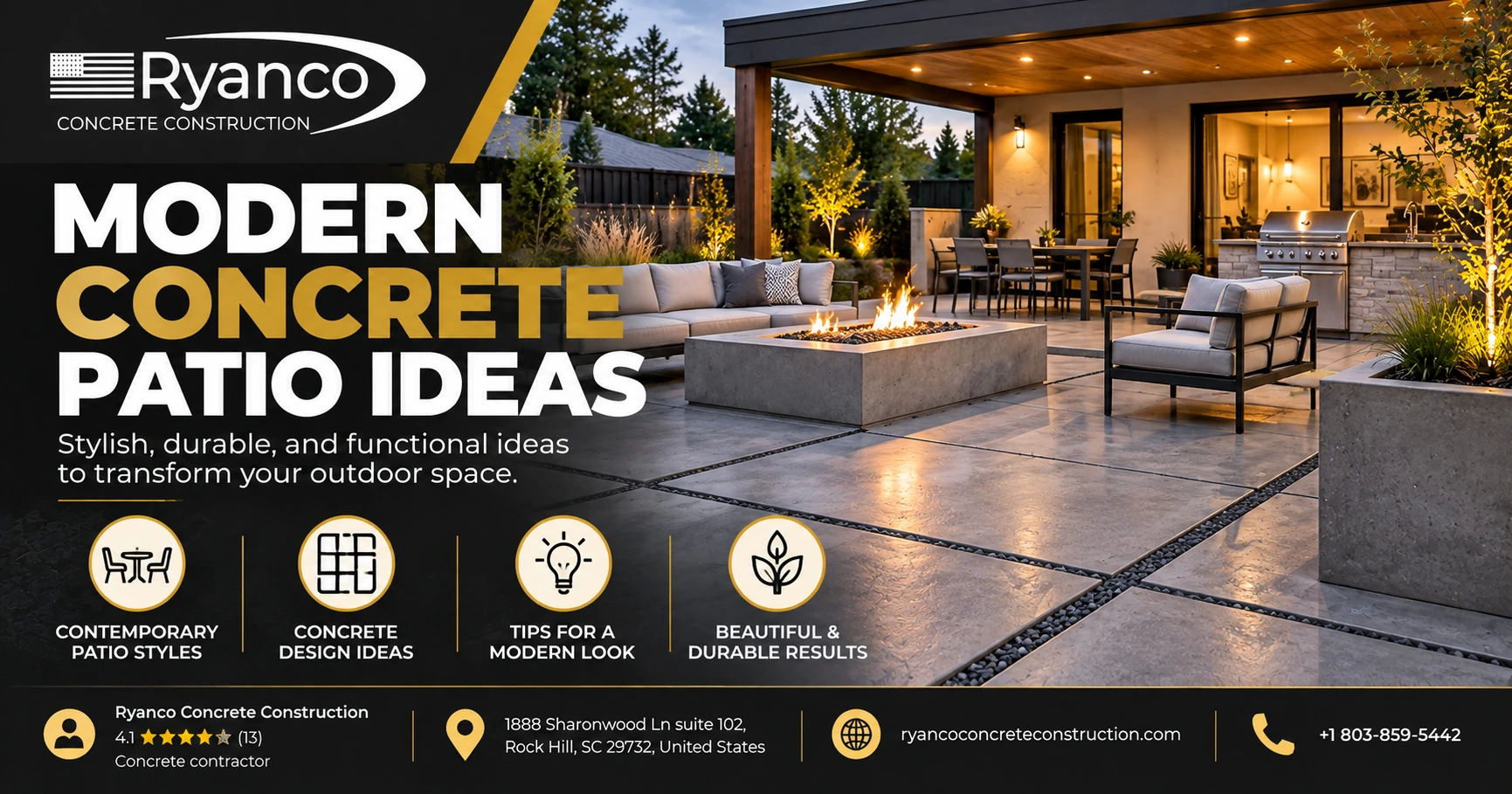
Modern concrete patios are less about adding as many decorative details as possible and more about creating a space that feels intentional. Clean lines, simple geometry, large-format sections, neutral colors, and carefully chosen materials can turn concrete into the foundation for a comfortable outdoor living area.
That does not mean a modern patio has to look cold or unfinished. Some of the strongest designs balance concrete with wood, stone, metal, planting beds, outdoor furniture, fire features, and warm lighting. The concrete creates visual structure while softer materials keep the backyard inviting.
Current contemporary patio examples continue to feature restrained color palettes, open layouts, large concrete units, outdoor kitchens, fire pits, pergolas, and clearly defined gathering areas.
For homeowners exploring modern concrete patio ideas, the goal should be to choose a layout and finish that complement the architecture of the home instead of simply copying a trend.
What Makes a Concrete Patio Look Modern?
Modern patio design usually begins with simplicity.
Straight edges, rectangular shapes, large sections of concrete, and uncluttered layouts are common characteristics. Concrete Network’s modern outdoor design guidance specifically emphasizes angular shapes, smooth surfaces, large-scale patterns, and simplified color schemes such as white, gray, and charcoal.
A modern patio also tends to use fewer competing finishes.
Instead of combining several stamp patterns, colors, borders, and decorative accents, the design may rely on one primary surface with one contrasting element.
For example, a light-gray patio might use dark charcoal planters and black outdoor furniture. A warm concrete surface could be paired with a cedar pergola and simple green landscaping.
The layout matters just as much as the finish.
A large open rectangle divided into cooking, dining, and lounge areas can feel more contemporary than a patio with several unrelated curves and small extensions.
Homeowners interested in customized finishes can explore Ryanco Concrete Construction’s decorative concrete services when planning the visual direction of the space.
Best Modern Concrete Patio Layout Ideas
Modern patios often work best when the layout reflects how people actually use the backyard.
One straightforward option is a large rectangular patio extending directly from the rear of the home. The simple shape creates flexibility for furniture and works well with contemporary architecture.
A second approach is to divide the patio into several connected rectangles.
One section may contain an outdoor dining table, another a lounge area, and a third a fire feature. The concrete can remain visually consistent while furniture placement gives each area a specific purpose.
L-shaped patios can work especially well around outdoor kitchens. One side can support cooking and dining while the other becomes a quieter seating zone.
For larger yards, several concrete areas can be connected with straight walkways rather than forming one oversized slab.
Current contemporary patio galleries frequently show separate zones for cooking, dining, lounging, pools, and fire features within the same overall outdoor design.
The most important principle is circulation. People should be able to move between the house, dining table, outdoor kitchen, lawn, and seating areas without constantly crossing through furniture arrangements.
Popular Concrete Colors for Contemporary Patios
Modern concrete patios typically rely on restrained colors.
Light gray is one of the easiest choices because it works with many home exteriors and helps create a clean visual base.
Medium gray provides more contrast and can pair especially well with white siding, dark windows, black railings, and stainless-steel outdoor kitchen equipment.
Charcoal can create a dramatic contemporary appearance, although homeowners may prefer to use very dark tones selectively as borders or accents rather than across a large patio exposed to direct summer sun.
Warm gray, taupe, sand, and muted beige can provide a softer modern look. These colors work particularly well when the patio includes wood furniture, stone walls, or warmer exterior finishes.
Concrete Network’s modern design guidance favors simple palettes, often using white, gray, charcoal, or a limited number of contrasting colors rather than heavily variegated earth-tone combinations.
A modern patio does not need to be monochromatic. The key is limiting the number of dominant colors so the design stays visually calm.
Large-Format Concrete Slab Ideas
Large-format concrete is one of the most recognizable contemporary hardscape looks.
The concept is simple: instead of making the surface appear to contain many small paving units, the patio is divided visually into large squares, rectangles, or broad geometric sections.
Current modern landscape examples continue to feature oversized concrete slabs and pavers in linear grids and geometric arrangements.
With poured concrete, saw cuts or planned joints can sometimes contribute to this visual style while still serving practical purposes within the slab design.
Large sections can make a smaller patio feel less busy because there are fewer visual lines competing for attention.
On a larger property, oversized rectangular forms can reinforce the architecture of a contemporary home.
Another popular look combines large concrete sections with narrow strips of gravel, stone, or landscaping between them. The contrast emphasizes the geometry and breaks up the hardscape.
That approach should still be designed around appropriate concrete construction and drainage rather than treating joints or gaps purely as decoration.
How to Use Clean Lines and Simple Geometry
Geometry is one of the easiest ways to make a concrete patio feel modern.
Start by looking at the lines already present in the home.
Window frames, rooflines, exterior walls, doors, decks, and architectural projections can provide natural reference points for patio edges.
Running the patio parallel to those features can help the outdoor space feel connected to the building.
Straight walkways can continue those lines into the backyard.
Rectangular planting beds can soften the edges while maintaining the same geometry.
Even furniture placement can reinforce the layout. A rectangular dining table aligned with the patio edge creates a cleaner visual relationship than several pieces placed at unrelated angles.
Modern does not require everything to form a perfect grid, however.
A circular fire pit or curved planter can create an effective contrast when the rest of the space is highly geometric. The key is using that curve as an intentional focal point rather than mixing many unrelated shapes.
Fewer strong lines usually create a more contemporary effect than numerous small decorative details.
Modern Stamped and Decorative Concrete Options
Stamped concrete is often associated with rustic stone patterns, but it can also work in a contemporary patio.
The pattern simply needs to fit the design.
Large slate-like textures, subtle stone patterns, or restrained geometric stamping can provide visual interest without making the patio look overly traditional.
Concrete Network notes that modern concrete design tends to favor large-scale patterns and minimal ornamentation rather than highly rustic finishes.
Seamless textures are another possibility. Instead of creating obvious individual stones or bricks, a seamless texture can give the surface variation while preserving a relatively uninterrupted appearance.
Exposed aggregate can work in modern landscapes as well, especially when the aggregate color is carefully coordinated with the house.
Another approach is extremely simple: use a clean broom finish and make the layout, joints, furniture, and landscaping the decorative elements.
Ryanco currently offers stamped concrete with custom colors and patterns for patios and other exterior surfaces in Rock Hill and Fort Mill.
Modern design often works best when the concrete finish supports the overall space rather than becoming its only focal point.
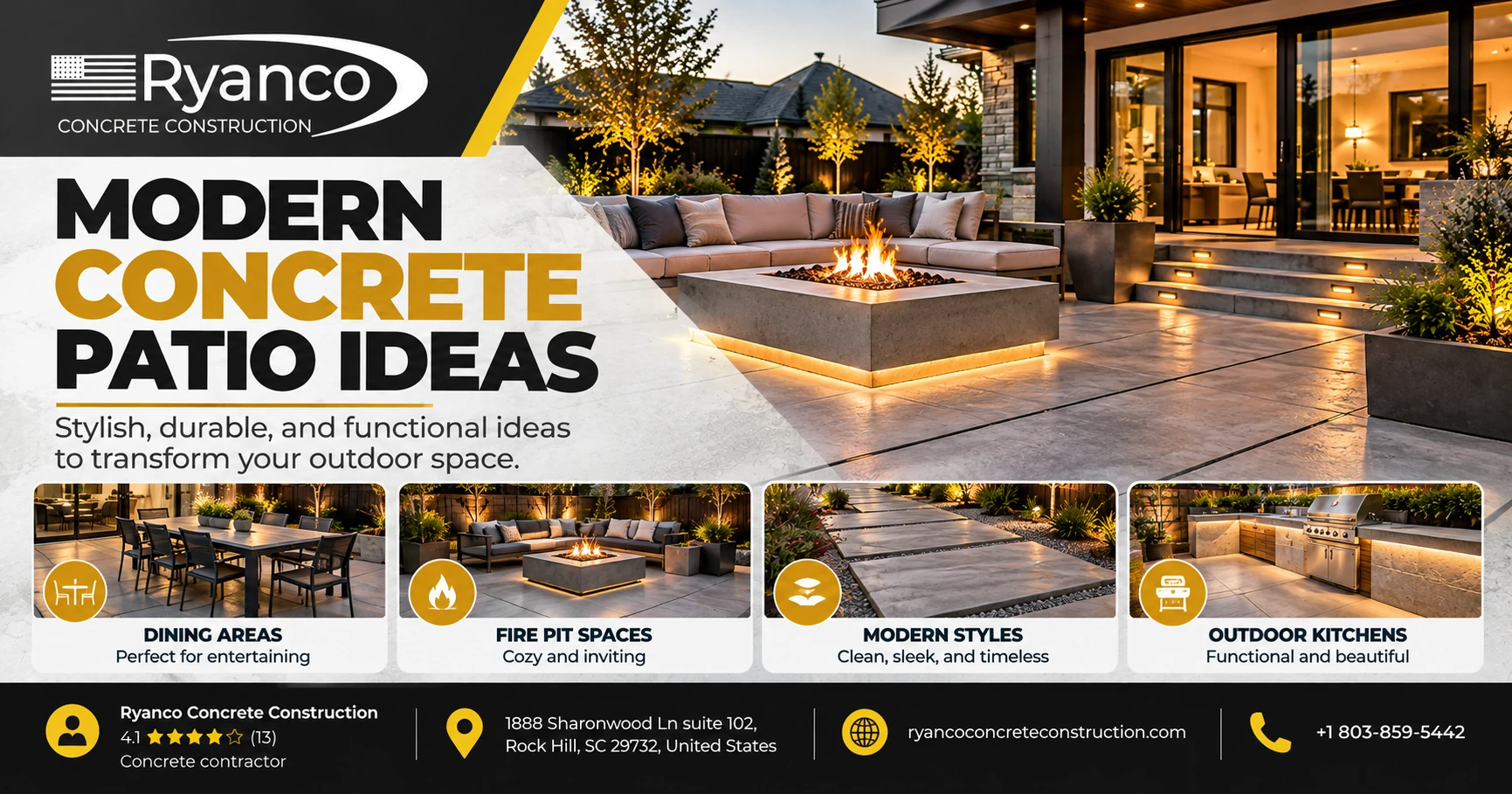
How to Combine Concrete With Wood, Stone, and Metal
Mixed materials keep modern concrete patios from feeling overly hard or industrial.
Wood adds warmth.
A cedar or dark-stained pergola can provide contrast above a gray concrete patio. Wood benches, privacy screens, furniture, and planters can produce the same effect on a smaller scale.
Stone adds texture and weight.
A low stone wall, fireplace, retaining feature, or outdoor kitchen veneer can interrupt broad concrete surfaces without making the patio visually cluttered.
Metal works particularly well as an accent.
Black steel railings, dark outdoor furniture, aluminum pergolas, stainless-steel appliances, and contemporary light fixtures can reinforce clean lines.
Current contemporary landscape examples also show concrete paired with wood details, metal containers, gravel, and planting areas to soften and frame modern hardscape.
Try to repeat materials instead of introducing something new in every zone.
If the patio has a wood pergola, repeating that wood tone in seating or privacy screens helps unify the design.
Two or three dominant materials are usually enough.
Modern Patio Ideas for Fire Pits and Outdoor Kitchens
Fire features and outdoor kitchens fit naturally into modern concrete patios because both can reinforce the geometry of the space.
A rectangular gas fire table can become the center of a lounge area surrounded by low-profile outdoor furniture.
A square fire feature can sit within a larger rectangular patio, creating contrast without disrupting the overall geometry.
A separate fire zone can also be connected to the main patio through a straight concrete walkway.
Outdoor kitchens often work well along one patio edge.
A long linear counter can preserve open floor space while keeping cooking equipment separate from the primary seating area.
L-shaped kitchens create stronger spatial definition and can form a boundary between dining and cooking zones.
Concrete can visually organize these spaces through joint patterns, subtle finish changes, or borders.
Contemporary patio examples increasingly treat outdoor kitchens and fire pits as integrated living zones rather than unrelated features added to the yard.
Homeowners planning the larger foundation for these areas can also review Ryanco Concrete Construction’s concrete patio services.
How Landscaping Can Soften a Modern Concrete Patio
Landscaping is especially important around modern concrete because large geometric surfaces can feel stark without softer elements nearby.
One approach is to frame the patio with simple planting beds.
Ornamental grasses can create movement along straight concrete edges. Evergreen shrubs provide structure without introducing excessive visual complexity.
Large planters can bring greenery directly onto the patio while maintaining clean geometry.
Trees can provide shade and vertical contrast, although mature root spread and placement should be considered when landscaping near concrete.
Groundcover, gravel, or narrow landscape strips can also break up large concrete sections.
Modern projects sometimes place turf, decorative rock, or planted strips between large concrete units to emphasize the grid while introducing texture and color.
Avoid feeling that every open edge needs a different plant.
Modern landscaping often benefits from repetition. Using the same ornamental grass, shrub, or planter style in several places can look more intentional than mixing many unrelated varieties.
Lighting can soften the space after dark as well. Low landscape lights, step lighting, and restrained architectural fixtures can emphasize patio edges and plantings without overwhelming the design.
How to Choose a Modern Patio Design That Fits Your Home
Start with the architecture rather than with an inspiration photo.
Look at the shape of the home, exterior colors, rooflines, windows, doors, and existing materials.
A contemporary home with dark window frames may pair naturally with gray concrete, simple joint lines, black furniture, and rectangular planting beds.
A transitional or traditional home can still support a modern patio, but a slightly warmer color palette or softer decorative texture may create a better connection between old and new.
Next, determine the functions the patio needs to support.
List dining, grilling, lounging, fire features, outdoor cooking, play areas, planters, and pathways before deciding on the final slab shape.
Then simplify.
Choose one primary concrete finish, one dominant color family, and perhaps one accent material or border. Let furniture and landscaping provide additional personality.
Also think about how the patio will age.
Highly specific decorative trends can change quickly, while simple geometry, neutral colors, and quality materials usually adapt more easily as outdoor furniture and landscaping change.
Homeowners considering a project locally can review Ryanco Concrete Construction’s Rock Hill concrete services. Ryanco currently serves Rock Hill and offers decorative and stamped concrete suitable for patios and other residential surfaces.
The strongest modern patio is not necessarily the most minimalist or dramatic. It is the one where concrete, architecture, furniture, landscaping, and outdoor living features feel like parts of the same design.
FAQs
What colors make a concrete patio look modern?
Light gray, medium gray, charcoal, warm gray, taupe, and other restrained neutrals work well in contemporary designs. Modern concrete guidance commonly emphasizes simple gray, white, and charcoal palettes with limited contrasting colors.
Are large concrete slabs good for modern patios?
Large-format squares and rectangles are strongly associated with contemporary hardscape because they reduce visual clutter and emphasize simple geometry. The exact slab or joint layout should still account for appropriate concrete construction and site conditions.
Can stamped concrete look modern?
Yes. Choose larger, subtler patterns rather than highly detailed rustic designs. Seamless textures, broad stone patterns, controlled color variation, and simple borders can give stamped concrete a more contemporary appearance.
What materials look good with a modern concrete patio?
Wood, stone, metal, gravel, and simple landscaping can all complement concrete. Wood adds warmth, stone adds natural texture, and dark metal accents can emphasize clean architectural lines.
Should a modern concrete patio have straight edges?
Straight lines and angular shapes are common in modern patio design, but they are not mandatory. A carefully placed curve or circular fire feature can create contrast when the rest of the patio uses simple geometry.
How can I make a concrete patio modern without making it look cold?
Combine a restrained concrete design with warmer elements such as wood furniture, planting beds, ornamental grasses, stone accents, fire features, textiles, and outdoor lighting. Keeping the hardscape simple gives those softer elements room to stand out.
