
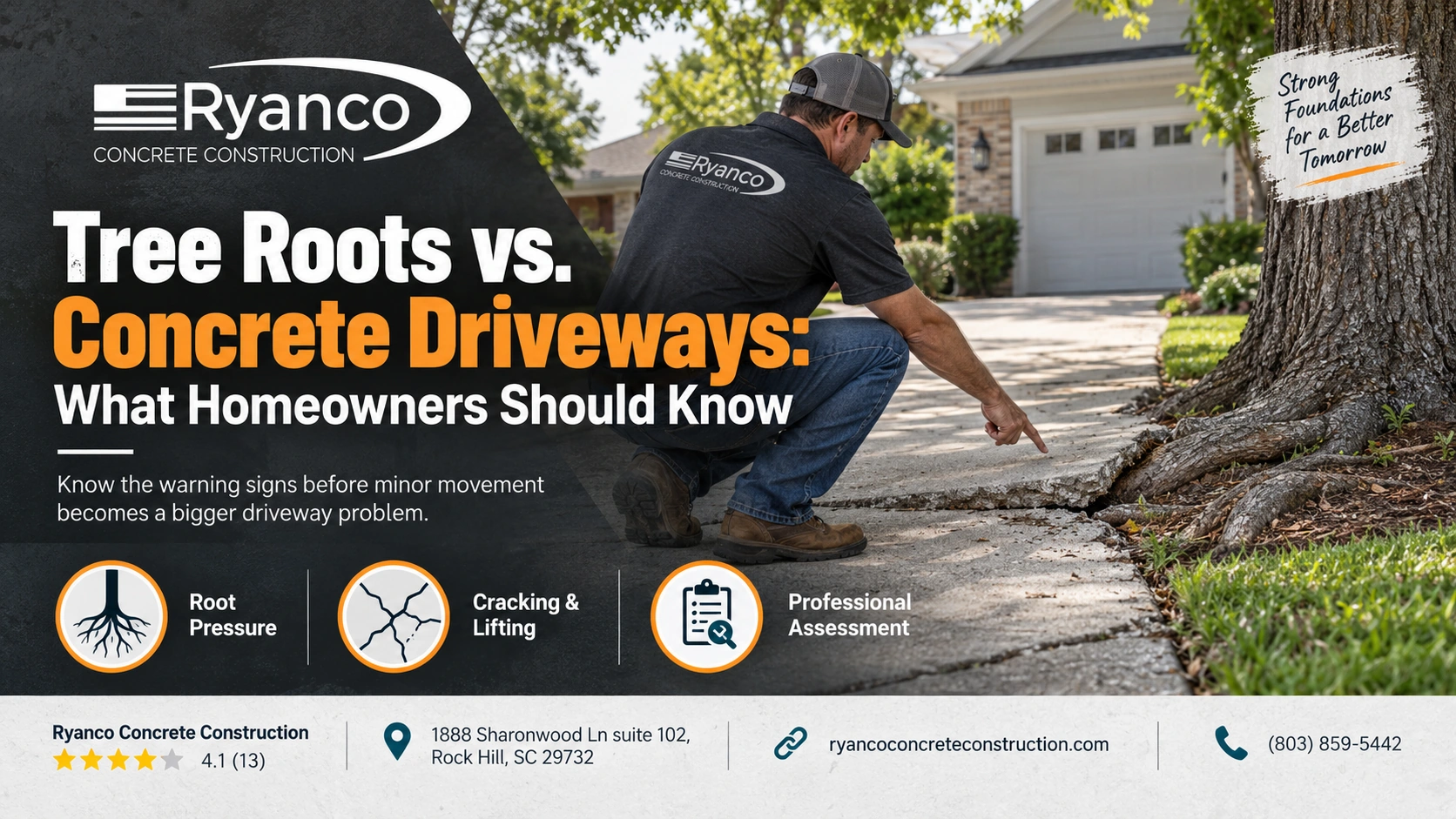
Trees can add shade and character to a property, but problems may develop when growing roots and concrete occupy the same limited space. A driveway near a mature tree can sometimes begin cracking, lifting, or becoming uneven as roots grow beneath or alongside the slab.
If you are dealing with tree roots damaging a concrete driveway, the tree may be part of the problem but it should not automatically receive all the blame. Soil movement, drainage problems, settlement, inadequate base preparation, and existing cracks can create similar symptoms or contribute alongside root growth.
Research on tree roots and pavement shows that roots growing close to hardscape can be associated with lifting and cracking, although the interaction between roots, soil, and concrete can be complex.
The right solution depends on what is moving, how badly the driveway has been affected, and whether nearby roots can be managed without unnecessarily damaging or destabilizing the tree.
Can Tree Roots Damage a Concrete Driveway?
Yes. Tree roots can contribute to concrete driveway damage, particularly when large roots develop close to the surface beneath or beside a slab.
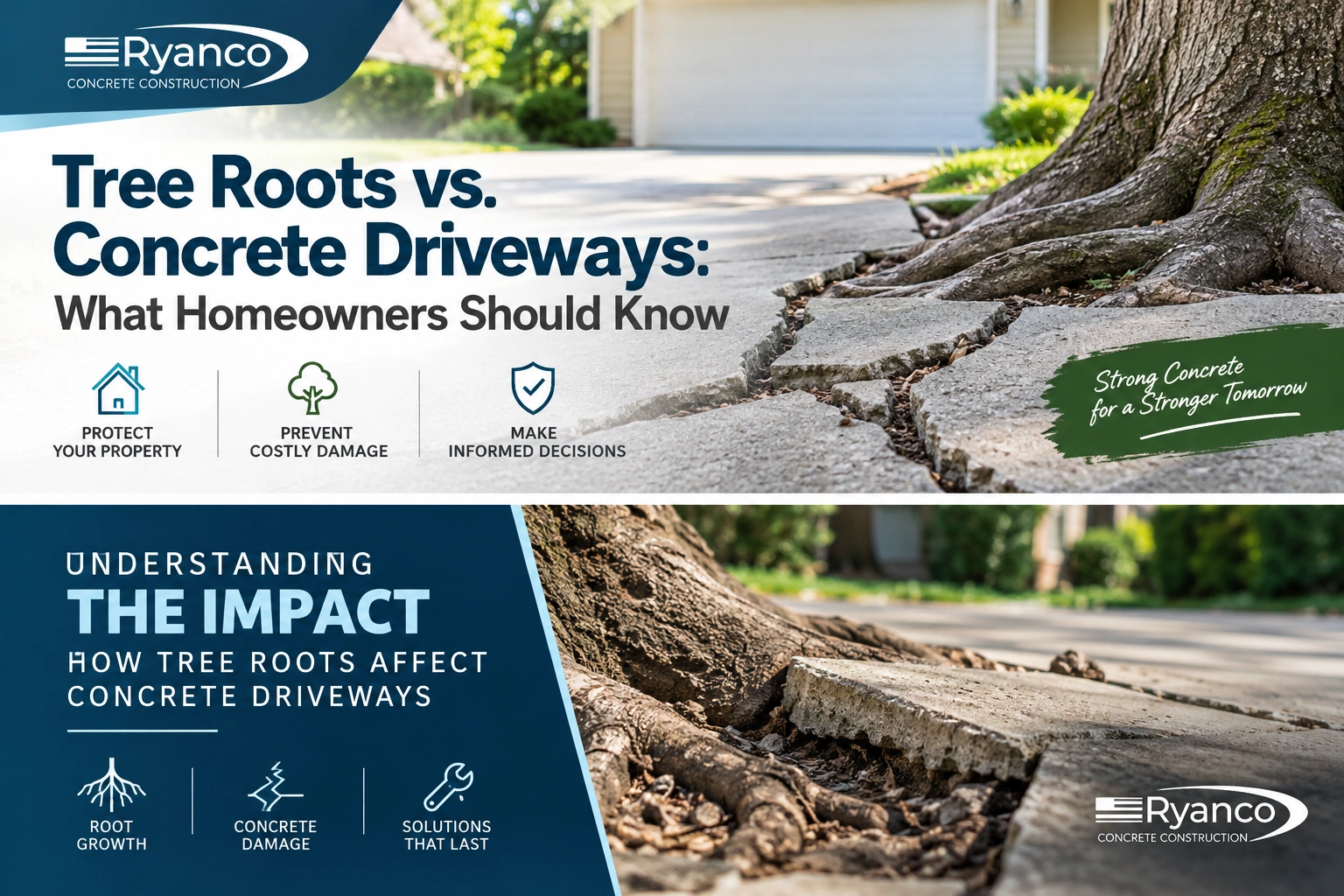
As roots increase in diameter, they need more space. If a substantial root is directly beneath a driveway slab with little room to expand, the concrete may begin to lift. Once one section rises relative to another, cracks or uneven joints can develop.
Tree roots do not always simply “push through” sound concrete. In some cases, roots grow beneath existing pavement and gradually change the support conditions around it. Existing cracks, soil conditions, moisture, and slab construction can all influence what happens.
A University of Florida study examining roots and concrete sidewalks documented pavement lifting near large roots but also noted that determining whether a root caused a particular crack or took advantage of an existing opening can be difficult.
That distinction matters for homeowners.
A tree beside a cracked driveway does not prove that roots caused every crack. Before removing concrete or cutting roots, it makes sense to determine whether root growth, settlement, drainage, soil movement, or several factors are contributing.
How Do Tree Roots Affect Concrete?
Tree roots grow where they can access suitable combinations of moisture, oxygen, and soil conditions.
In developed landscapes, pavement, compacted soil, buildings, utilities, and planting beds can limit the amount of usable root space available. Roots may therefore extend underneath driveways, sidewalks, and other hardscape.
Several processes can affect concrete.
Roots can lift a slab
A root growing immediately beneath concrete can increase in diameter over time. If there is insufficient space between the root and pavement, the root may contribute to upward displacement.
The result may be one driveway panel sitting higher than the neighboring section.
Roots and soil can interact
Not every root-related driveway problem is caused by the root alone.
Soil around trees experiences changes in moisture and structure. Drainage, soil type, compaction, erosion, and seasonal conditions can influence how well a slab is supported.
This means an uneven driveway near a tree may involve both root growth and changes in the soil underneath the concrete.
Existing cracks can become more noticeable
Once concrete is cracked or separated, nearby root growth and soil movement may contribute to additional displacement.
A hairline crack that initially had little effect on usability can become more noticeable when the slabs on either side no longer remain at the same elevation.
Roots may occupy limited spaces beneath pavement
Research into hardscape design has examined methods for directing roots deeper or creating more suitable root zones so trees and pavement can coexist more successfully. Root barriers and specialized subgrade designs can sometimes change root growth patterns, although their effectiveness depends on soil and site conditions.
The important takeaway is that the condition needs to be evaluated as a tree, soil, and concrete problem together, not simply as a visible crack.
What Are the Signs of Root Damage Under a Driveway?
Tree-related driveway damage often develops gradually.
One early clue is an uneven section near a mature tree. You may notice one side of a crack or joint beginning to sit higher than the other.
Other possible warning signs include:
- Raised concrete slabs near a tree. One section may slope upward toward the trunk or root zone.
- Cracks that appear near visible surface roots. The relationship should still be evaluated rather than assumed.
- Uneven joints between driveway panels. Adjacent sections that were previously level may develop a noticeable height difference.
- A growing ridge in the driveway. The concrete may gradually form a raised area over a buried root.
- Cracks that continue widening or changing. Ongoing movement can suggest that the underlying cause is still active.
- Visible roots at the driveway edge. Large surface roots disappearing beneath the slab can be an important clue.
- Broken or displaced driveway edges. Concrete near a tree may become lifted or fractured.
- New drainage problems. Changes in slab elevation can redirect runoff or create areas where water collects.
- Trip or tire hazards. Significant vertical displacement may interfere with walking or driving safely.
These signs do not prove tree roots are the only cause.
RyanCo’s current repair guidance notes that uneven slabs can also be associated with soil movement and other underlying conditions.
A useful professional evaluation should therefore look beyond the crack itself and consider the driveway base, drainage, surrounding grade, nearby trees, and direction of slab movement.
Can Tree Root Damage Be Prevented?
Some root-related conflicts can be reduced through planning, but there is no method that guarantees a mature tree and nearby pavement will never interfere with one another.
The best prevention often begins before a new driveway or tree is installed.
Allow enough growing space
Planting large trees immediately beside pavement can increase the likelihood of future conflicts.
The appropriate distance depends on tree species, expected mature size, site design, soil, and available rooting space. A qualified tree professional can help homeowners select suitable planting locations.
Protect adequate root space
Trees need enough soil for healthy root development.
Extremely confined planting areas can force roots to compete for limited space around pavement and other structures. Urban forestry guidance emphasizes designing adequate rooting environments rather than treating the tree and pavement as completely separate systems.
Consider root-management strategies during installation
Depending on the site, project design may incorporate specialized base materials, root barriers, or other methods intended to direct roots away from pavement.
These solutions should be planned according to site conditions rather than installed as a universal fix. Research has shown that different root-management approaches perform differently depending on drainage and soil.
Manage drainage
Good drainage helps maintain more consistent support beneath concrete and can reduce some forms of soil movement and erosion.
When installing or replacing a driveway, grading and drainage should be considered alongside the concrete itself.
Do not cut major roots without professional guidance
A visible root beside your driveway can make cutting it seem like an easy solution.
It may not be.
Roots help provide water, nutrients, and structural support to a tree. The International Society of Arboriculture warns that severing significant roots during construction can damage trees and potentially affect stability. An ISA Certified Arborist can evaluate root impacts when construction or excavation is planned near an established tree.
Removing the wrong root could trade a driveway problem for a hazardous tree problem.
Can a Driveway Damaged by Tree Roots Be Repaired?
Sometimes.
The appropriate concrete repair depends on the amount of movement, slab condition, root location, and whether the underlying cause can be controlled.
RyanCo currently provides repair services for cracked and uneven concrete surfaces, including leveling and resurfacing where suitable.
Possible approaches may include:
Crack repair
A stable crack with little displacement may sometimes be repairable.
However, filling a crack while an underlying root continues lifting the slab may only address the visible symptom. The crack can return or movement can continue.
Slab leveling
Certain uneven concrete sections may be candidates for professional leveling.
Whether leveling is suitable depends on why the slab moved and whether enough stable space exists beneath it. A root physically occupying the space beneath a raised slab creates different conditions from ordinary settlement.
Removing and replacing a damaged section
Sometimes an individual driveway panel can be removed so the underlying condition can be evaluated and a new section installed.
If roots are encountered during excavation, root decisions should be coordinated with a qualified tree professional when significant tree health or stability could be affected.
Modifying the driveway layout
In some situations, preserving both the tree and a functional driveway may require changing the geometry of the paved area.
That could mean increasing clearance around the tree or redesigning a portion of the driveway rather than repeatedly repairing concrete in the same conflict zone.
Every property is different. The goal should be to address the source of movement rather than repeatedly patching the surface.
When Is Concrete Replacement Necessary?
Not every root-damaged driveway needs complete replacement.
Replacement becomes more likely when multiple areas are significantly lifted, the slab has fractured into unstable sections, large height differences have developed, or the concrete has deteriorated beyond what localized repair can reasonably address.
A contractor may also consider:
- The age and overall condition of the driveway
- Number and severity of cracks
- Amount of vertical displacement
- Whether the slab remains adequately supported
- Drainage problems
- Extent of root activity beneath the concrete
- Whether repeated repairs have already failed
- Whether the existing driveway layout will continue conflicting with the tree
If only one panel has been affected, replacing that section may sometimes be more practical than rebuilding the entire driveway.
If several areas are compromised and root conflicts are likely to continue, a broader replacement plan may provide an opportunity to reconsider grading, base preparation, driveway layout, and interaction with nearby trees.
RyanCo’s verified driveway service includes both driveway installation and replacement for Rock Hill, Fort Mill, and surrounding areas.
When Should You Have the Damage Evaluated?
Have the driveway evaluated when movement becomes noticeable rather than waiting until the surface becomes difficult to use.
Professional attention is particularly helpful when:
- A slab is visibly lifting
- Cracks are widening
- Adjacent panels are no longer level
- The driveway creates a trip hazard
- A vehicle scrapes or bottoms out over a raised area
- Water begins pooling because the slope has changed
- Large roots are visible along the driveway edge
- Previous crack repairs continue failing
- Several sections are moving
- You are considering cutting or removing roots
Some properties may need input from two professionals.
A concrete contractor can evaluate the driveway, base, grading, damage, and repair options. A qualified arborist can assess the nearby tree and determine how proposed excavation or root work might affect its health and stability.
ISA guidance recommends involving a Certified Arborist when construction activity may affect significant roots or the critical root zone.
For homeowners in Fort Mill, RyanCo provides driveway and concrete repair services as part of its local service offering.
The most useful solution is one that considers both sides of the problem: a driveway that needs dependable support and a nearby tree that should not be unnecessarily damaged.
FAQs
Can tree roots really lift a concrete driveway?
Yes. Large roots growing close beneath a driveway can contribute to upward slab movement as the roots increase in diameter. However, soil conditions, settlement, drainage, and existing concrete problems can also contribute, so the cause should be evaluated rather than assumed.
Should I cut tree roots growing under my driveway?
Do not cut major tree roots without qualified guidance. Significant root removal can affect tree health and may reduce structural stability. If excavation or root pruning is being considered, an arborist can help assess the risk.
Will fixing a crack stop root damage?
Not necessarily. Crack repair addresses the concrete opening, but it does not automatically stop whatever caused the slab to move. If an active root or changing soil conditions remain beneath the driveway, movement may continue.
Can an uneven driveway caused by roots be leveled?
Some uneven slabs can be professionally leveled, but root-related uplift requires careful evaluation. If a large root physically occupies the space beneath the concrete, leveling alone may not provide a long-term solution.
Do I have to remove the tree to fix my driveway?
Not always. The options depend on the location and importance of the roots, condition of the tree, extent of driveway damage, and available space. Some situations may allow driveway modifications or localized repair while preserving the tree.
Can root barriers stop driveway damage?
Root barriers can be useful in certain designs, particularly when incorporated during planning or installation, but they are not guaranteed to solve every root conflict. Their effectiveness depends on barrier design, depth, tree species, drainage, and soil conditions.
When should I call both a concrete contractor and an arborist?
Consider involving both when large roots appear to be directly involved, root cutting may be required, the tree is mature or valuable, or excavation will occur near the trunk. The concrete professional can assess the slab while the arborist evaluates how proposed work may affect the tree.
Fix the Driveway Without Overlooking the Root of the Problem With RyanCo Concrete Construction
A raised or cracked driveway beside a tree may look like a straightforward concrete problem, but lasting repairs begin with understanding what is happening underneath the slab. Roots, soil movement, drainage, and the condition of the existing concrete may all influence the right solution.
At RyanCo Concrete Construction, we help homeowners in Fort Mill and surrounding communities evaluate cracked, uneven, and damaged concrete driveways. If roots appear to be contributing, our team can assess the condition of the concrete and discuss whether repair, partial replacement, or a new driveway approach makes sense.
When significant tree roots may need to be disturbed, coordinating concrete work with a qualified tree professional can also help protect both your property and the stability of the tree.
