
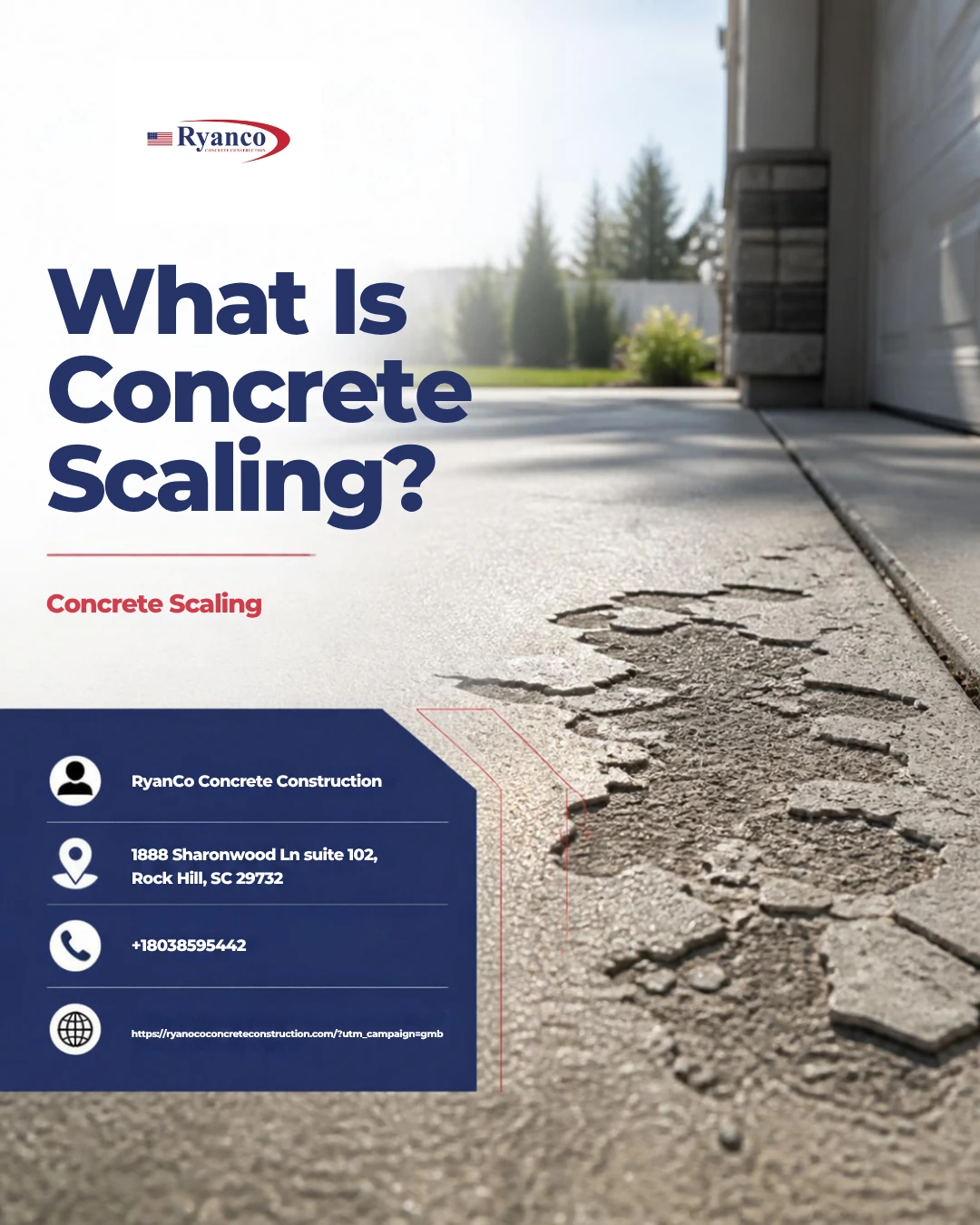
If the top of a driveway, patio, sidewalk, or other concrete slab begins flaking, peeling, or wearing away, the problem may be concrete scaling. Scaling affects the surface layer of hardened concrete and can range from small isolated patches to larger areas where aggregate underneath becomes visible.
Understanding what is concrete scaling is important because not every rough or deteriorating concrete surface has the same problem. Scaling is generally a surface defect. Cracking, spalling, settlement, and other forms of concrete deterioration can look similar but may have different causes and repair requirements.
Moisture and freezing conditions are common contributors. NRMCA describes scaling as localized flaking or peeling that commonly develops when saturated concrete experiences repeated freezing and thawing. Deicing chemicals, inadequate air entrainment, improper finishing, weak surface concrete, and insufficient curing can also increase susceptibility.
A small scaled area does not automatically mean an entire slab needs replacement. The depth, extent, underlying cause, and overall condition of the concrete should determine what happens next.
What Is Concrete Scaling?
Concrete scaling is the deterioration of the finished surface of hardened concrete.
It often begins with small patches where the thin outer layer flakes or peels away. As deterioration becomes more severe, those patches can grow together and expose the coarse aggregate underneath.
Homeowners may describe scaled concrete as:
- Flaking
- Peeling
- Rough
- Pitted
- Chipped at the surface
- Thin layers coming loose
- Exposing stones or aggregate
- Looking worn or weathered in patches
NRMCA groups scaling by severity. Light scaling affects the surface without exposing coarse aggregate, while more advanced scaling can remove enough mortar to expose aggregate clearly.
Scaling is common on exposed exterior concrete such as driveways, sidewalks, walkways, steps, patios, and other flatwork.
The key feature is that deterioration generally begins at the surface.
That distinction becomes important when comparing scaling with deeper defects such as spalling.
What Causes Concrete Scaling?
Concrete scaling rarely has only one possible cause.
Several factors can make the surface more susceptible, and more than one condition may be present on the same slab.
Freeze-thaw exposure
One of the most recognized causes involves moisture and repeated freezing and thawing.
Concrete contains small pores. When vulnerable concrete becomes sufficiently saturated and temperatures fall below freezing, water within those pores can freeze and expand.
Repeated cycles can create stress near the surface and eventually cause small layers of mortar to break away.
Air-entrained concrete is commonly used for freeze-thaw exposure because microscopic air spaces provide relief for pressure generated when water freezes. ACI explains that proper air entrainment substantially improves resistance to freezing-and-thawing deterioration and scaling.
Deicing chemicals
Certain deicing chemicals can increase the risk of surface scaling, particularly on concrete that is already saturated or vulnerable to freezing conditions.
NRMCA notes that deicing chemicals can aggravate scaling by increasing moisture saturation near the surface and increasing freeze-thaw exposure.
This does not mean one use of a deicer automatically destroys a driveway. The concrete mixture, age, moisture level, exposure, product used, and frequency of application all matter.
Too much water in the surface concrete
Weak surface concrete can be more vulnerable to deterioration.
Adding excessive water during placement or finishing can contribute to a weaker mortar layer at the surface.
The same concern applies when finishing practices bring excess water or cement paste to the top while changing the characteristics of the intended concrete mixture.
Finishing while bleed water is present
Freshly placed concrete may release water toward the surface before it finishes setting.
Finishing while this bleed water remains can contribute to a weaker surface layer.
Concrete-industry research has linked improper finishing—including finishing in the presence of excess surface water—to scaling, abrasion, or delamination even when freeze-thaw exposure is not the primary cause.
Insufficient curing
Concrete needs appropriate curing conditions after placement.
Poor curing can leave the near-surface concrete weaker and more susceptible to wear, moisture, and environmental exposure.
The damage may not become obvious immediately. A surface weakness created during installation can become more visible later as the slab experiences traffic and weather.
Weak or unsuitable concrete
The concrete mixture itself must be appropriate for the expected exposure.
Concrete that is too permeable, lacks appropriate air entrainment for freeze-thaw conditions, or develops inadequate surface strength can be more vulnerable to scaling.
Repeated moisture exposure
Moisture alone does not mean a slab will scale.
However, concrete that regularly becomes saturated has greater exposure to moisture-related deterioration, particularly when combined with freezing temperatures, deicing chemicals, or an already weak surface.
Drainage around the slab therefore remains important.
What Does Concrete Scaling Look Like?
Scaling often starts subtly.
A homeowner may first notice a driveway that no longer has a uniform surface. Small sections may look rougher or lighter than surrounding concrete.
As deterioration develops, the surface can begin shedding thin flakes or small pieces.
Common signs include:
- Small shallow pits
- Thin flakes coming loose
- Rough patches
- Surface mortar disappearing
- Aggregate becoming increasingly visible
- Multiple small deteriorated patches merging together
- Loose material after sweeping or cleaning
- Uneven surface texture
The appearance can vary substantially depending on severity.
Light scaling
Light scaling may look like superficial peeling or small rough patches.
The coarse aggregate usually remains covered.
Moderate scaling
As scaling progresses, more of the mortar surface may disappear and stones within the concrete can become visible.
The surface often looks noticeably rougher than surrounding areas.
Severe scaling
Severe deterioration can expose aggregate across larger areas and leave a highly irregular surface.
At this stage, the issue is no longer simply a subtle cosmetic change.
Homeowners should also watch how the surface changes over time. A rough spot that remains unchanged is different from an area that continues losing material each season.
Is Concrete Scaling the Same as Spalling?
No, although the terms are sometimes used interchangeably in casual conversation.
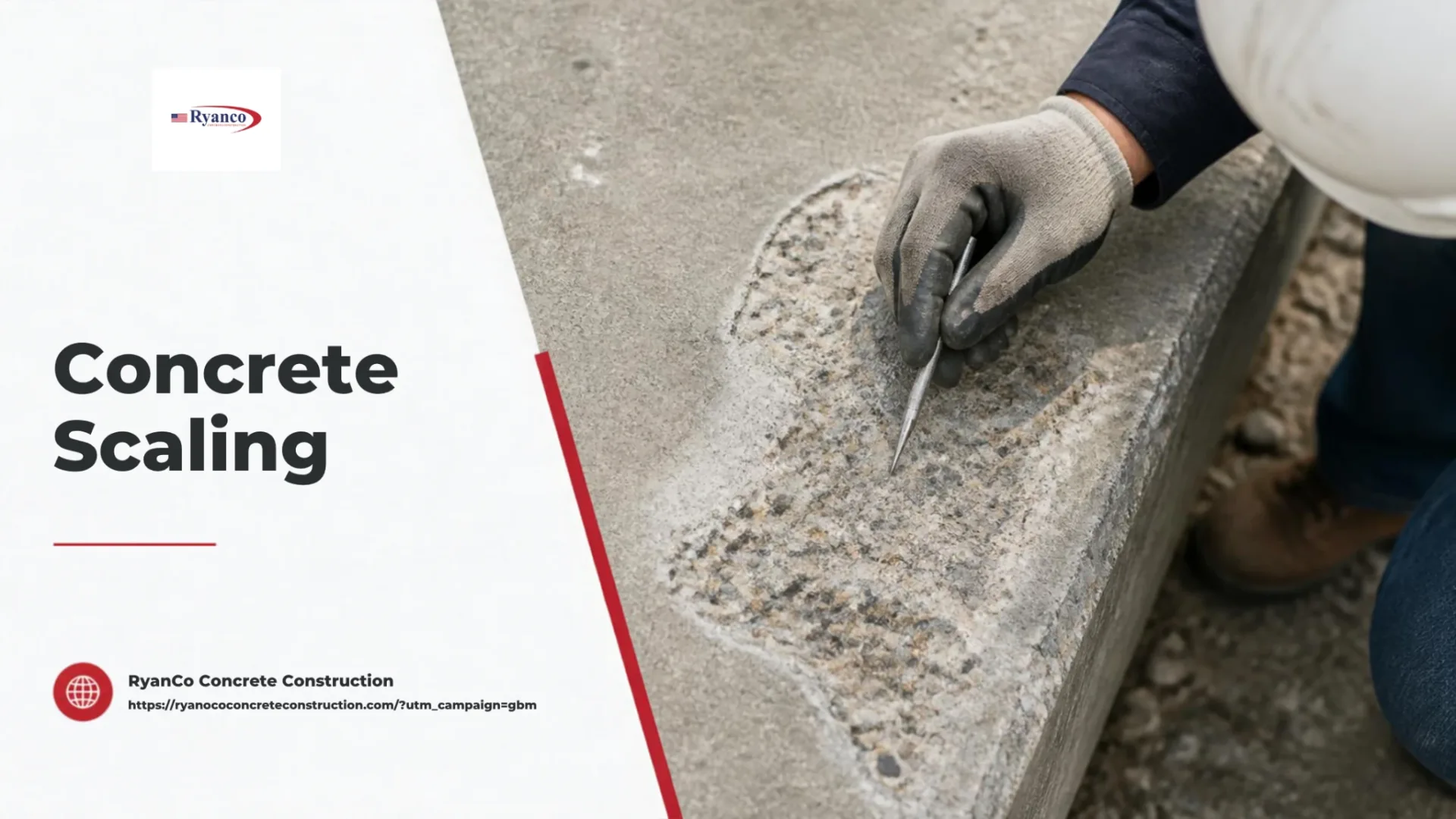
Scaling generally describes shallow deterioration of the concrete surface. The top mortar layer flakes, peels, or gradually wears away.
Spalling generally involves deeper localized pieces of concrete breaking away.
Spalling can create larger pits or cavities and may sometimes expose reinforcing steel or deeper aggregate. It can result from reinforcement corrosion, impact, freeze-thaw deterioration, or other problems.
The difference can sometimes be difficult for a homeowner to identify visually because advanced scaling may become deep enough to resemble other surface defects.
A simple way to think about the distinction is:
- Scaling: surface layer gradually flakes or peels.
- Spalling: larger or deeper portions break away.
- Cracking: concrete separates along a line but may remain otherwise intact.
- Settlement: the slab itself moves downward or becomes uneven.
These conditions can also occur together.
For example, a driveway may have a scaled surface and a settlement crack at the same time. Repair decisions should therefore consider the entire condition of the slab rather than giving every visible defect the same label.
Does Concrete Scaling Get Worse Over Time?
It can.
Once the surface begins deteriorating, newly exposed concrete may become more vulnerable to additional moisture, weather, abrasion, vehicle traffic, and contaminants.
Progression depends heavily on the cause.
A small area related to a localized finishing defect may behave differently from widespread scaling associated with repeated saturation and freeze-thaw exposure.
Continuing environmental exposure can gradually enlarge damaged areas.
Watch for:
- Flaking spreading into previously sound areas
- Increasing amounts of loose material
- Aggregate becoming more exposed
- Pits becoming deeper
- Cracking developing around scaled areas
- Water regularly collecting on or near the damaged surface
- Deterioration returning after cosmetic treatment
The presence of scaling does not automatically mean the underlying slab has lost its structural usefulness.
But continued surface loss should not simply be hidden under a coating without understanding why it is occurring.
A professional evaluation becomes more useful when the affected area is large, worsening, creating an uneven surface, or accompanied by cracks or slab movement.
How Is Concrete Scaling Repaired?
The appropriate repair depends on how deep the deterioration goes and whether the remaining concrete is sound.
Minor scaling may primarily affect appearance. More significant scaling may require removal of loose material followed by a repair or resurfacing method compatible with the existing slab.
Professional evaluation usually starts by determining:
- How much surface material has been lost
- Whether deterioration is still progressing
- Whether the underlying concrete is sound
- Whether cracking or settlement is also present
- Whether moisture or drainage is contributing
- Whether previous coatings or repairs are present
- How the surface will be used
Localized surface repair
Small areas may sometimes be repaired after loose or unsound material is removed and the remaining concrete is properly prepared.
The repair material needs a sound surface to bond to.
Simply covering loose flakes can lead to another failure because the patch is attached to material that was already separating.
Resurfacing
When deterioration affects a larger but relatively shallow area, resurfacing may sometimes be considered.
A resurfacing material creates a new wearing surface over adequately prepared existing concrete.
The condition of the underlying slab matters. Resurfacing cannot correct major settlement, serious structural cracking, or unstable concrete underneath.
Partial or full replacement
Replacement becomes more likely when deterioration is deep or widespread or when the slab has other major problems such as substantial movement or extensive cracking.
RyanCo’s current Concrete Repair service covers cracks, chips, uneven slabs, worn surfaces, and resurfacing, and specifically identifies surface flaking, pitting, and deterioration as signs that concrete may need repair.
The best repair therefore addresses the condition beneath the visible scaling, not simply the appearance of the top surface.
Can Concrete Sealing Help Prevent Scaling?
Concrete sealing may help suitable concrete resist moisture penetration, but sealing is not a repair for concrete that has already deteriorated.
This distinction is important.
Penetrating sealers can reduce movement of moisture and certain chemicals into concrete. Research published through ACI has examined penetrating sealers as a method for reducing moisture and chemical transport, both of which can influence durability under challenging exposure conditions.
RyanCo’s Concrete Sealing service similarly focuses on moisture protection, stain resistance, and reducing weather-related surface exposure.
However, a sealer cannot:
- Rebuild missing concrete
- Restore a flaking surface
- Fill deep pits
- Level a settled slab
- Correct weak underlying concrete
- Reverse an improper original finish
If concrete is already scaling, loose material should be evaluated before sealing.
Applying sealer over an unstable or deteriorated surface can leave the underlying problem unresolved.
Sealing is better viewed as a protective maintenance strategy for suitable concrete, potentially after necessary repairs have been completed.
Other preventive considerations include good drainage, appropriate concrete mixture selection during installation, proper finishing and curing, appropriate air entrainment where required, and responsible use of deicing products.
FAQs
Is concrete scaling a structural problem?
Not always. Light scaling may primarily affect the surface and appearance of the concrete. More extensive deterioration deserves evaluation, especially when it occurs alongside deep cracking, settlement, crumbling, or other signs that the slab has broader problems.
What is the main cause of concrete scaling?
Freeze-thaw exposure in sufficiently saturated concrete is a major cause of scaling. Deicing chemicals, inadequate air entrainment, weak surface concrete, poor finishing, and inadequate curing can also contribute.
Can concrete scale without freezing weather?
Yes. NRMCA notes that surface peeling or scaling-like deterioration can also occur without freeze-thaw exposure, including from improper finishing or finishing while bleed water remains on the surface.
Is scaling the same as spalling?
No. Scaling usually describes relatively shallow peeling or flaking of the surface mortar. Spalling often involves deeper localized sections of concrete breaking away.
Can scaled concrete be repaired?
Often, yes. The appropriate solution depends on the depth and extent of the deterioration and whether the underlying concrete remains sound. Options may include localized repair, resurfacing, or replacement when damage is extensive.
Can I seal concrete that is already scaling?
Sealer should not be used as a substitute for repairing a deteriorated surface. Loose or unstable concrete should be evaluated first. Sealing may be appropriate afterward if the repaired surface and product are suitable.
Why is the top of my driveway flaking off?
Possible causes include scaling from moisture and freeze-thaw exposure, deicing chemicals, weak surface concrete, finishing problems, inadequate curing, or another type of deterioration. The appearance and depth of damage can help determine the likely cause.
Does scaling continue getting deeper?
It can progress if the underlying conditions continue. Repeated moisture exposure, freezing, wear, and surface weakness can allow deterioration to expand or deepen over time.
Should scaled concrete be replaced?
Not automatically. Localized or shallow scaling may be repairable. Replacement becomes more likely when deterioration is widespread, deep, accompanied by significant cracking or movement, or when the underlying concrete cannot support a durable repair.
Restore a Deteriorating Surface With RyanCo Concrete Construction
Concrete scaling can begin with a few rough or flaky patches and gradually become much more noticeable. The right response depends on whether deterioration is shallow and localized or part of a larger problem involving cracking, moisture, settlement, or widespread surface failure.
At RyanCo Concrete Construction, we help property owners in Rock Hill and surrounding communities evaluate deteriorated driveways, patios, sidewalks, walkways, and other concrete surfaces.
If your concrete is peeling, flaking, pitting, or exposing aggregate, our team can assess the condition and discuss whether repair, resurfacing, sealing after appropriate repairs, or replacement makes sense.
Addressing the cause of scaling is more useful than simply covering the damaged surface.
